


This article has been written by Kilimi Praneeth Reddy a law student pursuing the B.A. LL.B. (Hons.) program at Dr. Ram Manohar Lohiya National Law University (RMLNLU), Lucknow.


Abstract
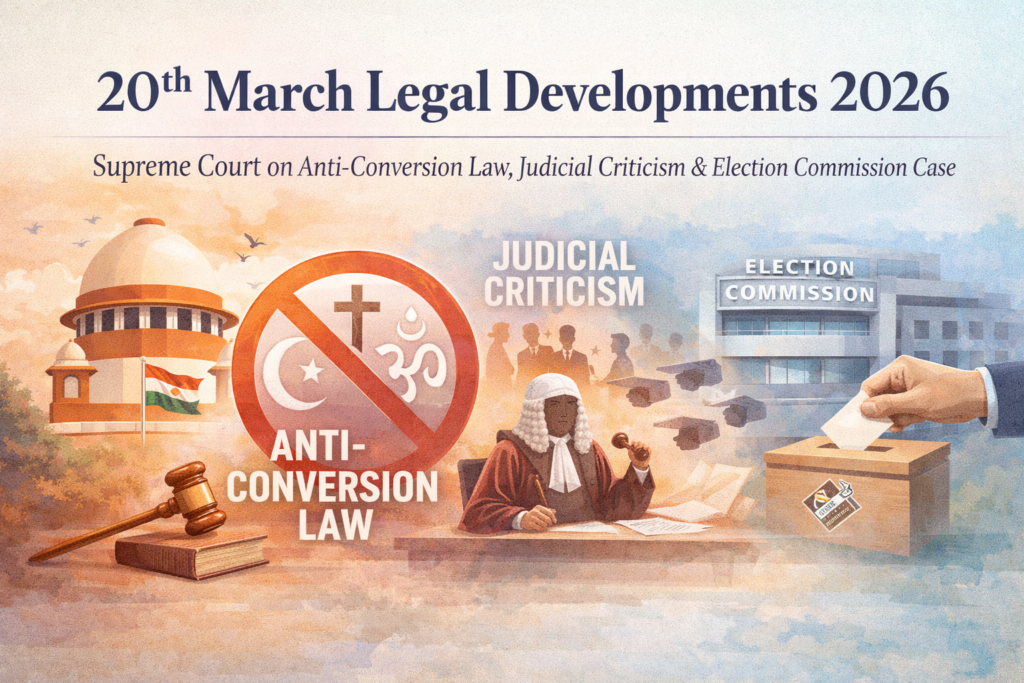
The developments of 20th March 2026 collectively reflect a judiciary that is simultaneously navigating constitutional restraint, institutional accountability, and evolving social realities. The Maharashtra Freedom of Religion Act, 2026 marks a significant addition to India’s expanding anti-conversion legal framework, introducing stringent procedural safeguards such as prior notice requirements, criminalisation of marriage-based conversions, and enhanced policing powers, thereby raising renewed constitutional concerns relating to privacy, autonomy and religious freedom.
In parallel, the Supreme Court’s observations in the NCERT textbook controversy reaffirm the constitutional tolerance for criticism of judicial decisions, with the Court explicitly recognising that public discourse, even if critical, forms an essential part of democratic engagement, while also prompting executive intervention through the constitution of an expert committee to ensure balanced pedagogical representation.
Further, in a matrimonial dispute, the Supreme Court’s oral observations rejecting stereotypical expectations from spouses signal a progressive shift in judicial understanding of marriage, emphasising shared responsibilities and rejecting the classification of domestic expectations as “cruelty.”
Institutionally, the Supreme Court’s recusal in the Election Commissioners’ appointment case highlights a conscious effort to preserve judicial neutrality and avoid even the appearance of bias, especially in matters involving constitutional offices and separation of powers. Finally, the Gujarat High Court’s decision underscores a rights-oriented approach by prioritising substantive equality over procedural technicalities, particularly in cases involving persons with disabilities, thereby reinforcing the legislative and constitutional mandate of inclusion. Taken together, these developments illustrate a judiciary attempting to balance doctrinal consistency with evolving constitutional values, particularly in areas involving individual rights, institutional legitimacy and social justice.
Keywords: Anti-conversion laws, Religious freedom, Judicial criticism, NCERT controversy, Matrimonial law, Gender equality, Judicial recusal, Election Commission, Disability rights, Substantive justice, Constitutional law, India.
“Maharashtra’s Anti-Conversion Law, 2026: Regulation, Restrictions and the Expanding State Control over Religious Choice”
Background
The Maharashtra Legislative Assembly on March 17, 2026 enacted the Maharashtra Freedom of Religion Act, 2026, placing the State within a broader national trend of legislations aimed at regulating religious conversions. Beginning with the Odisha Freedom of Religion Act, 1967, these laws have gradually evolved from simple prohibitions on forced conversions to more complex regulatory frameworks, particularly focusing on inter-faith marriages, procedural compliance and State oversight. Maharashtra’s law reflects this shift and positions itself within the newer generation of more stringent anti-conversion statutes.
What the Law Provides
The Act criminalises religious conversion carried out through allurement, coercion, deceit, force, misrepresentation, threat, undue influence, fraud or marriage. It prescribes a punishment of up to seven years’ imprisonment along with a fine up to ₹1 lakh. In aggravated situations—such as where the victim is a woman, minor, person of unsound mind, or belongs to Scheduled Castes or Scheduled Tribes, or in cases of mass conversion—the penalty increases to imprisonment of seven years along with a fine up to ₹5 lakh. Repeat offenders may face imprisonment up to ten years and fines up to ₹7 lakh. Additionally, institutions found involved in unlawful conversions may face cancellation of registration and loss of State aid or grants. A distinguishing feature of the Act is the power granted to the police to take suo motu cognisance, allowing initiation of proceedings even in the absence of a formal complaint.
This significantly strengthens enforcement compared to earlier laws which relied primarily on complaints by the affected individual or their relatives.
Regulation of Marriage and Conversion
The law specifically addresses conversions linked to marriage, providing that any marriage solemnised solely for the purpose of unlawful religious conversion may be declared null and void. At the same time, it attempts to mitigate the consequences of such invalidation by protecting the rights of children born from such unions. The child is to follow the mother’s religion but retains succession rights from both parents. Custody is generally presumed to vest with the mother, and provisions relating to maintenance are aligned with statutory criminal procedure principles. This reflects an attempt to balance penal consequences with social protection. Notice and Procedural Requirements
One of the most stringent aspects of the Act is the requirement of prior notice and post-conversion declaration. A person intending to convert, or an institution organising a conversion ceremony, must give a 60-day prior notice to the competent authority. This notice is subject to public disclosure, allowing objections to be raised, upon which authorities may initiate an inquiry through the police. After conversion, a declaration must be submitted within 21 days, failing which the conversion may be treated as void. This procedural regime significantly increases State oversight and introduces a formal verification mechanism before and after conversion.
Comparison with Other States
Maharashtra’s law must be understood in comparison with similar statutes across India. While earlier laws such as those in Odisha and Arunachal Pradesh prescribed relatively mild penalties, recent enactments in States like Uttar Pradesh, Madhya Pradesh, Karnataka and Rajasthan have introduced harsher punishments and broader definitions. For instance, Uttar Pradesh prescribes imprisonment ranging from seven to fourteen years in certain cases, with fines extending up to ₹10 lakh, and aggravated offences potentially attracting life imprisonment. Rajasthan goes even further by providing for imprisonment ranging from ten to twenty years, along with property confiscation and institutional penalties up to ₹1 crore. Compared to these, Maharashtra’s law appears slightly less severe in terms of maximum punishment. However, it is structurally stringent due to its combination of suo motu police powers, strict notice requirements, marriage invalidation provisions and institutional penalties. Unlike some States, which allow complaints from a wide range of individuals, including colleagues or third parties, Maharashtra limits this but compensates through police-driven enforcement.
This places the law firmly within the newer, more regulatory and enforcement-heavy category of anti-conversion statutes. Additionally, several States have introduced unique features, such as shifting the burden of proof onto the accused (Himachal Pradesh), recognising digital or social-media-based conversions (Haryana), or expanding the scope of “allurement” to include education and employment benefits (Karnataka, Uttarakhand). Maharashtra’s approach, while not introducing entirely novel concepts, consolidates multiple stringent features into a single framework.
Constitutional Position and Emerging Concerns
The constitutional validity of such laws continues to be tested against evolving jurisprudence. The framework originates from Rev. Stainislaus v. State of Madhya Pradesh (1977), where the Supreme Court upheld anti-conversion laws by holding that the right to propagate religion under Article 25 does not include the right to convert others. However, recent developments—particularly the recognition of the right to privacy and autonomy in K.S. Puttaswamy v. Union of India (2017)—have led to renewed scrutiny. Provisions such as mandatory prior notice, public disclosure of personal decisions and police inquiries into conversion have been challenged in various High Courts. Courts have, in some instances, struck down or stayed similar provisions, holding them to be intrusive and violative of personal liberty. Multiple challenges to anti-conversion laws are currently pending before the Supreme Court, and Maharashtra’s legislation is likely to be evaluated within this broader constitutional framework.
Analysis
The Maharashtra Freedom of Religion Act, 2026 represents a consolidation of recent legislative trends in regulating religious conversion. While it seeks to prevent coercion and fraudulent practices, it simultaneously expands the scope of State intervention into personal decisions relating to faith and marriage. The combination of penal provisions, procedural requirements and enforcement powers reflects a shift from mere prohibition to active regulatory control. Whether such a framework withstands constitutional scrutiny will ultimately depend on how courts balance the State’s interest in preventing exploitation with the individual’s right to privacy, dignity and freedom of religion.
“Right to Criticise Judgments vs Judicial Sensitivity: Supreme Court on NCERT Textbook Controversy”
Background
The issue arose from an NCERT Class 8 Social Science textbook which contained a line stating that “recent judgments tend to view slum dwellers as encroachers.” A petition was filed before the Supreme Court under Article 32 challenging this statement, arguing that it presented court judgments in a negative and misleading manner and could affect public perception about the judiciary.
What Happened Before the Court
The matter was heard by a Bench of Chief Justice of India Surya Kant, Justice Joymalya Bagchi and Justice Vipul M Pancholi in Pankaj Pushkar v. Union of India. The petitioner sought removal of the content and directions to ensure that textbooks do not include material that undermines the dignity of the judiciary. At the same time, a related controversy had already arisen regarding another NCERT chapter on “corruption in the judiciary,” on which the Court had taken suo motu cognisance earlier.
What the Supreme Court Said
The Supreme Court refused to interfere with the textbook content and made important observations on the right to criticise judicial decisions.
The Chief Justice clearly stated:
“It’s a viewpoint about a judgment. That’s a healthy criticism. Why the judiciary should be so oversensitive about that?”
The Court further observed:
“This is a viewpoint about a judgment, people have a right to criticize our judgments.”
When concerns were raised that such statements may create a negative impression among readers, the Court responded that perceptions can differ and cannot be a ground to suppress such views.
The Solicitor General also supported this position and stated:
“Perception which an uninformed person would gather from the judgment can never be a concern of the judiciary.”
Based on these observations, the Court held that expressing opinions about judgments— even critical ones—is part of democratic discussion and does not require judicial interference.
The petition was ultimately disposed of as infructuous since the textbook in question was from the 2015–16 edition and was no longer in use.
Committee Formed to Revise NCERT Chapter
During the hearing, the Central Government informed the Court that it has constituted an expert committee to re-draft the chapter on the judiciary in NCERT textbooks. The committee includes former Attorney General K.K. Venugopal and former Supreme Court judges Justice Indu Malhotra and Justice Aniruddha Bose. The Court accepted this development and closed the suo motu proceedings related to the textbook controversy.
Earlier, the Court had expressed concern over the lack of clarity regarding who drafted the content and had even directed the government to ensure that proper experts are involved in rewriting the chapter.
Legal Position
The observations of the Court reinforce that criticism of judicial decisions is not prohibited under the Constitution. While courts are protected from contempt, fair criticism is allowed as part of freedom of speech under Article 19(1)(a).
The Court made it clear that:
- Not every criticism amounts to contempt
- Public discussion on judgments is normal in a democracy Analysis
This case shows that the Supreme Court is willing to accept criticism of its decisions and does not want to appear overly sensitive. At the same time, by directing the formation of an expert committee, the Court ensured that academic material is prepared responsibly.
The judgment highlights an important balance—while criticism is allowed, it should be informed and properly presented, especially in educational content.
“You Are Not Marrying A Maid”: Supreme Court on Shared Household Responsibilities in Marriage
Background
The case arose from a matrimonial dispute where the husband sought divorce on the ground of cruelty. He alleged that his wife did not perform household duties such as cooking, used abusive language, and behaved improperly with him and his family. Based on these allegations, the Family Court granted a decree of divorce. However, the High Court later set aside this decision, after which the husband approached the Supreme Court.
Facts of the Case
The parties were married in 2017 and have a child. The husband is a government school teacher, while the wife is a lecturer. The husband claimed that soon after marriage, the wife started mistreating him, refused to cook, and behaved disrespectfully.
On the other hand, the wife denied these allegations and stated that she went to her parental home for childbirth with consent. She further alleged that the husband’s family demanded money and gold and that she was pressured financially.
What Happened Before the Supreme Court
The matter came before a Bench of Justice Vikram Nath and Justice Sandeep Mehta. During the hearing, the Court made significant oral observations regarding the nature of marital responsibilities and the concept of cruelty. The Court had earlier referred the matter for mediation, but the same failed. The parties have now been asked to appear personally on the next date of hearing.
What the Supreme Court Said
The Supreme Court clearly indicated that failure of a wife to perform household chores cannot be treated as cruelty.
Justice Sandeep Mehta made a strong remark:
“You are not marrying a maid, you are marrying a life partner.”
Justice Vikram Nath further emphasized the changing nature of society:
“You have to contribute in cooking, washing, etc. Today’s times are different.”
The Court thus rejected the idea that household work is solely the responsibility of the wife and observed that such expectations are outdated.
Legal Position
The observations of the Court suggest that:
- Non-performance of domestic duties like cooking does not amount to cruelty under matrimonial law
- Marriage is a partnership of equals, not a master-servant relationship
- Both spouses are expected to share responsibilities Current Status of the Case
The matter is still pending before the Supreme Court. The Court has not yet passed a final judgment and has directed the parties to appear personally for further proceedings.
Analysis
This case reflects the Supreme Court’s progressive approach towards marriage and gender roles. By rejecting traditional expectations placed only on wives, the Court is reinforcing the idea of equality within marriage.
The observations also clarify that trivial domestic disputes cannot be exaggerated into legal cruelty, which is an important requirement for divorce under matrimonial laws.
Recusal in Election Commissioners Case: Supreme Court Seeks Bench Without Prospective CJI
Background
The issue relates to the challenge against the Chief Election Commissioner and Other Election Commissioners (Appointment, Conditions of Service and Term of Office) Act, 2023. This law removed the Chief Justice of India from the selection committee responsible for appointing Election Commissioners. Earlier, in 2023, the Supreme Court had directed that the appointment of Election Commissioners should be made by a committee consisting of the Prime Minister, Leader of Opposition and the Chief Justice of India, in order to ensure independence from executive control. However, the new law replaced the CJI with a Union Cabinet Minister, which has now been challenged before the Court.
What Happened Before the Court
The matter came up before a Bench of Chief Justice of India Surya Kant, Justice Joymalya Bagchi and Justice Vipul Pancholi. During the hearing, the Court was dealing with petitions filed by leaders such as Dr. Jaya Thakur and organisations like the Association for Democratic Reforms, challenging the validity of the 2023 Act.
However, an important procedural issue arose during the hearing—whether the present Bench should continue hearing the matter.
What the Supreme Court Said
The Chief Justice expressed concern about a possible conflict of interest in hearing the case, since the issue directly concerns the role of the CJI in the appointment process. Advocate Prashant Bhushan, appearing for the petitioners, suggested:
“It will be best if it is sent to a bench which does not have a prospective Chief Justice.”
Responding to this, the Chief Justice agreed and stated:
“I should mark this matter to a bench where the judge may not be in line to become CJI. Then nobody can say anything.”
The Court therefore decided that the matter should be placed before a different Bench where none of the judges are in line to become Chief Justice of India.
Current Status of the Case
The Supreme Court has not yet examined the merits of the challenge. The matter has been listed for further hearing on April 7, 2026, before a separately constituted Bench.
Legal Context
The controversy arises from the shift in the appointment process. The 2023 law provides that Election Commissioners will be selected by a committee consisting of:
- The Prime Minister
- A Union Cabinet Minister
- The Leader of Opposition
This is different from the earlier interim arrangement laid down by the Supreme Court, which included the Chief Justice of India to ensure institutional independence.
The petitions argue that removing the CJI weakens the independence of the Election Commission and gives greater control to the executive.
Analysis
This development is important not because of a final judgment, but because it highlights the Court’s sensitivity to judicial propriety and institutional fairness. By stepping aside and ensuring that even future Chief Justices do not hear the case, the Court is trying to avoid any perception of bias. At the same time, the case itself raises a serious constitutional question about the independence of the Election Commission and the balance between the judiciary and executive in appointments. The final decision, when delivered, is likely to have major implications for electoral democracy in India.
Inclusion Over Technicalities: Gujarat High Court Rejects ‘Fence-Sitter’ Argument in Favour of Disabled Candidate
Background and Facts
The Gujarat High Court dealt with a significant service law dispute involving a physically disabled candidate who was denied appointment as a Postal Sorting Assistant by the Union of India. The rejection was based on the ground that the candidate had not passed 10+2 with English as a compulsory subject, as required under the recruitment rules. The authorities alleged that since the candidate had cleared English only as an additional subject, it amounted to misrepresentation of facts.
Aggrieved by this decision, the candidate approached the Central Administrative Tribunal (CAT), which ruled in his favour. The Tribunal relied on earlier litigation involving similarly placed candidates, where identical objections raised by the Union had already been rejected and such findings had also been upheld by the High Court in previous proceedings. The CAT therefore quashed the rejection and directed appointment. Contentions Before the High Court
Challenging the CAT’s decision, the Union of India argued two main points. First, that the candidate was ineligible on merits since he did not fulfill the essential qualification of having English as a compulsory subject. Second, it was argued that the candidate approached the Tribunal belatedly, only after similarly situated candidates had succeeded, and therefore he was merely a “fence-sitter” not entitled to relief.
What the Gujarat High Court Held
A Division Bench comprising Justice N.S. Sanjay Gowda and Justice J.L. Odedra rejected both contentions and upheld the CAT’s order.
On the issue of eligibility, the Court held that the matter was no longer open for reconsideration, since identical issues had already been conclusively settled in earlier rounds of litigation. The Court observed:
“The claim of the Union that the respondent was ineligible… cannot be accepted in light of the earlier round of litigation… which has been concluded by the Division Bench of this Court.”
On the argument of delay and the “fence-sitter” doctrine, the Court took a more nuanced and rights-based approach. It emphasised that such rigid technical principles cannot be mechanically applied, especially in cases involving persons with disabilities. The Court clearly stated:
“The respondent is, in fact, a physically handicapped candidate… the principle of a fence sitter being applied stricto senso, would not be appropriate.”
Legislative Policy and Judicial Approach; Importantly, the Court invoked the broader legislative and constitutional policy of inclusion of persons with disabilities. Taking judicial notice of this policy, the Bench highlighted that the law must favour accommodation rather than exclusion:
“Judicial notice can be taken of the fact that it is the legislative policy of the nation that people with physical disabilities are to be encouraged and reservations are also provided.”
The Court further observed that the post of Postal Sorting Assistant is suitable for persons with disabilities, thereby reinforcing the idea of substantive equality rather than formal compliance with rigid criteria.
On Delay and Procedural Objections;Addressing the issue of delay, the Court held that once the CAT had condoned the delay and such order was not challenged by the Union, the issue attained finality. Therefore, delay could not be used as a ground to deny relief. The Court categorically stated:
“The mere fact that the applicant approached the CAT with some delay cannot be a ground to repel his claim.”
Final Outcome
The High Court dismissed the writ petition filed by the Union of India and upheld the direction to appoint the candidate.
Case Details
Case Title: Union of India C Ors. v. Chirag Court: Gujarat High Court
Date: 16 March 2026
Case No.: R/Special Civil Application No. 16411 of 2023 Significance
This judgment reflects a shift from rigid proceduralism to a more inclusive constitutional approach. The Court prioritised substantive justice over technical objections, especially in the context of disability rights. By rejecting the “fence-sitter” argument and emphasising legislative intent, the decision reinforces that delay or procedural lapses cannot override the constitutional commitment to equality and inclusion.
Conclusion
The legal developments of the day demonstrate that Indian courts are increasingly moving beyond rigid formalism towards a more purposive and value-oriented interpretation of law. Whether it is the scrutiny surrounding anti-conversion laws, the defence of free criticism of judicial decisions, or the emphasis on gender equality within matrimonial relationships, the judiciary appears to be aligning itself with broader constitutional principles of liberty, dignity and inclusiveness.
At the same time, the Supreme Court’s cautious approach in matters such as the Election Commissioners’ appointment case reveals an acute awareness of institutional integrity and the need to maintain public confidence in the judicial process. Similarly, the Gujarat High Court’s refusal to allow procedural delay to defeat the claim of a disabled candidate reflects a deeper commitment to substantive justice over technical objections.
However, these developments also indicate emerging tensions particularly between individual freedoms and regulatory frameworks, and between judicial activism and institutional restraint which are likely to shape future constitutional adjudication.
Ultimately, the trajectory suggests that the judiciary is not merely interpreting law, but actively engaging with the changing social and constitutional landscape, striving to ensure that legal processes remain both fair and meaningful in contemporary India.