


This paper has been written by
Author 1: Deepak Chahal, Institute/ PH.D – Research Scholar, Punjabi University,Patiala
Author 2: Advocate Manali T. Brahmkhatri
This paper has been selected for LLJ Publication.
Abstract
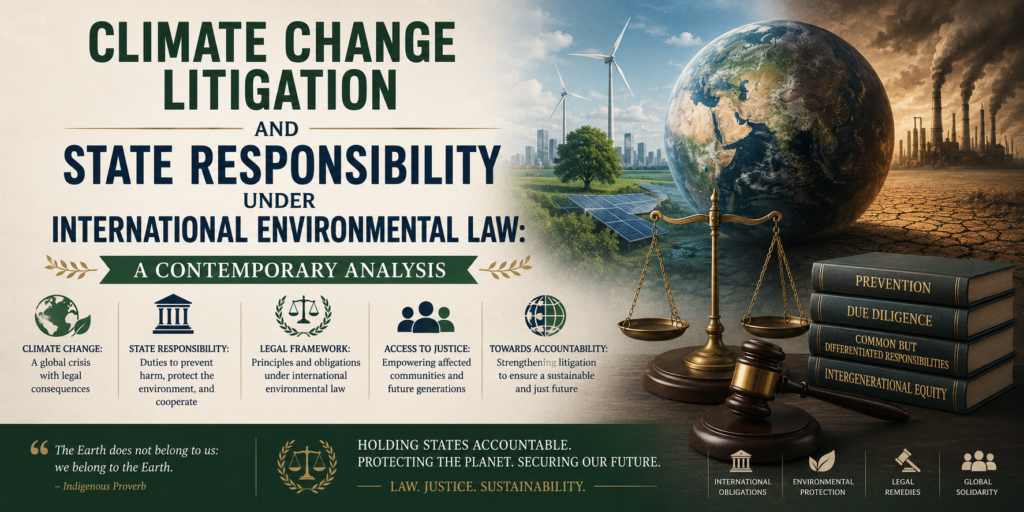
Climate change represents one of the most significant challenges confronting the international legal order in the twenty-first century. Increasing global temperatures, rising sea levels, extreme weather events, biodiversity loss, and environmental degradation have generated unprecedented concerns regarding the adequacy of existing international legal frameworks to address climate-related harms. In response, climate change litigation has emerged as a powerful mechanism through which individuals, communities, civil society organizations, and States seek accountability for environmental damage and inadequate climate action. Over the past decade, climate litigation has expanded dramatically across national, regional, and international forums, transforming climate governance from a predominantly political issue into a legal and rights-based concern.
The principle of State responsibility occupies a central position in contemporary climate litigation. States are increasingly challenged for failing to fulfil obligations arising under international environmental law, human rights law, customary international law, and climate treaties such as the United Nations Framework Convention on Climate Change (UNFCCC) and the Paris Agreement. Landmark judicial decisions, including Urgenda Foundation v. Netherlands, Milieudefensie v. Shell, the 2024 International Tribunal for the Law of the Sea (ITLOS) Advisory Opinion, and the 2025 International Court of Justice (ICJ) Advisory Opinion on Climate Change, have significantly contributed to the evolution of climate accountability jurisprudence. These developments indicate an emerging consensus that States possess legal obligations to prevent significant environmental harm, exercise due diligence, cooperate internationally, and protect present and future generations from the adverse effects of climate change.
This paper critically examines the relationship between climate change litigation and State responsibility under international environmental law. It analyses the evolving legal foundations of climate accountability, evaluates contemporary judicial developments, and explores the implications of recent international advisory opinions. The study argues that climate litigation has become a transformative instrument for enforcing international environmental obligations and advancing climate justice. It concludes that strengthening legal accountability mechanisms is essential to ensuring effective climate governance and protecting the interests of vulnerable populations and future generations.
Keywords: Climate Change Litigation, State Responsibility, International Environmental Law, Climate Justice, Paris Agreement, ICJ Advisory Opinion, ITLOS Advisory Opinion, Climate Accountability.
Introduction
Climate change has evolved from a scientific and environmental concern into one of the most pressing legal and governance challenges facing the international community. Scientific evidence consistently demonstrates that anthropogenic greenhouse gas emissions are responsible for accelerating global warming and causing severe environmental, economic, and social consequences.¹ The transboundary nature of climate change presents unique challenges for international law because emissions produced within one State may generate harmful consequences far beyond its territorial boundaries.
International environmental law has responded through a range of treaties and principles, including the UNFCCC, Kyoto Protocol, and Paris Agreement.² However, the effectiveness of these instruments has often been questioned due to their reliance on voluntary commitments and limited enforcement mechanisms. As a result, climate litigation has emerged as a significant tool for promoting accountability and ensuring compliance with climate obligations.
Recent judicial developments have transformed the legal landscape. Courts increasingly recognize climate change as a matter implicating human rights, environmental protection, intergenerational equity, and State responsibility. The landmark 2025 Advisory Opinion of the ICJ concerning the Obligations of States in Respect of Climate Change further clarified that States possess binding legal obligations under international law to prevent significant climate-related harm and protect present and future generations. (International Court of Justice)
This paper examines the evolving role of climate litigation in enforcing State responsibility and evaluates contemporary developments in international environmental law.
Literature Review
The literature on climate litigation reflects a growing shift from policy-oriented approaches toward accountability-based frameworks.
Edith Brown Weiss emphasizes intergenerational equity as a foundational principle requiring States to preserve environmental resources for future generations.³
Daniel Bodansky argues that climate governance increasingly relies upon a combination of treaty obligations, customary international law, and judicial enforcement mechanisms.⁴
Peel and Osofsky describe climate litigation as a “new frontier” of environmental governance capable of influencing public policy and corporate behaviour.⁵
Voigt contends that the Paris Agreement has strengthened normative expectations concerning State conduct even though many of its provisions lack traditional enforcement mechanisms.⁶
Recent scholarship focuses heavily on international judicial developments. Scholars increasingly view the 2024 ITLOS Advisory Opinion and the 2025 ICJ Advisory Opinion as transformative milestones in climate accountability jurisprudence. These opinions recognize climate obligations as legally binding duties rather than merely political aspirations. (orfonline.org)
Despite significant progress, debates continue regarding causation, attribution, extraterritorial responsibility, and remedies in climate-related disputes.
Analysis and Discussion
- Legal Foundations of State Responsibility in Climate Change
State responsibility is a fundamental principle of international law requiring States to bear consequences for internationally wrongful acts.
The Articles on Responsibility of States for Internationally Wrongful Acts (ARSIWA) establish that a State incurs responsibility where:
- Conduct is attributable to the State;
- The conduct breaches an international obligation.⁷
Climate change presents challenges because environmental harm often results from cumulative emissions generated by multiple States over extended periods.
Nevertheless, emerging jurisprudence increasingly supports the application of State responsibility principles to climate-related harms.
- Climate Change Litigation: Evolution and Trends
Climate litigation has expanded significantly since the early 2000s.
Current climate litigation can be categorized into:
- Human Rights-Based Litigation
Claimants increasingly argue that inadequate climate action violates fundamental rights including:
- Right to life;
- Right to health;
- Right to housing;
- Right to a healthy environment.
- Constitutional Litigation
National constitutions increasingly serve as legal foundations for climate claims.
- Public Trust Litigation
Courts have invoked public trust doctrines to require governments to protect environmental resources for future generations.
- International and Transnational Litigation
International tribunals increasingly consider climate-related claims involving State obligations and environmental protection.
Landmark Climate Litigation Cases
- Urgenda Foundation v. Netherlands (2019)
The Dutch Supreme Court held that the Netherlands had a legal obligation to reduce greenhouse gas emissions to protect human rights.⁸
The decision established a direct connection between climate change and State responsibility.
- Neubauer v. Germany (2021)
The German Constitutional Court ruled that insufficient climate action could violate constitutional rights of future generations.
The judgment strengthened the principle of intergenerational justice.
- Milieudefensie v. Royal Dutch Shell (2021)
The Hague District Court ordered Shell to reduce emissions consistent with climate goals.¹⁰
The case demonstrated the growing interaction between corporate accountability and climate governance.
- International Advisory Opinions and Climate Responsibility
- ITLOS Advisory Opinion (2024)
In May 2024, the International Tribunal for the Law of the Sea issued a landmark advisory opinion recognizing greenhouse gas emissions as marine pollution under UNCLOS. The Tribunal concluded that States possess obligations to prevent, reduce, and control such pollution. (orfonline.org)
This opinion significantly strengthened legal arguments regarding climate responsibility under international law.
- ICJ Advisory Opinion on Climate Change (2025)
On 23 July 2025, the ICJ delivered its historic Advisory Opinion concerning the Obligations of States in Respect of Climate Change. The Court described climate change as an “urgent and existential threat” and clarified that States have binding obligations under international law to prevent significant harm to the climate system. It further affirmed that failure to comply with climate obligations may constitute an internationally wrongful act attracting legal consequences. (International Court of Justice)
The ICJ emphasized:
- Due diligence obligations;
- International cooperation;
- Human rights protection;
- Protection of future generations;
- Prevention of transboundary environmental harm. (OUP Academic)
This opinion represents the most authoritative judicial statement on climate responsibility to date.
- Challenges in Establishing State Responsibility
- Attribution and Causation
Climate harm results from cumulative global emissions.
Determining precise causal links between a particular State’s conduct and specific climate impacts remains difficult.
- Shared Responsibility
Climate change involves multiple contributors.
Questions remain regarding allocation of responsibility among States.
- Enforcement Limitations
Many international decisions remain advisory or lack coercive enforcement mechanisms.
- Political and Economic Considerations
Climate litigation often intersects with national development priorities and energy security concerns.
- Climate Justice and Future Generations
Climate litigation increasingly emphasizes climate justice.
Vulnerable communities, indigenous peoples, and small island developing States disproportionately suffer climate impacts despite contributing minimally to global emissions.
Recent judicial developments recognize obligations owed not only to present populations but also to future generations. (House of Commons Library)
Findings
- Climate litigation has become a significant mechanism for enforcing environmental obligations and promoting accountability.
- International environmental law increasingly recognizes climate change as a matter of legal responsibility rather than political discretion.
- Human rights frameworks play a growing role in climate-related adjudication.
- The 2024 ITLOS Advisory Opinion strengthened legal obligations relating to greenhouse gas emissions and marine protection. (orfonline.org)
- The 2025 ICJ Advisory Opinion represents a landmark development affirming binding State obligations concerning climate change. (International Court of Justice)
- Attribution and causation remain major challenges in climate litigation.
- Climate justice and intergenerational equity increasingly influence judicial reasoning.
Recommendations
- Strengthen International Enforcement Mechanisms
Develop stronger compliance and monitoring mechanisms under climate agreements.
- Clarify State Responsibility Standards
International bodies should provide clearer guidance regarding attribution and causation.
- Enhance Judicial Cooperation
National and international courts should coordinate climate jurisprudence.
- Recognize Environmental Human Rights
States should incorporate the right to a healthy environment within domestic legal frameworks.
- Support Vulnerable States
Climate finance and adaptation assistance should be strengthened.
- Integrate Climate Justice Principles
Climate policies should prioritize vulnerable communities and future generations.
- Develop International Climate Accountability Frameworks
International organizations should promote uniform standards regarding climate obligations.
Conclusion
Climate change litigation has fundamentally transformed the relationship between environmental governance and legal accountability. What was once considered a predominantly political issue has increasingly become a matter of judicial scrutiny, legal responsibility, and rights-based enforcement. Contemporary developments demonstrate that States can no longer rely solely upon voluntary commitments or policy declarations to address climate change. International environmental law, human rights law, customary international law, and emerging judicial interpretations increasingly impose substantive obligations requiring States to prevent environmental harm, reduce greenhouse gas emissions, cooperate internationally, and protect present and future generations.
The landmark 2024 ITLOS Advisory Opinion and the historic 2025 ICJ Advisory Opinion have significantly advanced the legal foundations of climate responsibility by clarifying that climate obligations are binding and that failure to comply may constitute internationally wrongful conduct. These developments mark a transformative shift toward greater accountability within international environmental law and provide a stronger legal basis for future climate litigation. (orfonline.org)
While challenges remain regarding causation, attribution, enforcement, and shared responsibility, the trajectory of climate jurisprudence indicates a growing willingness of courts and tribunals to address climate-related harms through legal mechanisms. Climate litigation has emerged as an indispensable instrument for promoting climate justice, protecting vulnerable populations, safeguarding environmental rights, and ensuring that States fulfil their obligations under international law. As climate impacts intensify and demands for accountability increase, climate litigation is likely to play an increasingly influential role in shaping the future of international environmental governance and State responsibility. As climate impacts intensify and demands for accountability increase, climate litigation is likely to play an increasingly influential role in shaping the future of international environmental governance and State responsibility. The accelerating consequences of climate change, including rising global temperatures, sea-level rise, extreme weather events, biodiversity loss, desertification, food insecurity, water scarcity, and large-scale displacement of populations, have transformed climate change from a predominantly scientific and policy concern into a pressing legal issue with profound implications for international law, human rights, sustainable development, and global governance. Governments around the world are under growing pressure to adopt effective mitigation and adaptation measures, reduce greenhouse gas emissions, transition toward sustainable energy systems, and protect vulnerable communities from climate-related harms. However, despite decades of international negotiations and the adoption of numerous environmental agreements, many States continue to fall short of their climate commitments. This implementation gap has created a significant accountability deficit within the international climate regime, prompting individuals, civil society organizations, indigenous communities, environmental groups, and even States themselves to increasingly rely upon litigation as a mechanism for enforcing climate obligations and compelling governmental action. As a result, climate litigation has emerged as one of the most dynamic and rapidly expanding fields within international environmental law, fundamentally altering the relationship between law, governance, and environmental protection.
The growing prominence of climate litigation reflects a broader transformation in the nature of environmental governance. Traditionally, environmental protection relied heavily upon political negotiations, diplomatic processes, and voluntary commitments. International environmental agreements such as the United Nations Framework Convention on Climate Change (UNFCCC), the Kyoto Protocol, and the Paris Agreement established important frameworks for cooperation but often lacked strong enforcement mechanisms capable of ensuring compliance. Consequently, climate governance was frequently criticized for its dependence upon political will and the absence of meaningful accountability measures. Climate litigation has begun to address this deficiency by providing courts and tribunals with opportunities to evaluate governmental conduct against established legal obligations. Through judicial review, courts increasingly assess whether States have fulfilled their duties to protect the environment, safeguard human rights, and prevent foreseeable climate-related harm. This development represents a significant shift in environmental governance because it moves climate action from the realm of political discretion toward legally enforceable obligations. In doing so, climate litigation strengthens the rule of law and reinforces the principle that environmental protection is not merely a policy preference but a legal responsibility.
One of the most significant contributions of climate litigation is its role in clarifying and expanding the concept of State responsibility under international law. Historically, establishing State responsibility for climate change presented considerable challenges due to the complex and cumulative nature of greenhouse gas emissions. Climate change results from the combined emissions of numerous States and private actors over extended periods, making it difficult to attribute specific harms to particular sources. Nevertheless, recent judicial developments have increasingly recognized that States possess obligations to exercise due diligence, prevent significant environmental harm, cooperate internationally, and protect human rights threatened by climate change. Courts have begun to interpret existing legal principles in ways that strengthen accountability for climate-related conduct. Landmark decisions such as Urgenda Foundation v. Netherlands, Neubauer v. Germany, and subsequent climate cases have demonstrated a willingness to hold governments accountable for inadequate climate policies and insufficient emission reduction measures. These decisions indicate an emerging judicial consensus that climate inaction can constitute a breach of legal obligations, particularly where it jeopardizes fundamental rights and the well-being of future generations. As climate litigation continues to evolve, it is likely to further refine the contours of State responsibility and establish clearer standards regarding the obligations of governments in addressing climate change.
The increasing intersection between climate litigation and human rights law represents another transformative development likely to shape the future of environmental governance. Courts and human rights bodies increasingly recognize that climate change poses direct threats to a range of internationally protected rights, including the rights to life, health, food, water, housing, culture, and a healthy environment. Climate-related harms disproportionately affect vulnerable populations, including indigenous peoples, children, women, persons with disabilities, and communities residing in low-lying coastal regions or environmentally fragile areas. As awareness of these impacts grows, litigants increasingly frame climate claims in terms of human rights violations rather than solely environmental concerns. This rights-based approach has significantly strengthened climate litigation by providing courts with established legal frameworks through which to assess governmental conduct. Human rights principles offer powerful normative foundations for climate accountability because they emphasize the protection of individuals and communities from foreseeable harms. Furthermore, the recognition of environmental rights within national constitutions and international legal instruments provides additional avenues for challenging inadequate climate policies. As climate impacts intensify, the integration of human rights and environmental law is likely to become even more pronounced, further enhancing the capacity of litigation to influence climate governance.
Another important aspect of climate litigation is its contribution to the development of climate justice. Climate change is not merely an environmental issue; it is also a matter of equity, fairness, and distributive justice. The impacts of climate change are often borne disproportionately by those who have contributed least to the problem. Small island developing States, least developed countries, indigenous communities, and economically marginalized populations frequently experience the most severe consequences of climate change despite contributing only a minimal share of global greenhouse gas emissions. Climate litigation increasingly seeks to address these inequalities by highlighting issues of historical responsibility, intergenerational equity, and differential vulnerability. Courts are increasingly asked to consider whether States have fulfilled their obligations not only toward their own citizens but also toward vulnerable populations beyond their borders and future generations. The growing emphasis on climate justice has the potential to reshape international environmental governance by encouraging more equitable approaches to climate mitigation, adaptation, and financing. Through litigation, affected communities gain a platform to assert their rights and demand accountability from governments and other actors responsible for climate-related harms.
Climate litigation is also likely to influence corporate behaviour and private sector accountability in profound ways. While States remain the primary subjects of international law, private corporations, particularly those operating within fossil fuel industries, play a significant role in contributing to greenhouse gas emissions. Increasingly, climate litigation targets corporations for their contributions to climate change, inadequate disclosure of climate-related risks, misleading environmental claims, and failure to adopt sustainable business practices. Judicial decisions requiring corporations to reduce emissions or align their operations with climate goals demonstrate a growing willingness to extend accountability beyond States. This trend reflects the recognition that addressing climate change requires the participation of all major actors within society. As legal frameworks continue to evolve, corporations may face increasing obligations to assess, disclose, and mitigate climate-related risks. The resulting pressure could accelerate the transition toward sustainable business models and reinforce broader climate governance objectives.
Recent international judicial developments further underscore the growing importance of climate litigation in shaping future environmental governance. The 2024 Advisory Opinion of the International Tribunal for the Law of the Sea (ITLOS) and the 2025 Advisory Opinion of the International Court of Justice (ICJ) have significantly strengthened the legal foundations of climate accountability. These opinions clarify that States possess binding obligations under international law to prevent environmental harm, protect the climate system, and cooperate in addressing global climate challenges. Although advisory opinions are not directly enforceable in the same manner as contentious judgments, they carry substantial legal authority and influence the development of international law. They provide courts, policymakers, and litigants with authoritative interpretations of State obligations and contribute to the emergence of a more coherent body of climate jurisprudence. As future climate disputes arise, these opinions are likely to serve as important reference points guiding judicial reasoning and reinforcing accountability frameworks.
Technological advances, increased public awareness, and improved climate science are also expected to strengthen the effectiveness of climate litigation. Advances in attribution science now enable researchers to identify connections between specific emissions sources and particular climate impacts with increasing precision. Such developments may help overcome traditional challenges relating to causation and attribution, thereby facilitating more robust legal claims. Improved scientific evidence enhances the ability of courts to assess responsibility and evaluate the adequacy of governmental responses to climate risks. Furthermore, growing public awareness of climate issues has generated greater support for environmental accountability and increased willingness among affected communities to pursue legal remedies. The combination of scientific innovation, legal development, and public engagement creates favourable conditions for the continued expansion of climate litigation.
Ultimately, climate litigation is likely to become one of the most influential mechanisms for advancing environmental accountability in the twenty-first century. As climate impacts become more severe and societal expectations regarding governmental responsibility continue to evolve, courts will increasingly play a central role in interpreting legal obligations, resolving disputes, and shaping climate policy. Litigation serves not only as a tool for addressing individual grievances but also as a catalyst for broader systemic change. It promotes transparency, strengthens compliance with international commitments, encourages policy reform, and reinforces the principle that environmental protection is a matter of legal obligation rather than political discretion. Although litigation alone cannot solve the climate crisis, it provides an essential mechanism for ensuring that States and other actors are held accountable for their actions and omissions. In this way, climate litigation is poised to become a cornerstone of future international environmental governance, contributing to the development of a more just, effective, and accountable global response to climate change while strengthening the evolving doctrine of State responsibility under international law.
References
International Instruments
- United Nations Framework Convention on Climate Change, 1992.
- Kyoto Protocol to the UNFCCC, 1997.
- Paris Agreement, 2015.
- United Nations Convention on the Law of the Sea, 1982.
- Articles on Responsibility of States for Internationally Wrongful Acts, 2001.
Cases
- Urgenda Foundation v. State of the Netherlands, Supreme Court of the Netherlands, 2019.
- Neubauer v. Germany, German Federal Constitutional Court, 2021.
- Milieudefensie et al. v. Royal Dutch Shell plc, Hague District Court, 2021.
- Obligations of States in Respect of Climate Change, ICJ Advisory Opinion, 23 July 2025. (International Court of Justice)
- Request for an Advisory Opinion Submitted by COSIS, ITLOS Advisory Opinion, 21 May 2024. (ITLOS)
Books
- Philippe Sands and Jacqueline Peel, Principles of International Environmental Law (4th ed., Cambridge University Press, 2018).
- Daniel Bodansky, The Art and Craft of International Environmental Law (Harvard University Press, 2010).
- Edith Brown Weiss, In Fairness to Future Generations (United Nations University Press, 1989).
Journal Articles
- Jacqueline Peel & Hari Osofsky, “Climate Change Litigation” (2020) 16 Annual Review of Law and Social Science 21.
- Christina Voigt, “The Paris Agreement: What is the Standard of Conduct for Parties?” (2016) 26 RECIEL 17.
- Benoit Mayer, “The ICJ’s Application of Customary International Law to Climate Change” (2026) Journal of Environmental Law. (OUP Academic)
Reports and Recent Sources
- ICJ Advisory Opinion on Climate Change, 2025. (International Court of Justice)
- UK Parliament Research Briefing, Climate Change at the ICJ (2025). (House of Commons Library)
- Reuters, “World Court Says Countries Must Address Climate Change” (2025). (Reuters)
- ITLOS Advisory Opinion on Climate Obligations, 2024. (ITLOS)