


This article has been written by Kilimi Praneeth Reddy a law student pursuing the B.A. LL.B. (Hons.) program at Dr. Ram Manohar Lohiya National Law University (RMLNLU), Lucknow.


Abstract
The contemporary legal landscape reflects a dynamic interplay between constitutional rights, international law, and evolving socio-economic realities. The Allahabad High Court’s ruling on live-in relationships reaffirms that personal liberty under Article 21 cannot be curtailed by societal morality, even in cases involving a married individual. Simultaneously, the Supreme Court’s clarification on the loss and potential restoration of Scheduled Caste status upon religious conversion highlights the conditional nature of caste identity, rooted not only in birth but also in continued social and religious affiliation.
At the international level, the West Asia conflict and the strategic control of the Strait of Hormuz underscore the tension between established norms of international law;such as prohibition of use of force and freedom of navigation and their selective enforcement in practice. The crisis reveals how geopolitical considerations increasingly shape the application of legal principles, raising concerns about the weakening of multilateral institutions and rule-based order.
Together, these developments illustrate a broader shift where law is continuously negotiating between individual rights, social structures, and global power politics, demanding a more consistent and principled approach to legal interpretation and enforcement.
Keywords:
Article 21, Live-in Relationship, Conversion and Caste, Scheduled Caste Status, International Law, UN Charter, Freedom of Navigation, West Asia Conflict
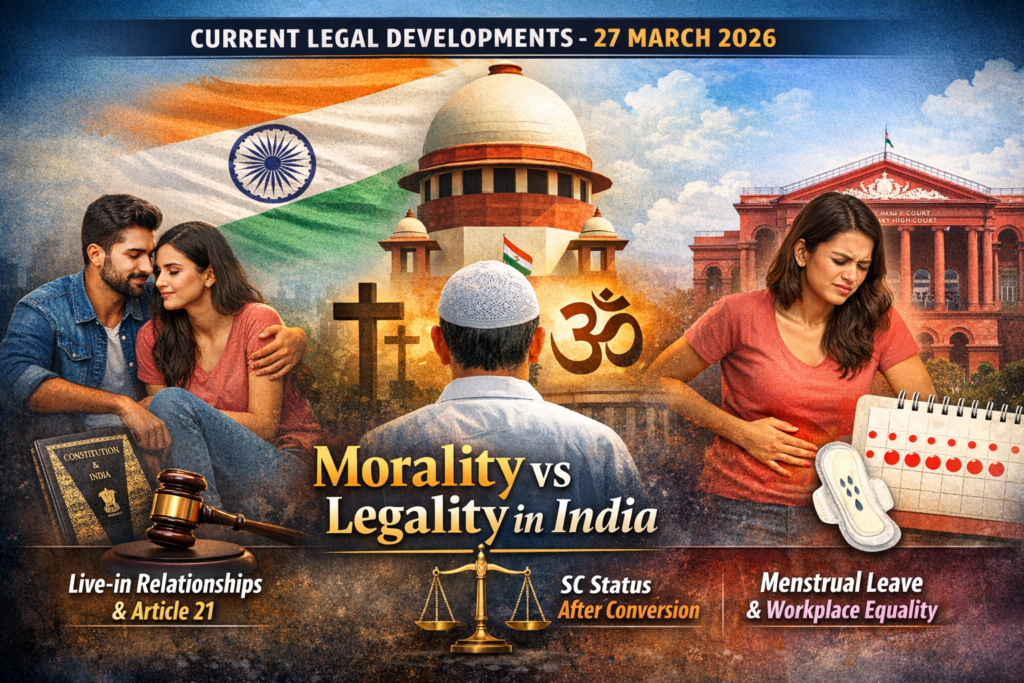
Morality vs Legality: Allahabad High Court Upholds Rights of Adults in Live-in Relationships
“Law Cannot Be Guided by Social Morality Where No Offence Exists”
Introduction
In a significant reaffirmation of individual autonomy and constitutional protections, the Allahabad High Court held that a married man living in a consensual live-in relationship with another adult woman does not constitute a criminal offence. The Court emphasised that social morality cannot override legal rights, thereby reinforcing the distinction between personal choices and legal prohibitions. Factual Background
The case, Anamika and Another v. State of UP and Others, arose from a petition filed by a live-in couple seeking protection from threats posed by the woman’s family.
Key facts include:
- The woman was a major and acting out of her free will
- She had informed the Superintendent of Police, Shahjahanpur, about threats from her family
- The couple apprehended honour-based violence
- A criminal case (kidnapping allegation) was also registered against the man The family argued that:
- Since the man was already married, the relationship was illegal and punishable
Observations of the Court
A Division Bench comprising Justice J.J. Munir and Justice Tarun Saxena firmly rejected this contention.
The Court categorically held:
“There is no offence of the kind where a married man, staying with an adult in a live-in relationship… can be prosecuted for any offence whatsoever.”
Further, the Bench made a crucial constitutional observation:
“Morality and law have to be kept apart… social opinions and morality will not guide the action of the Court.”
Legal Position on Live-in Relationships
The Court’s reasoning aligns with established jurisprudence that:
- Live-in relationships between consenting adults are not illegal
- They fall within the ambit of personal liberty under Article 21
The Supreme Court of India has previously recognised:
- Right to choose a partner as part of right to life and liberty
- Protection of couples against honour-based violence
Duty of State Authorities
The Court also emphasised the responsibility of law enforcement:
- Failure of police to act on complaints was noted
- Protection of adults in consensual relationships is a legal duty
The Court relied on:
Shakti Vahini v. Union of IndiaWhere the Supreme Court held that:
- State authorities must prevent honour crimes
- Police must ensure safety of couples facing threats
The Bench directed:
- The Superintendent of Police to be personally responsible for protection
- No arrest of the couple in the pending criminal case
- Restraint on family members from harassment or interference Key Legal Issues
This case raises important questions:
- Can personal relationships be criminalised based on social morality?
- Does marriage restrict an individual’s right to personal liberty?
- What is the role of courts in protecting non-traditional relationships?
Critical Analysis
The judgment reinforces a crucial constitutional principle:
- Law is not equal to Morality
While society may view such relationships as unacceptable, the Court clarified that:
- Courts operate on legal standards, not moral judgments The ruling:
- Strengthens individual autonomy
- Prevents misuse of criminal law for personal vendetta
- Protects against honour-based violence
However, it also indirectly raises civil law concerns:
- Such relationships may still have implications under marriage and family law (e.g., divorce, maintenance), even if not
Conclusion
The Allahabad High Court’s ruling marks an important reaffirmation of constitutional values, particularly the primacy of individual liberty over societal morality. By holding that a consensual live-in relationship even involving a married person is not a criminal offence, the Court has drawn a clear boundary between legal wrongdoing and moral disapproval.
The judgment ultimately underscores that in a constitutional democracy, rights cannot be curtailed by social perceptions, and the role of the judiciary is to protect freedoms guaranteed by law, irrespective of prevailing moral narratives.
Reproductive Rights and Workplace Equality: Karnataka High Court Examines Validity of Menstrual Leave Mandate
“Does the Right to Reproductive Health Extend to Menstrual Leave?”
Introduction
In a significant constitutional and labour law debate, the Karnataka High Court has raised critical questions regarding the intersection of reproductive health, gender justice, and executive power. While hearing challenges to a State notification mandating one day paid menstrual leave per month, the Court questioned whether such a right flows from Article 21 and whether it can be enforced through executive action under Article 162.
Factual Background
The case arises from a batch of writ petitions challenging a Government notification issued by the State of Karnataka directing:
- One day of paid menstrual leave per month
- Applicable to women aged 18–52 years
- Covering industrial establishments such as factories, shops, plantations, and transport undertakings
The petitioners, including industry associations, did not oppose the objective but challenged:
- The mode of implementation
- The validity of the notification under executive powers
Observations of the Court
Justice Anant Ramanath Hegde made crucial observations highlighting the constitutional complexity of the issue.
The Court posed a fundamental question:
“If reproductive health is a fundamental right, would that translate into menstrual leave?”
Further, the Court noted:
“The question is whether menstrual leave is permissible through a notification… the arguments are more on Article 1C2.”
The Bench also observed that:
- Any executive action must satisfy Article 13 of Indian Constitution
- Executive power cannot override constitutional limitations Legal Framework Involved
The right to reproductive health has been recognised as part of personal liberty and dignity.
Reliance was placed on:
- Suchita Srivastava Chandigarh Administration
- Other precedents affirming bodily autonomy and reproductive choice
The argument advanced:
- Menstrual health is integral to reproduction
- Therefore, menstrual leave may be linked to Article 21
The State justified the notification under:
- Article 162 of Indian Constitution The Court examined:
- Whether executive instructions can create substantive rights/obligations
- Whether such action requires legislative backing
Questions were raised regarding:
- Selective application of the notification to specific industries
- Possible classification issues
However, it was argued that:
- Under-inclusion alone does not invalidate a law unless arbitrary
The State relied on:
- Article 42 of Indian Constitution Which mandates:
- Humane working conditions
- Maternity relief
The State argued menstrual leave is an extension of this principle. Arguments Advanced
In Support of Menstrual Leave
- Menstrual pain and conditions like endometriosis affect productivity
- Leave enables women to participate more effectively in workforce
- It is a “cost of doing business”, similar to sick leave
- Promotes substantive equality
It was also highlighted:
- Low female workforce participation (~35%)
- Need for supportive workplace policies Against the Notification
- Executive action cannot impose obligations without legislative sanction
- Concerns about procedural validity
- Possible impact on employability of women
Key Legal Issues
The case raises foundational constitutional questions:
- Does reproductive health under Article 21 include menstrual leave?
- Can executive power under Article 162 mandate such welfare measures?
- Is menstrual leave a matter of rights or policy?
- Does selective application violate Article 14?
Critical Analysis
This case represents a classic tension between:
- Welfare rights vs procedural legality
Progressive Aspect
- Recognises menstrual health as a workplace issue
- Aligns with gender justice and dignity
Legal Challenge
- Raises limits of executive overreach
- Questions whether policy can precede legislation
The broader implication:
- Transition from formal equality to substantive equality
Conclusion
The Karnataka High Court’s deliberation on menstrual leave reflects a transformative moment in Indian constitutional law, where issues of gender, health, and labour rights converge. While the objective of ensuring dignity and health for women workers is undisputed, the case highlights the need to reconcile such welfare measures with constitutional principles governing separation of powers and legality of executive action. Ultimately, the outcome of this case will determine whether menstrual leave is recognised as a derivative of fundamental rights or a policy choice, thereby shaping the future discourse on gender-sensitive workplace reforms in India.
Reconversion and Caste Identity: Supreme Court Clarifies When Scheduled Caste Status Can Be Reclaimed
“Caste Status Is Not Revived by Mere Conversion It Must Be Proven Through Identity, Conduct, and Community Acceptance”
Introduction
In a landmark ruling addressing the complex intersection of religion, caste identity, and constitutional benefits, the Supreme Court of India has clarified that conversion to a non-recognised religion results in immediate loss of Scheduled Caste (SC) status, and such status can only be reclaimed upon reconversion if strict legal conditions are fulfilled.
The judgment provides much-needed clarity on the evidentiary and legal standards required for reclaiming caste identity, particularly in cases involving claims under protective legislations like the SC/ST (Prevention of Atrocities) Act, 1989.
Factual Background
The case, Chinthada Anand v. State of Andhra Pradesh, arose from a criminal appeal where:
- The complainant originally belonged to a Scheduled Caste community
- He later converted to Christianity and functioned as a Pastor
- Subsequently, he invoked protection under the SC/ST Act, 1G8G
The accused challenged the maintainability of the case on the ground that:
After conversion to Christianity, the complainant ceased to be a Scheduled Caste member in law
Core Legal Issue
The central issue before the Court was:
Whether a person who has converted to another religion can claim Scheduled Caste status, and under what conditions such status can be restored upon reconversion?Legal Framework
The Court’s reasoning was primarily based on:
1. Constitution (Scheduled Castes) Order, 1G50Under Clause 3:
- SC status is restricted only to persons professing:
→ Hinduism
→ Sikhism
→ Buddhism Thus:
- Conversion to any other religion leads to automatic and complete loss of SC status
The protections under this Act are available only to:
- Legally recognised members of Scheduled Castes/Tribes Therefore:
Loss of caste status is equal to Loss of statutory protection Key Observations of the Court
A Bench comprising Justice Prashant Kumar Mishra and Justice Manmohan made a categorical observation:
“Conversion to a religion not specified under the 1350 Order results in immediate loss of Scheduled Caste status.”
The Court further clarified:
“No statutory benefit or protection can be claimed by a person who is not deemed to be a member of the Scheduled Caste under the Constitution.”
Importantly, the Court rejected the argument that:
- Possession of a caste certificate
- Or birth-based identity
could independently sustain SC status after conversion.
Reclaiming SC Status After Reconversion: The Three-Fold Test
The Court laid down a strict three-condition test, all of which are mandatory:
1. Proof of Original CasteThere must be clear and reliable evidence that:
- The person originally belonged to a caste notified under the 1950 Order
The claimant must prove:
- Actual reconversion to Hinduism, Sikhism, or Buddhism
- Complete renunciation of the previous religion
- Adoption of:
→ Customs
→ Practices
→ Rituals
→ Social conduct of the original caste
3. Community AcceptanceThe most crucial requirement:
- The caste/community must accept and recognise the individual The Court emphasized:
“Mere self-proclamation is insufficient; the community must acknowledge the person as one of its own.”
Burden of Proof
The Court clearly held:
- The burden lies entirely on the claimant Failure to prove any one condition:
- Results in rejection of the claim Position Regarding Scheduled Tribes
The Court made an important distinction:
- For Scheduled Tribes, religion is not decisive However:
- The person must prove:
°Continuity of the tribal way of life
°Acceptance by the tribal community Application to the Present Case
Applying these principles, the Court found:
- The appellant continued to profess Christianity
- He actively functioned as a Pastor
- There was no evidence of reconversion or community acceptance
Thus:
- He could not claim SC status
- Proceedings under the SC/ST Act were rightly quashed Legal Significance
This judgment is crucial in clarifying:
1. Nature of Caste IdentityCaste is not merely:
- A birth-based identity But also:
- A continuing social and religious identity
- Prevention of Misuse
The ruling prevents:
- Misuse of reservation and protective laws
- Dual religious identity claims for legal benefits
The decision reinforces that:
- Caste is also a social institution
- Legal recognition depends on community acceptance
Critical Analysis
Strengths- Provides clear legal test
- Ensures integrity of affirmative action policies
- Balances constitutional protection with social realities
- Heavy reliance on community acceptance may create subjectivity
- Burden of proof may be difficult in practice
- Raises tension between individual choice vs social validation
Conclusion
The Supreme Court’s ruling marks a significant development in caste jurisprudence by establishing that Scheduled Caste status is not automatically revived upon reconversion, but must be strictly proven through identity, conduct, and social acceptance. By insisting on a rigorous evidentiary standard, the Court has ensured that constitutional protections are preserved for genuine beneficiaries while preventing misuse. At the same time, the judgment highlights the continuing complexity of caste as both a legal and social construct, requiring careful balancing between individual rights and community recognition.
Strait of Hormuz Crisis: Which Countries Are Allowed Passage Amid U.S.–Israel–Iran Conflict?
“Selective Access in a Strategic Chokepoint Reshaping Global Energy and Maritime Law”
Introduction
The ongoing geopolitical conflict involving the United States, Israel, and Iran has triggered a major disruption in global energy markets, particularly due to tensions in the Strait of Hormuz a critical maritime corridor through which nearly 20% of the world’s oil and LNG supply flows. Amid rising hostilities, Iran has imposed a partial blockade, significantly restricting maritime traffic. However, the passage is not completely shut; instead, Iran has adopted a selective access policy, allowing certain countries while barring others, thereby transforming the Strait into a zone of strategic control and geopolitical leverage.
Background: Strategic Importance of the Strait The Strait of Hormuz is:
- A narrow shipping lane connecting the Persian Gulf and Gulf of Oman
- The primary export route for oil-producing nations like Saudi Arabia, Iraq, UAE, and Iran
- Responsible for transporting around one-fifth of global oil supply
Thus, any disruption:
Directly impacts global oil prices, trade routes, and economic stability
Iran’s Position: Conditional Access, Not Complete Closure
Contrary to initial reports of a full blockade, Iran clarified before international bodies that:
“Non-hostile vessels may pass through the Strait, while those linked to hostile nations are barred.”
Further statements confirmed:
The Strait is closed only to “enemy-linked” ships, particularly those associated with:
- United States
- Israel
- Their allies
Countries Allowed to Cross the Strait
Based on diplomatic arrangements and evolving developments, the following countries have been allowed passage (fully or conditionally):
1. Key Approved Nations- China
- Russia
- India
- Iraq
- Pakistan Wikipedia
These countries are largely:
- Either neutral in the conflict
- Or maintain strategic/economic ties with Iran
- Malaysia – allowed after diplomatic talks
- Thailand – permitted passage following negotiations
- Turkey – ships allowed with identification and coordination Additionally:
- Some Indian vessels received specific clearance
- Certain ships reportedly paid or negotiated transit permissions
Iran has introduced a broad category:
“Non-hostile vessels”
Meaning:
- Ships not linked to US/Israel military or strategic support
- Vessels complying with Iranian coordination mechanisms Such ships may:
- Use designated routes
- Follow security protocols
- In some cases, pay transit-related costs Countries Restricted or Barred
Iran has explicitly restricted passage for:
- United States
- Israel
- Allied or affiliated vessels
The Iranian military further declared:
Ships connected to these nations are prohibited from using the StraitPractical Reality: Limited and Risky Transit Despite partial permission:
- Ship traffic has drastically reduced
- Many vessels are stranded or avoiding the route
- Insurance and security risks remain extremely high Reports indicate:
- Only a small number of ships are passing through
- Some routes operate under Iranian monitoring (“controlled corridors”) Impact on Global Economy
The selective blockade has led to:
- Sharp rise in oil and gas prices
- Disruption in global supply chains
- Increased cost of transportation and commodities Countries heavily affected include:
- India (high oil import dependency)
- China (largest buyer of Gulf oil)
- European and Asian economies
Legal and Geopolitical Implications
- Violation of Freedom of Navigation? Under international maritime law:
- Straits like Hormuz are subjec,t to transit passage rights
However:
Iran’s selective control raises questions about:- Legality under UNCLOS principles
- Extent of sovereignty during armed conflict
- Weaponisation of Trade Routes The crisis demonstrates:
- How strategic chokepoints can be used as economic pressure tools
- Shift from open sea governance – controlled maritime access
- Rise of “Selective Globalisation” Instead of complete closure:
This reflects:
- A move towards politically aligned trade corridors. Conclusion
The Strait of Hormuz crisis highlights a new model of geopolitical control where access to critical global trade routes is no longer universally guaranteed but strategically regulated based on alliances and conflict dynamics.
By allowing passage to “non-hostile” nations while restricting adversaries, Iran has effectively transformed the Strait into a selective maritime gateway, influencing global energy flows and international trade patterns.
In the long run, this crisis may redefine principles of freedom of navigation, economic security, and global interdependence, making the Strait of Hormuz not just a geographic chokepoint, but a symbol of geopolitical power in the modern world.
The Charter’s Silence: International Law, West Asia Conflict, and the Limits of Multilateral Enforcement
Introduction
The ongoing conflict in West Asia, particularly involving the United States, Israel, and Iran, has raised serious concerns regarding the effectiveness of international law and multilateral institutions. The targeted killing of Iran’s Supreme Leader and subsequent developments, including civilian casualties and disruptions in global navigation such as the closure of the Strait of Hormuz, have brought into focus the gap between legal norms and their actual enforcement. This situation highlights a critical question: whether the international legal order, built on the United Nations Charter, is being applied uniformly or selectively.
Violation of the UN Charter Framework
The legal position governing the use of force is clearly laid down under the Article 2(4) of UN Charter, which prohibits states from using force against the territorial integrity or political independence of another state. The only exception is provided under Article 51 of UN Charter, which permits self-defence in response to an armed attack, subject to conditions of necessity and proportionality.
The International Court of Justice in the landmark Nicaragua v United States clarified that even security concerns cannot justify bypassing these requirements. In the present context, the absence of clear evidence of an imminent armed attack and lack of Security Council authorization raises serious doubts about the legality of the strike.
“Use of force outside the framework of Article 51 and without Security Council approval is impermissible under international law.”
The failure of global institutions to address this issue reflects not legal uncertainty, but a political unwillingness to enforce established norms.
Targeted Killing and Sovereign Equality
The deliberate targeting of a sitting head of state introduces another serious legal concern. Under the principle of sovereign equality enshrined in Article 2(1) of UN Charter, all states are entitled to respect for their political independence.
The assassination of a head of state:
- Violates customary international law
- Undermines diplomatic norms
- Threatens stability in international relations
“The targeted killing of a constitutional head of state cannot be justified as a routine act of warfare.”
The lack of widespread condemnation indicates a troubling trend where such acts risk becoming normalized in international relations.
Humanitarian Law Violations
The conflict has also resulted in significant civilian casualties, including the bombing of civilian infrastructure. International humanitarian law, particularly under the Geneva Conventions, strictly prohibits attacks on civilians.
Relevant principles include:
- Distinction between civilians and combatants
- Proportionality in military operations
- Precaution to minimize civilian harm
Under the Rome Statute of ICC, intentional attacks on civilians may constitute war crimes.
“Civilian populations cannot be treated as collateral instruments of military strategy.”
The absence of any meaningful investigation or accountability mechanism further weakens the credibility of international humanitarian law.
Strait of Hormuz and Freedom of Navigation
The closure or restriction of the Strait of Hormuz introduces a separate but equally significant legal issue. Under UNCLOS, international straits are governed by the principle of transit passage, which cannot be suspended by coastal states.
Iran’s selective restriction:
- Affects global energy supply (20% of oil trade)
- Impacts international trade routes
- Raises questions on compliance with international law
However, Iran’s argument of restricting only “hostile” states shows a shift from absolute blockade to strategic control, reflecting geopolitical realities rather than strict legal adherence.
India’s Role and Legal Position
India’s response has been measured but legally grounded. By supporting international navigation rights, India has upheld:
- Freedom of navigation (erga omnes obligation)
- Stability of global trade routes
- Energy security interests
However, India’s position raises an important question:
Can a state selectively respond to some violations while remaining silent on others?A consistent legal approach would require:
- Condemnation of unlawful use of force
- Opposition to civilian targeting
- Support for international legal mechanisms Conclusion
The West Asia crisis underscores a fundamental challenge in international law the gap between normative clarity and practical enforcement. While the United Nations Charter, humanitarian law, and maritime law provide a comprehensive legal framework, their selective application undermines their legitimacy. Ultimately, the issue is not whether international law exists, but whether states are willing to apply it consistently. The future of the global legal order depends on restoring principled multilateralism, where legality is not shaped by power politics but by universal norms. Without such commitment, the silence of institutions may gradually transform into the erosion of the very system they were designed to protect.
CONCLUSION
The issues addressed across today’s topics collectively highlight the evolving nature of law as both a protective framework and a contested space shaped by social realities and political power. While domestic courts continue to strengthen constitutional values such as personal liberty and dignity, as seen in the recognition of live-in relationships, they also impose structured limitations where necessary, as reflected in the strict conditions for reclaiming Scheduled Caste status after reconversion.
On the global front, the West Asia crisis demonstrates that the effectiveness of international law ultimately depends not on its existence but on the willingness of states to uphold it uniformly. The selective invocation of legal principles, particularly in matters of use of force and maritime rights, risks undermining the credibility of the international legal order.
Therefore, the need of the hour is a balanced and principled approach both domestically and internationally where legal norms are applied consistently, without succumbing to societal pressures or geopolitical interests. Only through such an approach can the rule of law retain its legitimacy and continue to function as a cornerstone of justice and global stability.