


Shivani Gupta is a 4th year BA LLB student at Sinhgad Law College, Pune. Read More


Abstract
The Indian Constitution’s emergency provisions, contained in Articles 352 to 360, grant the Union Government broad authority to address unusual circumstances that threaten the nation’s security, financial stability, or constitutional integrity. These clauses give the president the authority to declare three separate kinds of emergencies, each with its own set of justifications and legal ramifications: financial, state and national emergencies (President’s Rule). However, these powers are not unchecked; the parliament must follow specific procedures to approve and maintain them. This essay examines the constitutional justification for declaring emergencies, the procedures for extending them, and their significant impacts on India’s federalism, basic rights, and democratic governance.
Introduction
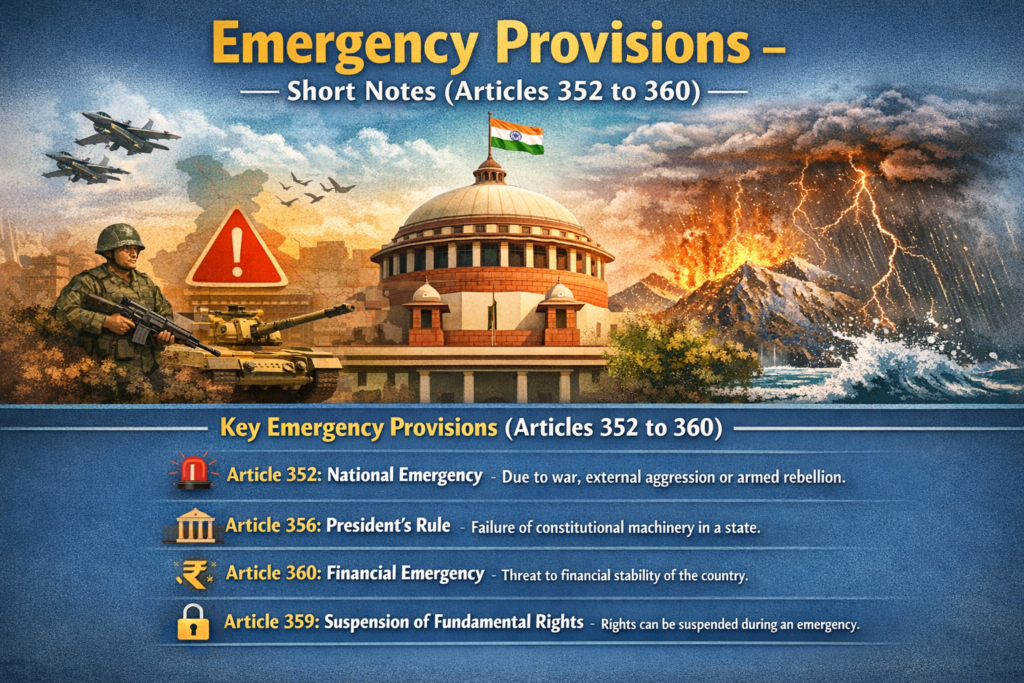
The Indian Constitution’s founders included emergency provisions to protect the country’s integrity and sovereignty in times of serious crisis, taking into account both domestic and international experiences. Three categories of emergencies are covered by the Constitution:
- National Emergency (Article 352)- due to war, external aggression, or armed rebellion.
- President’s Rule (Article 356)- due to the failure of constitutional machinery in a state.
- Financial Emergency (Article 360)- due to financial instability or a threat to the financial credit of India.
By limiting state autonomy and consolidating authority in the Union Government, these rules fundamentally change the federal structure. They also affect how civil liberties and democratic institutions operate.
National Emergency (Article 352)
- Under the Indian Constitution, Article 352 deals with the proclamation of a National Emergency. This provision allows the President of India to declare a national emergency when the security of India or any part of it is threatened.
- By granting the Executive broad authority to suspend fundamental rights, the proclamation enables the government to take the required actions to successfully manage the situation.
Grounds for Proclamation:
- War
- External aggression
- Armed rebellion (Earlier it was “internal disturbance”- changed by the 44th Amendment Act
Procedure for Proclamation:
The President can proclaim an emergency only on the written advice of the Council of Ministers.
Both Houses of Parliament must concur on such a proclamation:
- Within 1 month from the date of issue.
- It is in effect for six months after approval.
- With the consent of Parliament, it may be extended indefinitely every six months.
Effects of National Emergency:
- Extension of central authority over states: The federal system momentarily adopts a unitary form.
- Parliament has the authority to prolong the life of the Lok Sabha and State Assemblies, one year at a time, but no more than six months after the end of the emergency.
- During an emergency brought on by war or external attack, Article 19’s fundamental rights are immediately suspended (although not in the event of an armed insurrection).
- Article 359 gives the president the authority to halt the implementation of other fundamental rights, with the exception of Article 20 and 21.
President’s Rule (Article 356)-
Grounds for proclamation
- If a state’s administration is unable to operate in conformity with the Constitution’s requirements, the president may declare a State Emergency, often known as President’s Rule, under Article 356. This is usually used in situations where the state’s constitutional mechanism fails and a stable government cannot be formed.
Procedure for proclamation
- The information obtained from the state governor or other sources is used by the president to take action.
- After reviewing the report, the President that the constitutional mechanism has failed. There must be valid and pertinent reasons for the subjective contentment.
- The proclamation must be approved by both houses of parliament
Within 2 months from the date of issuance
By a simple majority of members present and voting
- If Parliament is not in session, the proclamation must be approved within 30 days of reassembling.
Effect of State Governance
The state government is overthrown and the President takes over under the President’s Rule (Article 356), with the Governor running the state on behalf of the Union Government.
Parliament creates legislation for the state during this time, and the state legislative assembly is either suspended or dissolved. The rule is susceptible to court review, and the judiciary is unaffected.
Financial Emergency (Article 360)
- Under Article 360 of the Indian Constitution, the President may declare a financial emergency if he or she is convinced that the credit or financial stability of India or any portion of its territory is in danger.
Features
- The president’s proclamation needs to be accepted by both houses of parliament within two months.
There is no temporal limit on how long it can last.
The financial affairs of the state are turned over to the Union Government.
Effects of Financial Emergency
The Centre has the authority to advise states on financial issues, such as lowering pay and benefits for:
- Government workers (including judges of the Supreme Court and High Court),
- Other employees of the government.
The President may need to approve state financial decisions and money bills.
Suspension of Fundamental Rights (Articles 358–359)
Article 358 – Suspension of Article 19-
Applies only during a national emergency declared on grounds of war or external aggression (not armed rebellion).
-
Automatically suspends Article 19 (six freedoms).
-
The State can make any law or take executive action inconsistent with Article 19.
-
Suspension lasts only during the emergency period.
-
Laws made under this article become inoperative after the emergency, except for actions already taken.
-
After the 44th Constitutional Amendment (1978), Article 19 cannot be suspended during an emergency declared on armed rebellion.
-
The President may suspend the right to move courts for the enforcement of specified Fundamental Rights.
-
Applies during any type of National Emergency (war, external aggression, armed rebellion).
-
Rights are not suspended; only their enforcement is suspended.
-
Must be done by a Presidential Order.
-
Articles 20 (protection in criminal cases) and 21 (right to life and personal liberty) cannot be suspended even during an emergency (44th Amendment).
-
Suspension can be for the entire country or a part thereof
Conclusion
There are two sides to India’s regulations for announcing a national emergency. They have the potential to be abused and to undermine democratic principles, even as they give the central government the authority it needs to protect the country in times of emergency. Maintaining constitutional protections while facilitating efficient crisis response is still a difficult task. In order to preserve India’s democratic fabric as it negotiates changing security challenges and political dynamics, it is crucial that the emergency measures be used sparingly, under strict supervision, and in accordance with the law.