


Tanu Sharma is currently in her third year of study for a BA LLB (Hons) at GGU, Central University of Chhattisgarh. Read More


Introduction: Family, Property, and the Hidden Fault Lines
“In the courtroom, blood ties often dissolve faster than property disputes.”
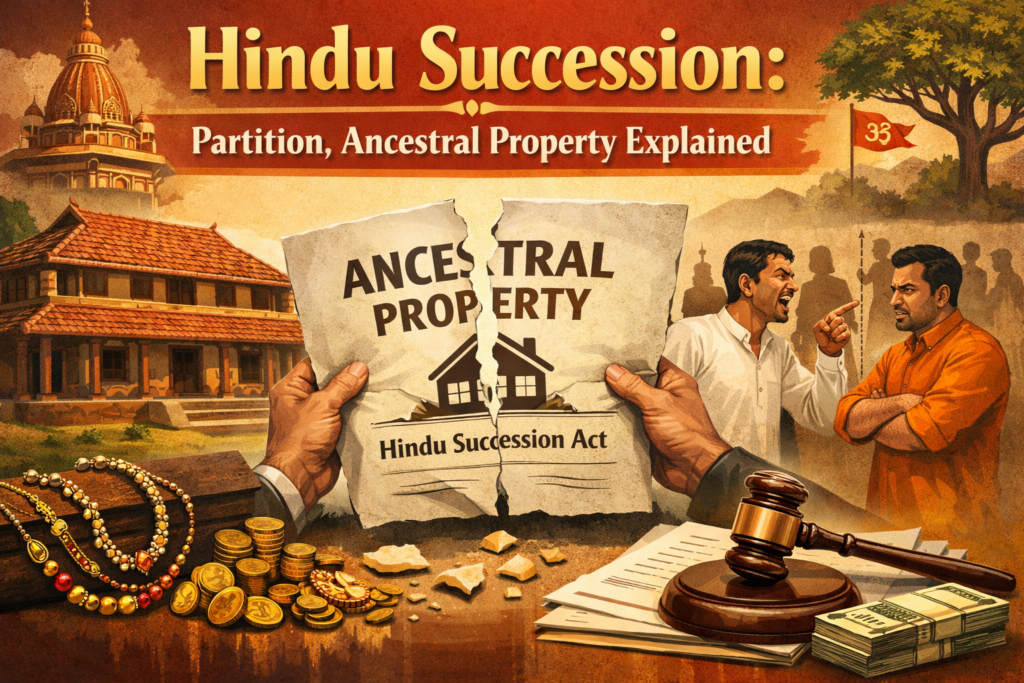
Picture this- a large joint Hindu family gathered for their evening meal—a lively din of laughter, chatter, and shared memories. The same evening, one cousin gets served a legal notice over a piece of land they all call “ancestral.” Suddenly, that warm dinner table becomes a battleground. This is not a movie plot; it’s an everyday reality in countless Indian households. The battlefield? Property. The war? Succession and partition. The weapon? Law.
In Hindu families, property is never just about land or money—it’s an heirloom of dignity, lineage, and legacy. It’s a living connection to forefathers and often the silent thread that binds generations together. Whether it’s the ancestral home in a dusty village or a piece of urban land passed down over generations, the emotional value attached to such assets can hardly be overstated. However, it’s also these very assets that drive wedges between families when questions of inheritance arise.
One must understand the difference between ancestral property and self-acquired property to grasp the legal web that entangles many families. Ancestral property is that which passes undivided from four generations of male lineage—father, grandfather, great-grandfather, and great-great-grandfather—whereas self-acquired property is what one earns or purchases independently. The classification determines whether a family member can claim an automatic share or whether it must be bequeathed by will or gift.
The major tension lies in the clash of emotions and entitlements. A son who believes he has a right to his father’s business might be shocked to discover it is actually self-acquired and not subject to equal partition. Daughters, for long denied their rightful shares, are now coming forward to assert their coparcenary rights, post the 2005 amendment to the Hindu Succession Act. But even then, implementation often lags behind legal recognition.
Legal recognition of such rights was significantly shaped by landmark judgments, one of the most important being Gurupad Khandappa Magdum v. Hirabai Khandappa Magdum, AIR 1978 SC 1239. In this case, the Supreme Court acknowledged that a coparcener has a vested right in the ancestral property from birth, which crystallises at the time of partition. This ruling emphasized that partition is not merely a family arrangement but a legal mechanism where rights solidify and entitlements surface.
Today, family feuds over property are clogging Indian courts, with thousands of cases pending across the country. What’s heartbreaking is that often, these battles are not about greed but about misunderstanding, lack of documentation, or unclear succession planning. The result? Emotional damage, broken relationships, and years of litigation.
The institution of the joint family, once the bedrock of Hindu society, is visibly cracking under the weight of conflicting interpretations of legacy and law. Property, which should ideally be a symbol of continuity and cohesion, has turned into a trigger for confrontation.
Today, as more families find themselves tangled in “heir wars”, what emerges is a deeper realisation: inheritance is not just about legacy; it is about justice, and often, it’s about finally having your voice heard—even if it’s across the courtroom instead of across the dinner table.
Understanding Ancestral Property: Meaning, Myth and Legal Roots
In many Hindu families, there’s often that one home, one plot of land, or a chest of jewellery referred to as “baap-dada ki sampatti”—property that generations have passed down without ever really talking about ownership. It’s assumed, inherited, respected, and… when disputes arise, fiercely contested.
“It’s not just land—it’s the legacy of love, labour, and law.”
But what does the law actually say about ancestral property?
What is Ancestral Property?
Under Hindu law, ancestral property is that which is inherited up to four generations of male lineage, without any division. So, if a Hindu male inherits property from his father, grandfather, or great-grandfather, and that property has remained undivided, it is considered ancestral. Each male descendant acquires a coparcenary right in it by birth, not by will or gift.
This was powerfully reinforced in Rohit Chauhan v. Surinder Singh, (2013) 9 SCC 419, where the Supreme Court clarified that property inherited from paternal ancestors up to three degrees before the propositus (person in question) is ancestral. The Court laid down that once such inheritance takes place, every male descendant automatically becomes a coparcener.
How is it Different from Self-Acquired Property?
The distinction is critical. Self-acquired property is what an individual earns or acquires on their own. They can choose to sell it, gift it, or will it as they wish. Ancestral property, on the other hand, cannot be freely disposed of. Every coparcener has a vested interest in it, even if they are unborn at the time of its acquisition.
This birthright, known as coparcenary, means that a child—especially under the Mitakshara school of Hindu law followed in most of India—is born with a share in ancestral property. That’s why even minor children have legal standing in partition suits involving ancestral assets.
Myths vs Law
Many families operate on myths—that the eldest son controls everything, or that daughters have no rights unless gifted. But the law sees it differently. The Mitakshara school, the foundation of Hindu succession in most parts of India, clearly outlines the rights of each male coparcener, and with post-2005 reforms, daughters too have equal footing.
Understanding ancestral property isn’t just about knowing your rights. It’s about unpacking centuries of tradition, and sometimes, challenging those traditions in the name of fairness and legal clarity.
- The Hindu Succession Act, 1956-Breaking the Male Bastion
For centuries, Hindu succession was heavily tilted in favour of men. Property, especially ancestral property, was seen as a male domain—passed from father to son, while daughters were expected to leave their family homes behind after marriage. Legal recognition of women’s inheritance rights was minimal, if not absent, and tradition often triumphed over equality.
That changed with the Hindu Succession Act, 1956, a landmark legislation that began the slow but steady dismantling of patriarchal inheritance laws in India. However, even this Act retained the doctrine of survivorship—a rule under which property passed automatically to male coparceners in the joint family, excluding female heirs from coparcenary rights.
The Turning Point-2005 Amendment
A revolution came with the Hindu Succession (Amendment) Act, 2005. It abolished the survivorship rule for coparcenary property and gave daughters equal rights, declaring them coparceners “by birth,” at par with sons. This wasn’t just legislative change—it was social transformation encoded in law.
But confusion followed. What if the father died before 2005? Would the daughter still have coparcenary rights?
Judicial Clarifications
In Prakash v. Phulavati, (2016) 2 SCC 36, the Supreme Court held that the father must be alive on the date of the 2005 amendment for the daughter to claim coparcenary rights. This created significant injustice—many daughters lost their right simply because their father had passed away a year or even a day too early.
This injustice was corrected in Vineeta Sharma v. Rakesh Sharma, (2020) 9 SCC 1, where a larger bench of the Supreme Court overruled the earlier decision. The Court ruled that a daughter’s right is by birth, not dependent on the father’s death, and is not retrospective, but retroactive—meaning, the law applied to all living daughters on the date of the amendment, regardless of when their father died.
A Giant Step Toward Equality
This ruling was more than a legal decision—it was a message of gender justice. Daughters, long side-lined in inheritance conversations, were finally brought into the fold of equal rights. The male bastion was broken—not just with a legislative hammer, but with the weight of constitutional morality and fairness.
The law had spoken- a daughter is not a guest in her father’s house—she is a rightful heir.
- Partition-Law, Emotions and the Breaking of a Household
In many Indian households, the word “partition” doesn’t just refer to legal papers or property shares. It often signifies the end of something deeply emotional—a joint family that once lived, loved, and struggled together now deciding to go their separate ways. The legal act may be clinical, but its effects ripple through generations.
Legally speaking, partition in Hindu law is the severance of joint family status and division of joint family property among its coparceners. This can happen through various means: a partition deed, a will, a mutual family arrangement, or even through a formal lawsuit filed in court. But the law, while clear in its method, doesn’t capture the emotional complexity of this break.
Imagine two brothers, who once shared a room, now arguing over who gets the bigger portion of their father’s house. The kitchen that once served shared meals becomes a line of control. Suddenly, a home turns into a battleground.
Yet, not all partitions are formal. In many families, property gets divided informally, often with oral agreements or casual understandings. Years later, when disputes arise, the question of proof becomes central.
This was precisely the issue in Kalyani v. Narayanan, AIR 1980 SC 1173, where the Supreme Court held that even oral partition is valid, provided there is sufficient evidence—like changes in possession, conduct of parties, and family behaviour. The court recognised that in Indian society, not all family matters are written down—but they are understood, accepted, and acted upon.
That said, informal arrangements are often vulnerable. Without proper documentation, even the most peaceful division can turn into a bitter legal dispute. Therefore, while the law accepts oral partition, it insists on evidence that reflects real change, not just empty claims.
Partition is not just a legal term—it’s a deeply personal event. And in most families, it marks the moment when blood ties give way to boundary lines.
- The Battle Among Heirs: Who Gets What, and Why?
In most Hindu households, the death of a family patriarch brings not just grief, but a wave of uncertainty. Who gets the house? What happens to the land? Do daughters have an equal share? Can widowed daughters-in-law claim anything? The moment inheritance becomes a question, heirs become contenders.
The Hindu Succession Act, 1956 tries to bring order to this chaos by laying out clear categories of heirs. The most immediate beneficiaries are listed under Class I heirs: sons, daughters, widows, and mothers of the deceased. If there are no Class I heirs, the law turns to Class II heirs, like siblings, nephews, and other relatives. Then come agnates (blood relatives through males), and lastly, cognates (relatives through females).
In theory, the law gives priority to those closest in relationship and dependence. But in practice, the battlefield is far from fair.
One of the most common points of friction is the exclusion or undervaluation of women. Daughters may be asked to “let go” of their share in favour of brothers. Widows, especially those without sons, are often sidelined. Remarried heirs or illegitimate children face social stigma, despite having legal rights.
In Anar Devi v. Parmeshwari Devi, (2006) 8 SCC 656, the Supreme Court had to address a dispute among widows of deceased sons over their respective shares in the property. The court upheld that each widow was entitled to an equal share in her husband’s portion, which had devolved upon him at the time of the notional partition.
What is Notional Partition?
This legal fiction assumes that a partition occurred immediately before the death of the male coparcener, allowing the law to calculate what his share would have been. This is done to determine what portion passes to his heirs under succession, especially when the family remains undivided.
For example, if a father had three sons and dies intestate, his property is notionally split as if he had taken his share, and then his portion is passed down to all his Class I heirs—including daughters and widow—equally.
But here’s the real challenge: mathematical equality doesn’t always feel like emotional justice. What about the daughter who was married off young and never lived in the family house? Or the son who stayed back to care for aging parents? These stories rarely make it into legal equations—but they always echo in courtrooms.
As the law evolves to include more inclusive definitions of heirs, the real test lies in balancing law with lived experience. Because when it comes to family, inheritance isn’t just about shares—it’s about stories.
Illegitimacy, Adoption, and Other Complex Scenarios
When it comes to inheritance, families are rarely simple. In today’s world, blended families, adoptions, and complex parental relationships raise critical questions: Who counts as a legal heir? Can a child born outside marriage claim a share? What about a child who was adopted?
Under Hindu law, an adopted child is treated as a natural-born child of the adoptive parents. Once adopted, the child acquires the same coparcenary rights, including rights in ancestral property, as a biological child. This ensures not only legal protection but also emotional inclusion.
The more difficult terrain is that of illegitimate children. Traditionally, such children were denied inheritance in the father’s estate, causing deep injustice. However, with the 2005 amendment to the Hindu Succession Act and judicial progression, the law has begun to shift.
In Revansiddappa v. Mallikarjun, (2011) 11 SCC 1, the Supreme Court held that illegitimate children are entitled to a share in their parents’ ancestral property. The Court observed:
“A child born outside a valid marriage has no control over the circumstances of their birth… the law must protect their dignity and inheritance.”
Even so, a child born out of wedlock still faces limitations in claiming rights through the father’s side unless paternity is accepted or proven. The mother’s estate, however, is fully available to them.
Stepchildren and half-siblings bring their own legal challenges. While stepchildren are generally not entitled to ancestral property unless legally adopted, half-blood siblings (sharing one common parent) may inherit, provided they fall within the relevant class of heirs.
Women’s Rights in Succession: Between Tradition and Transformation
For centuries, Hindu succession law sidelined women. Property was passed down along male lines; daughters, wives, and even widowed mothers had limited or no share in ancestral property. The notion that women could inherit on equal terms was socially and legally foreign.
That began to change with the Hindu Succession (Amendment) Act, 2005, which made daughters coparceners by birth—just like sons. This wasn’t merely a statutory change—it was a constitutional correction. Mothers, widows, and daughters now stood equally in the line of succession.
Yet, real-life enforcement lags. Many women are unaware of their rights, and even when they are, social stigma often pressures them to “leave it to the brothers.” Many daughters still hesitate to go to court out of respect—or fear.
But winds are shifting.
In Danamma v. Amar, (2018) 3 SCC 343, the Supreme Court held that daughters born even before the 2005 amendment are entitled to coparcenary rights, provided the partition hadn’t been completed. The Court reaffirmed that gender cannot be a barrier to inheritance and that the law recognizes birthright, not the date of legal awareness.
Today, more women are challenging patriarchal inheritance customs and asserting their legal status in ancestral homes—sometimes not just for wealth, but for recognition and dignity.
Doctrine of Survivorship vs Testamentary Succession
Before 1956, ancestral property under Hindu law followed the doctrine of survivorship—if a male coparcener died, his share automatically passed to surviving male members, excluding daughters and widows. Wills had limited influence in joint family property.
The Hindu Succession Act, 1956, fundamentally altered this structure. It allowed for testamentary succession, enabling a person to will away their share in coparcenary property. This signified a shift from joint ownership by birthright to individual autonomy—provided the property had been partitioned or identifiable.
The doctrine of “notional partition” plays a key role here. It allows courts to calculate what share the deceased would have received if partition had taken place immediately before death—thus enabling testamentary bequests from that portion alone.
But the right to will one’s share isn’t absolute. In C. Masilamani Mudaliar v. Idol of Sri Swaminathaswami Thirukoil, (1996) 8 SCC 525, the Supreme Court held that testamentary freedom is subordinate to statutory succession. A will cannot defeat the rightful inheritance of Class I heirs unless properly executed and proven.
This balance between customary survivorship and modern testamentary rights reflects the evolving tension in Hindu succession law—a tension between tradition and individual choice, between legacy and legality.
Role of Family Settlements and Mediation: Peace Before Pieces
In Indian families, property disputes are never just about square footage or gold—they’re about identity, sacrifice, emotion, and legacy. But over the years, the emotional cost of litigating with one’s own blood has led many to seek something different: peace without a price tag. Enter the rise of family settlements and mediation.
Courts today strongly encourage parties to resolve inheritance disputes outside of litigation, especially within families. Why? Because court battles are long, expensive, and emotionally corrosive. No legal win can restore the relationships lost in the process.
This is where family settlements come in. These are mutual agreements—often informal—where family members sit across a table (or WhatsApp group, in today’s context) and decide “who gets what” without going to court. These arrangements may be oral or written, and surprisingly, even if not registered, the law recognises them as valid.
This was solidified in the landmark case of Kale v. Deputy Director of Consolidation, AIR 1976 SC 807, where the Supreme Court held that-
“A family settlement does not require registration if it is made voluntarily, fairly, and intended to resolve future disputes.”
Mediation also plays a vital role. Trained mediators now help feuding siblings and estranged uncles find middle ground. Instead of adversaries, they become co-creators of a peaceful future. And while legal settlements divide property, mediated ones often preserve relationships.
Sometimes, just being heard—outside the formal setting of affidavits and cross-examinations—helps heal wounds that property papers alone cannot touch.
Modern Challenges: Urbanisation, NRI Heirs, and Digital Disputes
As India urbanises and families scatter across the globe, succession battles have entered a new age. Today’s heirs are not always found at family functions; many are Non-Resident Indians (NRIs) or grandchildren living in New York or Sydney who suddenly learn they’re entitled to a slice of ancestral farmland in Punjab or a bungalow in Bengaluru.
But with distance comes complication. Tracing ancestral property becomes a legal labyrinth—especially when records are missing, mutated, or non-digitised. Forgery of wills, impersonation, or tampering of digital documents have also surged. WhatsApp screenshots, scanned signatures, and PDF wills—can they be trusted?
In the landmark case Krishna Kumar Birla v. Rajendra Singh Lodha, (2008) 4 SCC 300, the Supreme Court addressed issues surrounding testamentary succession, including the burden of proof in digital and contested wills. The case showed how wealth, mobility, and technology have complicated inheritance.
In response, the government has pushed for land transparency through the Digital India Land Records Modernization Programme (DILRMP). This initiative aims to digitise land titles, link Aadhaar IDs, and reduce disputes by making records transparent, tamper-proof, and accessible online.
But until awareness reaches every heir—urban or rural, NRI or local—modern law must catch up with modern lives.
Conclusion: Justice in Blood and Stone
“Some inherit land. Others inherit silence. Justice is making sure both are heard.”
The battle over ancestral property is never just about square feet or survey numbers. It’s a deeper struggle—a clash of memories, morals, and entitlement. It unravels decades of shared meals, whispered promises, and buried resentments. In Indian families, property is not merely land—it is identity. And when that identity is questioned, emotions erupt where law alone cannot soothe.
Over time, our laws have evolved to reflect equality. Daughters have become coparceners. Widows have claimed their due. Adopted and even illegitimate children have been given a voice where once there was only silence. The judiciary has played a powerful role—reshaping traditions to fit constitutional values and ensuring that inheritance reflects not just history, but fairness.
But while statutes can be amended in Parliament, societal mindsets change slowly at the dinner table. Legal victories are often bittersweet when they come at the cost of broken families.
True justice lies in striking a balance—between entitlement and empathy, between what is written in wills and what is written in hearts.
The road ahead isn’t just legal—it’s emotional. We need awareness, early legal planning, open conversations, and a willingness to heal, not just inherit. Because in the end, what we leave behind matters just as much as how we leave it behind.
Certainly! Here’s a list of references (case laws, statutes, and official reports) used throughout the article “Heirs at War – Partition, Ancestral Property and the Battle for Succession of Hindus”, formatted in a standard legal citation style suitable for academic or internship submissions (ILI or neutral format):
References
Statutory and Legislative References
- Hindu Succession Act, 1956, as amended by the Hindu Succession (Amendment) Act, 2005.
- Indian Evidence Act, 1872, for rules regarding oral agreements and admissibility of proof in partition and inheritance claims.
- Transfer of Property Act, 1882, in context of testamentary and inter vivos transfer rights.
Case Law References
- Gurupad Khandappa Magdum v. Hirabai Khandappa Magdum, AIR 1978 SC 1239
— Recognised the vested coparcenary right of a daughter at birth for ancestral property. - Rohit Chauhan v. Surinder Singh, (2013) 9 SCC 419
— Defined ancestral property as property inherited up to three paternal generations. - Prakash v. Phulavati, (2016) 2 SCC 36
— Held daughters’ coparcenary rights only if the father was alive on the date of the 2005 amendment (later overruled). - Vineeta Sharma v. Rakesh Sharma, (2020) 9 SCC 1
— Overruled Prakash; affirmed daughters as coparceners by birth, irrespective of father’s death before 2005. - Danamma v. Amar, (2018) 3 SCC 343
— Upheld the coparcenary rights of daughters born before 2005 amendment if partition not concluded. - Kalyani v. Narayanan, AIR 1980 SC 1173
— Validated oral partitions if substantiated by conduct and evidence. - Anar Devi v. Parmeshwari Devi, (2006) 8 SCC 656
— Recognised widow’s rights in the notional share of deceased sons. - Revansiddappa v. Mallikarjun, (2011) 11 SCC 1
— Held that children born from void or voidable marriages have inheritance rights in ancestral property. - C. Masilamani Mudaliar v. Idol of Sri Swaminathaswami Thirukoil, (1996) 8 SCC 525
— Clarified that testamentary succession is subordinate to statutory inheritance rights. - Kale v. Deputy Director of Consolidation, AIR 1976 SC 807
— Validated oral and unregistered family settlements when done voluntarily and fairly. - Krishna Kumar Birla v. Rajendra Singh Lodha, (2008) 4 SCC 300
— Dealt with the validity of wills, especially contested ones involving high-value estates.
Policy and Official Reports
- Digital India Land Records Modernization Programme (DILRMP)
— Ministry of Rural Development, Government of India. https://dolr.gov.in
— Addresses digitisation of land records, mutation transparency, and tamper-proof documentation.