


Lalith Swetha Author, Student Editor Forth-year BA LLB student at Sastra University, Read More.


ABSTRACT
This article examines the evolving dynamics of the Indus Waters Treaty (IWT) between India and Pakistan in the wake of the April 2025 Pahalgam terrorist attack. Originally signed in 1960 with the World Bank as guarantor, the IWT served as a rare model of cooperation, successfully regulating water sharing from the Indus River system despite hostile relations between the two countries. However, India’s decision to place the treaty in abeyance marks a significant shift in its diplomatic posture, linking national security to treaty-based cooperation. The article also explores India’s rejection of the Hague-based Court of Arbitration’s jurisdiction over disputes concerning the Kishenganga and Ratle hydroelectric projects. India asserts that the arbitration process violates the treaty’s mandated sequential dispute resolution mechanism, which prioritizes neutral expert intervention. The broader narrative highlights India’s emphasis on legal restraint and strategic signalling, rather than complete disruption of water flow or formal treaty withdrawal. The article concludes that the sustainability of the IWT now depends on Pakistan’s willingness to address concerns regarding cross-border terrorism.
KEY WORDS: Abeyance, agreement, treaty, arbitration, punitive
INTRODUCTION
Sharing river waters across political boundaries, whether within a country or between nations, has always been a contentious issue. The complexity deepens when rivers traverse regions marked by historical and political discord. One such river is the Indus, which cradled an ancient civilisation and lends its name to the Indian subcontinent, the world’s largest democracy, and even the third-largest ocean—the Indian Ocean. The Indus, one of the world’s longest rivers, flows through India and Pakistan, both countries formed from the partition of British India in 1947.
To manage the distribution of water resources, the Indus Waters Treaty was signed on September 19, 1960, by India and Pakistan, with the World Bank acting as a mediator. The treaty clearly defined the rights and responsibilities of both nations over the use of the Indus river system.
However, recent developments have challenged the stability of this longstanding agreement. On April 22, a brutal terrorist attack occurred at a tourist location near Pahalgam, a popular hill station in India. The attack resulted in the deaths of 26 civilians and sent shockwaves throughout the country. The global community condemned the incident, and the United Nations emphasized the importance of bringing the perpetrators, organizers, sponsors, and financiers of such terrorism to justice.
In response, India announced a series of punitive actions against Pakistan on April 23, one of which was the suspension of the Indus Waters Treaty. This came as part of a broader reaction that included precision military strikes on May 7, targeting nine terrorist infrastructures across the border.
Commenting on the matter, Indian External Affairs Minister S. Jaishankar stated that the Indus Waters Treaty was “a very unique agreement,” noting its rarity in global diplomacy. “I cannot think of another case where a country has allowed its major rivers to flow to another without securing rights over them,” he said. He also highlighted the importance of remembering the history behind such agreements, criticizing those who selectively recall historical events to suit their narratives.
INDUS WATER TREATY
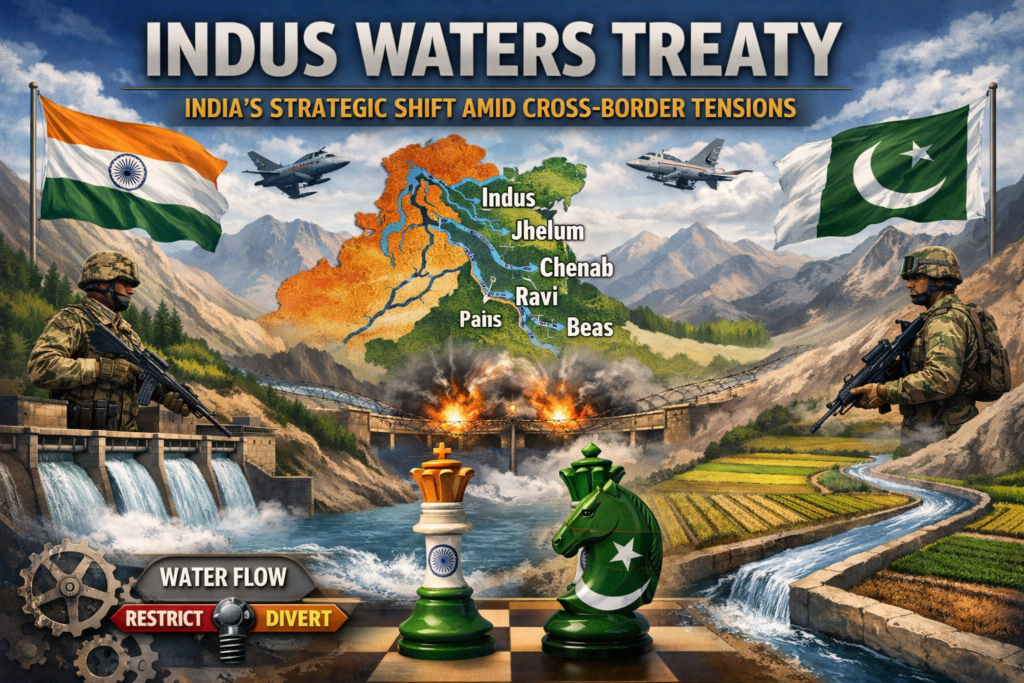
The Indus Waters Treaty, signed in 1960 with the World Bank as a guarantor, has long been a cornerstone of water-sharing between India and Pakistan. Its primary goal was to divide the waters of the Indus river system, ensuring fair usage between the two countries. Under this treaty, the eastern rivers—Ravi, Beas, and Sutlej—were allocated to India, while the western rivers—Indus, Jhelum, and Chenab—were reserved for Pakistan, with India permitted limited use for purposes like domestic needs, agriculture, flood control, navigation, and hydropower.
According to Article III(1) of the treaty, India is obligated to allow the uninterrupted flow of the western rivers to Pakistan. Additionally, the treaty includes provisions for regular exchange of hydrological data, reinforcing transparency and cooperation.
To manage disputes, the IWT outlines a three-stage resolution mechanism:
- Permanent Indus Commission (PIC): A body consisting of one commissioner from each country, mandated to meet annually and resolve technical disagreements.
- Neutral Expert: If the PIC cannot resolve an issue, a neutral expert appointed by the World Bank steps in, offering a binding decision on specific technical matters.
- Court of Arbitration (CoA): For more complex or unresolved disputes, the matter escalates to a tribunal that functions independently, with decisions made by majority vote.
PAHALGAM ATTACK AND INDIA’S RETALIATION
The recent bloodshed in Pahalgam, where at least 26 tourists lost their lives in a hail of gunfire, marks the deadliest militant attack in Indian-administered Kashmir since 2019. Unlike previous incidents targeting security forces, this assault claimed the lives of civilians on vacation in one of India’s most scenic and serene regions. This makes the attack particularly shocking—not just due to the scale of violence, but because it strikes at the heart of a fragile normalcy that India has long sought to establish in the disputed Kashmir region.
Kashmir’s complex legacy—claimed in its entirety by both India and Pakistan, though each governs only a part—means that New Delhi’s response will likely be influenced by both historical precedent and current public and political pressure. A pattern of military responses to previous attacks provides a useful reference. In September 2016, after 19 Indian soldiers were killed in the Uri attack, India responded with what it termed “surgical strikes” across the Line of Control (LoC), targeting what it described as militant launch pads in Pakistan-administered territory.
Similarly, in 2019, after a suicide bombing in Pulwama killed at least 40 paramilitary personnel, India conducted airstrikes in Balakot, targeting an alleged militant training facility. This marked the first Indian airstrike deep inside Pakistan since the 1971 war. In retaliation, Pakistan launched air raids, resulting in an aerial dogfight and the brief capture of an Indian Air Force pilot. Although tensions escalated, both countries stopped short of entering a full-scale war.
Despite these hostilities, India and Pakistan agreed to a ceasefire along the LoC in 2021, which, while not perfect, has largely held, even amid sporadic militant incidents within Indian-administered Kashmir.
Following the recent Pahalgam attack, India has implemented a series of punitive measures against Pakistan, the most consequential being the suspension of the 1960 Indus Waters Treaty. India accuses Pakistan of supporting cross-border terrorism, a claim Islamabad has strongly denied. In turn, Pakistan has issued a stern warning, stating that any attempt to halt water flow from the Indus River system would be seen as an “Act of War”, further inflaming an already volatile situation.
TREATY IN ABEYANCE
The treaty will remain in abeyance until Pakistan permanently and credibly ends its support for cross-border terrorism. This announcement marks a significant shift in India’s policy, especially given the historical resilience of the IWT, which had managed to survive wars and decades of strained relations between the two neighbours.
Unlike previous occasions, where the treaty remained untouched despite heightened tensions, this decision reflects a calculated use of international legal tools. Notably, India has not withdrawn from the agreement, nor has it interrupted the actual flow of water to Pakistan. Instead, it has paused procedural cooperation, signalling a shift towards legal diplomacy, where the emphasis lies on policy restraint rather than disruption of water flows. The term “abeyance” has been used purposefully to highlight that this is a temporary and strategic suspension, not a violation of international obligations.
Despite years of hostilities and recurring conflicts, the mechanisms established under the treaty have functioned effectively. However, the recent suspension demonstrates how legal agreements, even those considered resilient, can be strategically leveraged in response to evolving security threats.
DISPUTE OVER HYDROPOWER PROJECTS AND ARBITRATION ROW
There was a dispute going on between India and Pakistan over the Indus Waters Treaty with concerns raised by Pakistan about the design of two Indian hydroelectric projects—Kishenganga on a tributary of the Jhelum and Ratle on the Chenab River. In 2015, Pakistan approached the World Bank, seeking the appointment of a Neutral Expert to examine these concerns. However, in 2016, Pakistan shifted its position and demanded the initiation of arbitration proceedings instead. India objected to this change, arguing that the treaty requires a step-by-step process for resolving disputes, beginning with the Neutral Expert stage before moving to arbitration if necessary.
Despite India’s objections, on October 13, 2022, the World Bank made an unusual move by simultaneously appointing a Neutral Expert and constituting a Court of Arbitration, responding separately to requests from both countries. India strongly opposed this parallel process, stating that it violated the treaty’s single-track dispute resolution mechanism. As a result, India chose to participate only in the Neutral Expert proceedings and refused to recognise or engage with the Court of Arbitration, which was seated in The Hague.
This legal escalation occurred around the 65th anniversary of the Indus Waters Treaty. India, reflecting a broader shift in its strategic approach, sent formal notices to Pakistan in January 2023 and again in September 2024. These notices called for a full review and possible modification of the treaty, citing changes in geopolitical and hydrological conditions since the treaty was signed in 1960.
In June 2025, the Hague-based Court of Arbitration issued a supplemental award claiming jurisdiction over the disputes concerning the Kishenganga and Ratle projects. On June 27, 2025, India rejected the court’s authority, describing it as “illegally constituted” and lacking legal validity. According to the Ministry of External Affairs, the very formation of the court violated treaty provisions, and therefore, any decisions it issues are inherently void. India reiterated that it never accepted the court’s legitimacy and does not consider its rulings binding.
In response to Pakistan’s arguments during the arbitration, the court examined India’s recent decision to suspend the Indus Waters Treaty following the terror attack. India clarified that placing the treaty in abeyance was a sovereign decision taken under international law, and that a tribunal formed without mutual consent could not judge or override such an action.
India has further accused Pakistan of misusing international legal mechanisms to distract from its ongoing support for cross-border terrorism. The Ministry of External Affairs called the arbitration proceedings a “charade at Pakistan’s behest” and emphasized that Pakistan must irreversibly renounce terrorism before any reconsideration of India’s treaty obligations can be discussed.
India continues to insist that the Neutral Expert route remains the only valid option for resolving the technical disputes raised by Pakistan. It maintains that seeking arbitration alongside the Neutral Expert process is a clear breach of the treaty’s sequential resolution framework, and undermines the integrity of one of the longest-standing international water-sharing agreements in the world.
CONCLUSION
The suspension of the Indus Waters Treaty marks a pivotal moment in South Asia’s diplomatic and security landscape. For over six decades, the treaty stood as a rare example of cooperation between two nuclear-armed neighbours, enduring wars, political upheavals, and diplomatic deadlocks. However, the recent decision by India to place the treaty in abeyance—while not severing water flows—signals a strategic recalibration in response to persistent security threats, particularly cross-border terrorism. This move shows India’s growing emphasis on legal and diplomatic leverage rather than traditional military retaliation alone.
India’s stance reflects the evolving nature of international law and statecraft, where treaties are not merely legal texts but instruments of policy that must adapt to shifting geopolitical realities. The invocation of “abeyance” rather than outright termination illustrates a conscious effort to preserve the framework of the treaty while asserting national interests. At the same time, India’s rejection of the Hague-based Court of Arbitration’s jurisdiction over the Kishenganga and Ratle disputes reflects its firm position on maintaining the treaty’s procedural integrity.
The broader implication of this development extends beyond bilateral relations—it questions the role of international institutions when treaty obligations are interpreted unilaterally. Going forward, the future of the Indus Waters Treaty will likely depend on whether Pakistan takes credible steps to address India’s core security concerns. Until then, India’s actions serve as a cautionary signal that even the most resilient international agreements are not immune to the consequences of unresolved conflict and evolving threats. The balance between cooperation and sovereignty now hangs in delicate uncertainty.
REFERENCES
https://www.britannica.com/event/Indus-Waters-Treaty
https://icct.nl/publication/operation-sindoor-turning-point-india-addressing-terrorism-kashmir
https://www.bbc.com/news/articles/cwynx7kgyqvo
https://www.orfonline.org/expert-speak/indus-treaty-in-abeyance-a-strategic-pause-not-a-legal-breach
https://www.mea.gov.in/bilateral-documents.htm?dtl/6439/Indus