




Abstract
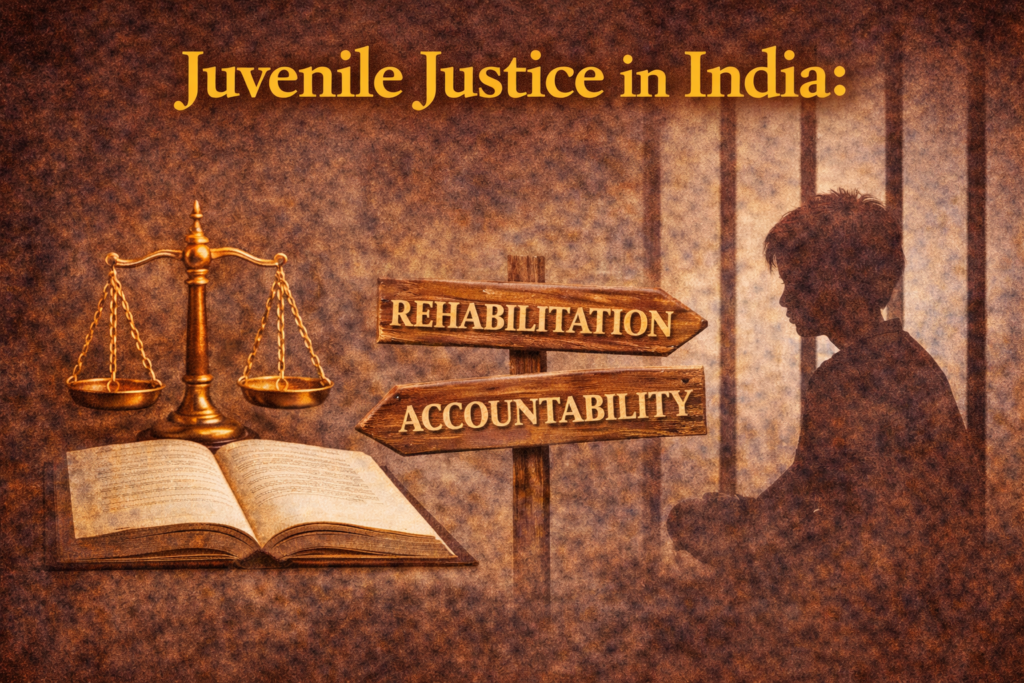
This article examines the evolving landscape of juvenile justice in India, with a focus on the delicate balance between rehabilitation and accountability in a rapidly changing society. It evaluates the legislative framework’s conformity with international commitments like the UN Convention on the Rights of the Child and constitutional mandates, paying particular attention to the Juvenile Justice (Care and Protection of Children) Act, 2015, and its 2021 modification. The article highlights the benefits of the current regime, including child-friendly procedures and a rehabilitative focus, while also identifying key shortcomings such as inconsistent preliminary assessments, infrastructure deficits, and socio-economic bias. Judicial interventions and empirical crime trends are analysed to reveal systemic gaps and implementation challenges. Comparative insights and a reform agenda are proposed to ensure a child-centric, rights-based approach that accommodates public demand for justice without compromising the long-term reintegration of children in conflict with the law.
Keywords: Juvenile Justice, India, Rehabilitation, Accountability, Juvenile Justice Act 2015, Children in Conflict with Law, Supreme Court of India, UNCRC, Restorative Justice, Child Rights, Legal Reform, Preliminary Assessment, Juvenile Crime Trends.
Introduction
India’s juvenile justice system sits at the intersection of child‐rights ideals and societal demands for public safety. Since the Juvenile Justice (Care and Protection of Children) Act, 2015 (“JJ Act 2015”) was passed, legislators have had difficulty balancing the growing public pressure to try 16- to 18-year-olds as adults in cases of serious crime with a rehabilitative mindset.
Recent statutory amendments, empirical data and Supreme Court jurisprudence reveal both the promise and the fragility of India’s child-centric approach. This article evaluates the evolution, achievements and shortcomings of India’s juvenile justice framework and proposes reforms that can realign the system with constitutional and international child‐rights norms while acknowledging legitimate accountability concerns.
Historical Evolution of Juvenile Justice in India
The first national statute was the Juvenile Justice Act 1986, which gave way to the Juvenile Justice (Care and Protection of Children) Act 2000 after India ratified the U.N. Convention on the Rights of the Child (“UNCRC”). The Delhi gang-rape of December 2012, in which one accused was 17, triggered public outrage and spurred Parliament to enact the JJ Act 2015. For the first time, “heinous,” “serious,” and “petty” offences were statutorily differentiated, and Juvenile Justice Boards (“JJBs”) received the power to conduct a preliminary assessment to decide whether a child aged 16-18 should face trial as an adult.
Current Legislative Framework
JJ Act 2015 (as amended 2021)
To remedy a deficiency pointed out by the Supreme Court, the Juvenile Justice (Care and Protection of Children) Act, 2015, along with its 2021 Amendment, inter alia, introduced specific clarifications and structural changes to the legal framework. Moved adoption orders from civil courts to District Magistrates and broadened the definition of “serious offences.”
The Amendment also sought to reduce case backlogs by empowering executive magistracy and to ensure appellate oversight via Divisional Commissioners.
Institutional Architecture
Every district is required to have a Child Welfare Committee (“CWC”) for children in need of care and protection and a JJB for children in legal trouble.
Designated Children’s Courts (Sessions Courts) hear (i) trials of transferred juveniles and (ii) appeals from JJBs and CWCs. The Integrated Child Protection Scheme (ICPS) funds Observation Homes, Special Homes and Places of Safety, while the National Commission for Protection of Child Rights monitors compliance. The framework is constitutionally buttressed by Articles 15(3), 21, 39(e)–(f) and 45, which mandate State protection of children.
- Benefits of the Existing Regime
- Rehabilitation over retribution. The JJ Act codifies proportional, individualized interventions: counselling, vocational training, community service and aftercare support rather than incarceration. Studies indicate that diversionary measures reduce recidivism among first-time offenders.
- Child-friendly due-process safeguards. Proceedings before the JJB are conducted in camera, with psychologists and social workers on the bench and with a statutory bar on handcuffing or the death penalty.
- Victim-centric restorative mechanisms. Section 18 authorises JJBs to order compensation and facilitated apologies, promoting reconciliation.
- Alignment with UNCRC Article 40. India’s framework recognises children’s evolving capacities and right to reintegration, satisfying treaty obligations.
- Persistent Shortcomings
Despite normative strengths, gaps in implementation undermine both rehabilitation and accountability:
- Discretionary and opaque preliminary assessments. Section 15 lacks uniform psychological tools or trained personnel, producing inconsistent transfer decisions.5 The May 2024 Supreme Court ruling that the three-month assessment period is merely directory risks protracted uncertainty for children.
- Infrastructure deficits. Observation and Special Homes remain overcrowded, under-resourced and occasionally violent; only 17 of 35 States/UTs had full complements of statutory bodies as of 2019. The 2021 Amendment’s shift to District Magistrates risks executive overreach without parallel capacity‐building.
- Socio-economic and gender bias. NCRB figures show that a disproportionate share of juveniles in conflict with law come from marginalised backgrounds. Legal-aid quality and age-determination procedures vary sharply, allowing wealthier accused to secure adult-court exemptions.
- Rise in violent offending. The percentage of violent juvenile crimes increased from 32.5% to 49.5% between 2017 and 2022, despite a decrease in overall juvenile crime. Just Maharashtra and Madhya Pradesh were responsible for 38% of all cases.
- Digital-age challenges. The 2024 Pune Porsche disaster, in which the State attempted to trial a 17-year-old as an adult, serves as an example of how cyber-enabled abuse, incitement, and ready access to pornography confound standard diversion strategies.
Judicial Engagement
Indian courts have played an active role in clarifying statutes and balancing rights:
- Shilpa Mittal v. State (NCT of Delhi) (2020) held that offences with no minimum but a maximum sentence exceeding seven years fall outside “heinous offences,” prompting Parliament’s 2021 fix.
- Rahul Kumar Yadav v. State of Bihar. To prevent “hyper-technical” unfairness, Rahul Kumar Yadav v. State of Bihar (2024), it was established that a claim regarding a person’s minor status can be raised at any stage of the legal process, even following a judgment of guilt.
- Child in Conflict with Law through Mother v. State of Karnataka (2024) equated “Children’s Court” with “Court of Sessions,” thereby identifying a uniform appellate forum and imposing a 30-day limit to challenge faulty assessments.
- Unnamed CCL v. State of Karnataka (May 2024) declared the statutory three-month limit for preliminary assessments directory, but insisted that reasons for delay be recorded. While this guards against dismissal for technical delay, it may dilute the child’s right to expeditious determination.
Patterns of Juvenile Offending and the Cost to Society
Beyond moral arguments, juvenile offending imposes sizable direct (medical, policing) and indirect (lost productivity) costs on society. Yet research shows that every rupee spent on high-quality rehabilitation saves multiple rupees in future policing and prison expenditure. Despite this, ICPS grants remain at roughly ₹2 000 per child per month—insufficient for holistic services. Evidence further shows geographic clustering of violent juvenile offences in Central and Western India, necessitating targeted, data-driven interventions.
International Obligations and Comparative Insights
Under the UNCRC, States must ensure respect for children’s dignity and promote reintegration. The Beijing Rules exhort the “least possible use of institutionalisation.” Comparative models, such as New Zealand’s Family Group Conferences or Germany’s suspended sentences with intensive probation, demonstrate that restorative, community-embedded responses can enhance accountability without stigmatisation. India’s statutory scheme already allows Community Service Orders, but rarely employs them due to limited NGO partnerships and judicial unfamiliarity.
- Toward a Child-Centric Balanced Model: Reform Agenda
- Standardise preliminary assessments. The Ministry of Women & Child Development should issue binding guidelines with validated psychological tools, minimum qualifications for experts and videographed proceedings to ensure transparency and appellate review.
- Scale restorative justice pilots. Amend Section 18 to mandate consideration of victim-offender mediation in serious-but-non-heinous cases and fund trained facilitators via ICPS.
- Professionalise statutory bodies. Ring-fence budgets for child psychologists and social workers; require annual certification and performance audits of JJBs and CWCs.
- Integrate digital literacy and mental-health services. Partner with NCERT and CBSE to embed counsellors in government schools and establish cyber-safety hotlines.
- Diversify aftercare and employability pathways. Extend the Yuva Udaan skill-training scheme to all Special Homes and create public-sector apprenticeship quotas for re-integrated youth.
- Data‐driven policy. Mandate NCRB to publish disaggregated juvenile-crime dashboards (age, gender, caste, locality, socio-economic profile) to facilitate targeted prevention.
- Legislative fine-tuning. Restore judicial primacy in adoption orders or, at minimum, require child-rights trained Additional District Magistrates; enhance punitive sanctions for observation-home abuse; and raise ICPS unit costs to reflect inflation.
Conclusion
India’s experiment with a dual-track juvenile justice model, rehabilitative in aspiration yet selectively punitive, remains unfinished. Statutory innovations and Supreme Court vigilance have brought clarity, but implementation deficits, socio-economic bias and emerging digital harms continue to threaten children’s rights and public confidence. A recalibrated framework that honours scientific understandings of adolescent development, strengthens institutions, and embeds restorative justice can reconcile rehabilitation with accountability. “Such reforms are essential for India to uphold its constitutional duty of fostering an environment where every child can grow with well-being, autonomy, and respect.”
Bibliography
- Shilpa Mittal v. State (NCT of Delhi), (2020) 2 SCC 787 (India). org
- Juvenile Justice (Care & Protection of Children) Amendment Act, No. 8 of 2021, § 2, INDIA CODE (2021). org
- Ministry of Women & Child Dev., Integrated Child Protection Scheme: Programme Guidelines (2014).
- Juvenile Justice (Care & Protection of Children) Act, No. 2 of 2016, §§ 41-59, INDIA CODE (2016).
- Why Preliminary Assessment Is Against the Idea of Juvenile Justice, IDR (Dec. 2022). org
- Standing Comm. on Hum. Res. Dev., Rajya Sabha, Report on the Juvenile Justice (Care & Protection of Children) Bill 2015, 4.9 (2015). org
- National Crime Records Bureau, Crime in India 2023, ch. 5 (2024). com
- Teen Was Driving Drunk, Knew Import, Try Him as Adult: State, Times of India (June 24 2025). indiatimes.com
- Shilpa Mittal, supra note 1.
- Rahul Kumar Yadav v. State of Bihar, 2024 SCC OnLine SC 425. in
- Child in Conflict with Law Through Mother v. State of Karnataka, 2024 SCC OnLine SC 612. in
- The Economics of Juvenile Crime, Hindustan Times Insight (Aug. 2023). com
- Convention on the Rights of the Child art. 40, Nov. 20 1989, 1577 U.N.T.S. 3.