




Introduction
Judicial Review is the foremost concept in the Indian Constitution1. Because it preserves the ground rule of law, protects respective rights, and maintains the balance of authority, judicial review is crucial to a republic. The Supreme Court and High Courts of India have been given the crucial authority of judicial review, which enables them to judge whether legislation and executive actions are constitutional2. Thus, authority ensures that no conduct or law can violate the fundamental rights protected by the Constitution. Recognised as a fundamental element of the Constitution’s framework, judicial review protects citizens from arbitrary governance and upholds the rule of law. As such, it acts as a vital check on the nation’s legislative and executive branches.
Meaning of Judicial Review
Judicial review is the process by which the judiciary determines whether the federal and state governments’ legislative and executive actions are legal. The judiciary declares them unlawful, unconstitutional, and invalid (null and void) if it examines them and determines that they violate the Constitution (ultra vires). As so, the government is unable to enforce3 them.
History of Judicial Review
In the United States, the Supreme Court established its power to overturn laws that violated the US Constitution, giving rise to the idea of judicial review. The concept of judicial review was borrowed from the US Constitution and adapted for the Indian setting. The US Constitution serves asone of the foundations for the Indian Constitution. The evolution of judicial review in India was greatly influenced by the U.S. Constitution. India, however, has modified this idea to suit its distinct social structure and constitution. This historical trajectory demonstrates India’s dedication to a vibrant and changing legal system that can handle the intricacies of a populous and diverse democracy.
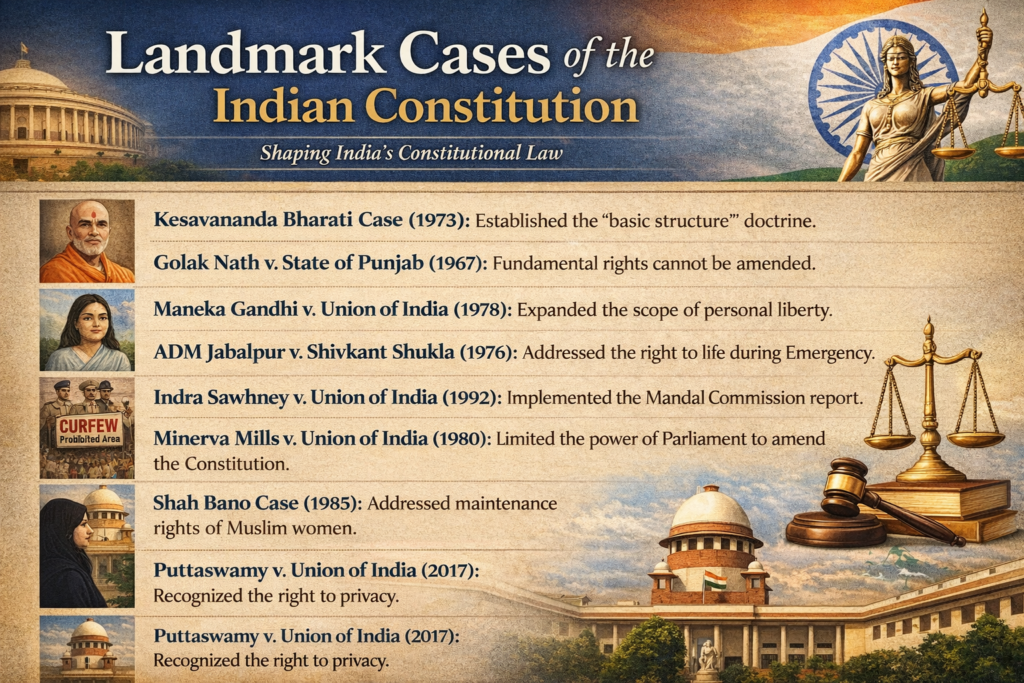
In the 1951 case of Shankari Prasad v. Union of India, the Supreme Court created the power of judicial review for the first time, ruling that the Constitution did not limit the Parliament’s amending authority. However, in kesavanda Bharati v. State of Kerala (1973), the Supreme Court held that the Parliament’s amending power was limited and that the Constitution’s basic framework could not be altered.
Example of Judicial Review
Suppose a law restricting virtual freedom of speech is passed. One could argue that the right to free speech guaranteed by the Indian Constitution is violated by this law. the Supreme Court or High Court may hear their appeal. After reviewing the legislation, the judges would determine if it violates the Constitution. They can overturn it if they believe it to be unconstitutional.
This is an example of judicial review in action, where the judiciary checks the legislative branch’s authority to ensure that laws are just and constitutional.
Scope of Judicial Review
The following grounds6 may be used to contest the constitutionality of a legislative act or executive order before the Supreme Court or the High Court.
- It violates the fundamental rights guaranteed by Part III of the Constitution.
- The authority that framed it has no jurisdiction over it.
- It violates the provisions of the Constitution.
Importance of Judicial Review
Protect the Constitution
- The Nation’s Supreme law is the constitution.
- Judicial review ensures that no legislation or action violates the Constitution’s tenet.
Protects Essential Rights
- It safeguards your fundamental rights, including the freedom of expression, equality, and life.
- You have the right to go to court if the government tries to violate your rights, and the court has the authority to put an end to such actions.
Hold the Government Responsible
- The Executive (Government) carries out the laws that are made by the Parliament.
- Both are prevented from abusing their power by judicial review.
Preserves the Equilibrium of Power
- The legislature, executive branch, and judiciary are the three branches of government in India.
- In order to prevent one branch from growing too strong, judicial review maintains equilibrium.
Respects the Rule of Law
- Everyone is treated equally under the law when there is a rule of law.
- Even the chief minister is required to abide by the law.
- Judicial review ensures that the rules are followed by all.
Types of Judicial Review
- Reviews of Legislative Actions:
- This review includes the power to verify that laws passed by the legislature comply with the Indian Constitution7 of 1950.
- Review of Administrative Actions:
- This is a tool for enforcing constitutional discipline over administrative agencies while exercising their powers.
- Review of Judicial Decisions:
- Allows courts to revisit and correct their own decisions under specified circumstances8.
Constitutional Provision of Judicial Review
- The Constitution contains no explicit or direct clause allowing the courts to declare something invalid.
- The Constitution contains several clauses that support the judicial review process, including
- Article 372 (1): The judicial review of pre-constitution laws is established.
- Article 13: Declares that any legislation that violates any of the Fundamental Rights clauses is null and void.
- Articles 32 and 226: Assigns the Supreme and High Courts the responsibility of safeguarding and defending fundamental rights.
- Articles 251 and 254: The state law will be null and void if the union and state laws are inconsistent.
- Article 246 (3): Guarantees the exclusive authority of the state legislature on issues relating to the State List.
- Article 137: Grants the SC the unique authority to examine every ruling or directive it issues. Only in cases where flaws are evident in the record can an order issued in a criminal case be reviewed and overturned.
By whom can judicial review be carried out?
Judicial review is the theory that the judiciary uses to analyze legislative and executive actions. Although India adheres to the idea of separation of powers for the executive, legislative, and judicial branches of government, the judiciary is nevertheless empowered to examine the activities of the other two branches.
The Supreme Court of India and the High Courts are both able to conduct judicial review. Article 32 and Article 136 of the Indian Constitution, as well as Articles 226 and 227 with regard to the High Courts, grant the courts the authority to conduct judicial reviews.
Limitation of Judicial Review
Even while India’s judicial review system has a wide reach, it does have some restrictions. The President, Governors, and Supreme Court and High Court judges are granted specific privileges and immunities under the Constitution. Unless these people have acted in their individual capacity, the courts are unable to investigate their actions.
Furthermore, unless the executive’s policy choices violate the Constitution, the courts are not allowed to get involved. As long as the government makes a policy decision that complies with the Constitution, the courts are also not allowed to dispute its wisdom or appropriateness.
Landmark Cases of Judicial Review
Keshwanand Bharti v. Union of India (1973):
This case is considered to be one of the most significant cases in the history of judicial review in India. In this instance, it was decided that nothing that contradicted the fundamental framework of the constitution may be excluded from judicial examination.
Vishaka v. State of Rajasthan (1997):
In this case, the Supreme Court ruled that sexual harassment in the workplace violates women’s basic rights. In order to prevent and address workplace harassment, the court established guidelines for employers.
Maneka Gandhi v. Union of India (1978):
In this case, the Supreme Court ruled that Article 21 of the Constitution’s surety of individual liberty contained the right to travel overseas. This ruling broadened the definition of the right to personal liberty and shielded it from capricious government limitations.
A.K. Gopalan v. State of Madras 1950
In this case, it was the first significant ruling to interpret the Indian Constitution’s fundamental rights. created a limited and formalist interpretation of Article 21. Maneka Gandhi v. Union of India (1978), in which the Supreme Court expanded the interpretation of Article 21 to encompass due process and a fair, just, and reasonable procedure, later overturned the ruling in spirit.
Minerva Mills Ltd. v. Union of India
The Constitution’s supremacy, checks and balances, and individual liberties against governmental excess were all upheld in the historic Minerva Mills ruling. It continues to be a fundamental case in the basic structure concept and a pillar of Indian constitutional law.
The Constitution’s supremacy, checks and balances, and individual liberties against governmental excess were all upheld in the historic Minerva Mills ruling. It continues to be a fundamental case in the basic structure concept and a pillar of Indian constitutional law.
I.R. Coelho v. State of Tamil Nadu (2007)
The Supreme Court of India ruled in I.R. Coelho v. State of Tamil Nadu (2007) that courts have the authority to evaluate statutes added to the 9th Schedule after April 24, 1973, the date of the Keshavananda Bharati ruling. The judiciary has the authority to overturn these laws if they infringe upon the Constitution’s Basic Structure or Fundamental Rights.
This judgment emphasised that no law, including one listed in the 9th Schedule, supersedes the Constitution and that judicial review is a fundamental component of the Constitution.
Conclusion
In Conclusion, the Indian Constitution’s judicial review system is a crucial component that guarantees that the laws enacted by the legislature and the executive branch operate in accordance with the document. Any statute that violates the Constitution can be overturned by the courts, and they can also grant writs to defend citizens’ fundamental rights. Judicial review has a wide range of applications, but it also has some restrictions that are required to preserve the balance between the legislative, executive, and judicial branches of government.
1Judicial Review ensures democratic accountability and legal compliance.
2Article 32 and 226 of the constitution empower the courts to enforce rights,
3Defined in various rulings including L. Chandra Kumar v. Union of India
4The doctrine of “ultra vires” applies
5AIR 1973 SC 458
6Derived from constitutional principles and court decisions
7State of Madra v. V.G. Row clarified the standard of reasonableness
8Article 137 provides this review power the SC.