


This article has been written by Kilimi Praneeth Reddy a law student pursuing the B.A. LL.B. (Hons.) program at Dr. Ram Manohar Lohiya National Law University (RMLNLU), Lucknow.


Abstract
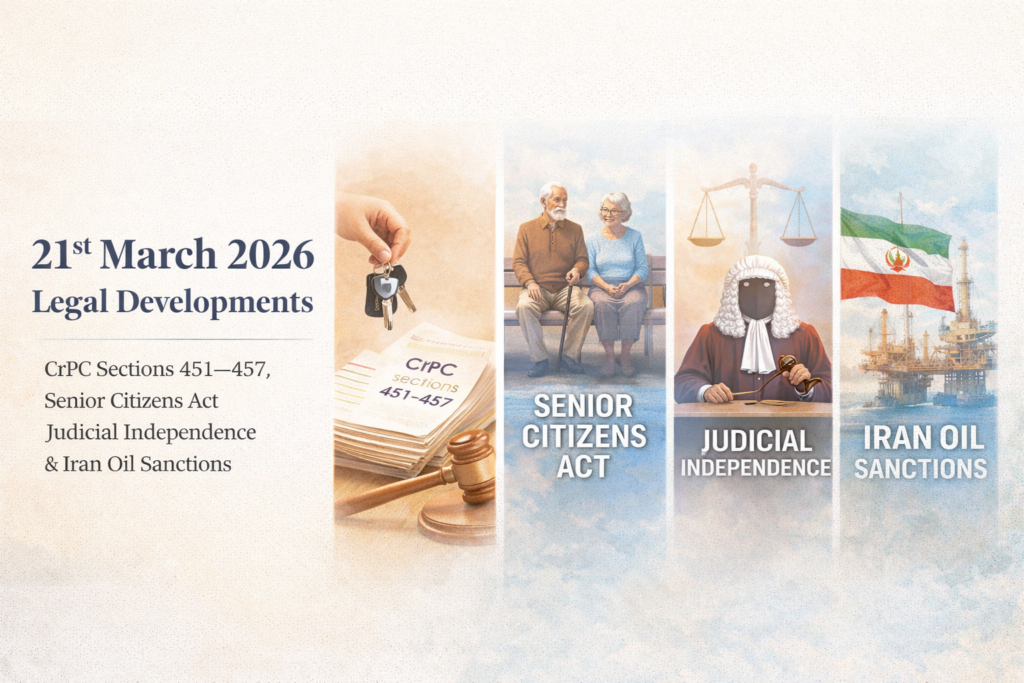
The recent legal developments reflect a combination of domestic judicial principles and evolving global regulatory dynamics. Within India, the Karnataka High Court reiterated under Sections 451 and 457 of the CrPC that seized property should not remain unnecessarily in police custody, emphasising a practical and rights-oriented approach. The Allahabad High Court clarified that the Maintenance and Welfare of Parents and Senior Citizens Act, 2007, cannot be used to resolve property ownership disputes, reaffirming the jurisdiction of civil courts in such matters.
At the institutional level, concerns raised by Justice Dipankar Datta regarding the failure of the collegium system to protect upright judges highlight issues of judicial independence, while Justice B.V. Nagarathna pointed to systemic causes of judicial delay, including excessive government litigation and infrastructural limitations.
Alongside these domestic developments, the U.S. decision to temporarily waive sanctions on Iranian oil reflects the growing intersection of international economic sanctions, geopolitical conflicts, and global energy regulation. Such measures influence global oil markets and have indirect legal and economic implications for countries like India, which are heavily dependent on energy imports.
Taken together, these developments demonstrate how law today operates across both national judicial frameworks and international regulatory environments, shaping governance, rights, and economic stability.
Keywords: Interim Custody, CrPC Sections 451–457, Senior Citizens Act 2007, Collegium System, Judicial Independence, Judicial Pendency, Economic Sanctions, Global Energy Law
Sanctions, Sea Routes s Global Energy Law: U.S. Waiver on Iranian Oil Amid Strait of Hormuz Crisis
Background and Recent Development
In a significant geopolitical and legal development, the United States issued a 30-day sanctions waiver (March 20–April 1G, 2026) allowing the sale of Iranian crude oil and petroleum products already loaded on vessels at sea. This marks the third such temporary relaxation within two weeks, reflecting the urgency to stabilise global energy markets amid rising tensions due to the ongoing U.S.-Israel conflict with Iran.
The U.S. Treasury clarified that this waiver aims to ease global energy supply pressures and control rising oil prices. Notably, the move comes at a time when Iran has blocked the Strait of Hormuz, a critical maritime route through which nearly 20% of global oil trade passes, causing severe disruption in international energy supply chains.
Legal Nature of Sanctions and Waivers
Sanctions imposed by the United States are based on its domestic legal framework, particularly laws governing economic emergency powers and foreign policy control. These sanctions prohibit trade in Iranian oil globally, even affecting non-U.S. entities, thereby creating what is known as extra-territorial application of law.
The present waiver is legally significant because:
- It shows that sanctions are not absolute, but flexible
- It reflects how executive power can temporarily override restrictions through general
- It raises questions about legal certainty in international trade, as businesses must constantly adapt to changing regulatory
International Law and Maritime Implications
The issue also directly involves international maritime law, especially principles under the law of the sea. The Strait of Hormuz is an international transit passage, and blocking it raises serious concerns regarding:
- Freedom of navigation
- Global trade rights
- Energy security obligations of States
Iran’s blockade and the U.S. response through sanctions and waivers highlight a tension between:
- State sovereignty and security interests, and
- Global Commons and International Trade Obligations
Geopolitics of Energy and Legal Strategy
Energy resources, especially oil, have always shaped global power relations. The present situation reflects how law is being used as a strategic tool (lawfare) in international politics.
The U.S., being both a major producer and consumer of oil, is attempting to:
- Control global oil prices
- Influence supply chains
- Maintain strategic dominance in West Asia
Interestingly, the disruption in West Asia has also made Russia a key alternative supplier, despite existing sanctions on it. This shows how legal sanctions can unintentionally reshape global markets.
Impact on India and Other Import-Dependent Nations
India is the second-largest importer of crude oil and is highly dependent on energy imports from West Asia. The closure of the Strait of Hormuz and fluctuating sanctions regimes directly impact:
- Oil prices in India – leading to inflation
- Trade policies – balancing relations with S., Iran, and Russia
- Energy security strategies – diversification of supply sources
India has previously navigated similar situations by importing discounted Russian oil, showing a pragmatic approach within legal constraints.
Critical Legal Issues Emerging
This development raises several important legal questions:
- Can domestic laws like S. sanctions legitimately control global trade?
- Does blocking international waterways violate international law norms?
- How should countries balance sovereignty vs global obligations?
- What is the role of law in managing economic and geopolitical conflicts?
Conclusion
The U.S. sanctions waiver on Iranian oil, in the backdrop of the Strait of Hormuz crisis, highlights the complex intersection of international law, economic sanctions, maritime rights, and global energy politics,demonstrating how legal mechanisms are increasingly used as strategic tools influencing both global markets and national policies, especially for countries like India.
“Seized Valuables Cannot Lie Idle”: Karnataka High Court on Interim Custody Amid Rival Claims
Background and Facts
In a significant ruling on criminal procedure and property rights, the Karnataka High Court addressed the issue of interim custody of seized valuables in a cyber fraud case involving the Reward360 platform. The case arose after a hacker was accused of fraudulently acquiring digital vouchers and converting them into physical assets such as gold (5.2 kg), silver (27.25 kg), and cash (₹11.13 lakh). These valuables were seized by the police during the investigation.
Both the accused and the complainant company (Reward360) filed applications seeking interim custody of these seized articles. However, the Magistrate Court rejected both applications on the ground that ownership was disputed and not conclusively established.
High Court’s Decision
Justice Mohammad Nawaz of the Karnataka High Court set aside the Magistrate’s order and granted interim custody of the seized valuables to the accused, while rejecting the claim of the complainant company.
The Court clearly held that valuable property should not remain in police custody for an indefinite period, especially when such items are prone to damage, misuse, or loss.
The Court observed:
“Continued retention of valuable articles such as gold and silver in police custody serves no useful purpose and may, in fact, result in misuse or loss.”
Key Legal Principle Explained
The Court relied on established principles under Sections 451 and 457 of the Code of Criminal Procedure (CrPC), which aim to ensure that seized property is properly managed and not unnecessarily detained during investigation or trial.
It reiterated that:
- At the stage of granting interim custody, the Court only needs to form a prima facie opinion about who is the appropriate person to hold
- A detailed inquiry into ownership is not required at this Importantly, the Court clarified:
“The existence of rival claims or absence of conclusive proof cannot, by itself, be a ground to reject an application for interim custody.”
Reasoning of the Court
The High Court pointed out several errors in the Magistrate’s approach:
- The Magistrate wrongly treated the issue as a final determination of ownership, which is not required at this
- Earlier, the same court had already released some seized items (like motorcycles) to the accused, so refusing other items without distinction was unjustified.
- The complainant company failed to produce prima facie evidence (like transaction records or bank statements) to establish a direct link between the seized valuables and the alleged fraud.
The Court also rejected the argument that a pending investigation justifies indefinite retention, stating that such reasoning defeats the purpose of procedural law.
Legal Significance
This judgment reinforces important principles in criminal law:
- Protection of property rights even during an investigation
- Prevention of misuse or deterioration of seized assets
- Clarification that interim custody is procedural, not determinative of ownership
- Emphasis on judicial consistency and fairness
It also strengthens the precedent laid down in Sunderbhai Ambalal Desai v. State of Gujarat (2002), where the Supreme Court had similarly held that seized property should not be kept idle in police custody.
Conclusion
The Karnataka High Court’s ruling underscores that seized valuables cannot be kept indefinitely in police custody merely due to disputed ownership, and that courts must adopt a practical and prima facie approach while granting interim custody, ensuring both protection of property and fairness in criminal proceedings.
Senior Citizens Act Not Meant For Property Title Disputes: Allahabad High Court Clarifies Scope
Background and Facts
In an important ruling clarifying the scope of welfare legislation, the Allahabad High Court held that the Maintenance and Welfare of Parents and Senior Citizens Act, 2007 cannot be used to decide property ownership or title disputes between unrelated parties.
The case arose when the petitioner, a senior citizen, approached authorities seeking protection of his property under Section 22 of the Act, alleging that another व्यक्ति (who had purchased part of the same land) was trying to encroach upon his portion. The dispute
essentially involved rival claims over ownership and possession of land, with both parties deriving title from different sale deeds relating to a common property.
Court’s Key Observation
Justice Subhash Vidyarthi clearly rejected the use of the Senior Citizens Act in such disputes and held:
“The protection of property of senior citizens would not extend to deciding rival claims regarding title of immovable property, which can only be done by a competent civil or revenue court.”
The Court emphasised that ownership disputes require a detailed examination of evidence, which is not possible under the summary procedure prescribed under the Act.
Purpose and Scope of the Act Explained
The Court examined the object and purpose of the Senior Citizens Act and clarified that:
- The Act is meant to ensure maintenance and welfare of senior citizens, especially by their children or relatives who may inherit their
- It provides a speedy and summary mechanism for protection of life and property, but not for the adjudication of complex legal disputes. The Court highlighted that:
- Proceedings under the Act do not involve detailed trial procedures like framing of issues, recording of evidence, or cross-examination.
- Therefore, such forums are not competent to decide questions of title or ownership, which require a full-fledged civil
On Sections 22 and 27 of the Act
The petitioner relied on Section 22, which empowers authorities to protect the life and property of senior citizens. However, the Court clarified:
- Section 22 only enables administrative protection, not adjudication of ownership
- Authorities like District Magistrates cannot decide competing claims over
Regarding Section 27, which bars civil court jurisdiction in certain matters, the Court held:
- This bar applies only to matters covered under the Act (like maintenance).
- It does not exclude civil courts’ jurisdiction over property disputes, especially between unrelated
Reasoning of the Court
The Court gave strong reasoning for rejecting the petition:
- The dispute was purely a property/title dispute between third parties, not a case of neglect or exploitation by
- The matter was already pending before revenue authorities, making intervention under the Act
- Deciding such disputes in a summary manner would violate principles of natural justice, as parties would not get a full opportunity to present
Legal Significance
This judgment is important because it:
- Clearly limits the misuse of welfare legislation like the Senior Citizens Act
- Reinforces the principle that special statutes cannot override civil law procedures for property disputes
- Protects the jurisdiction of civil and revenue courts in matters requiring detailed adjudication
- Ensures that the Act remains focused on its true objective protection and maintenance of senior citizens
Conclusion
The Allahabad High Court’s ruling firmly establishes that the Senior Citizens Act, 2007, is a welfare legislation meant for maintenance and protection, not for resolving property ownership disputes, and that such disputes must be adjudicated only by competent civil or revenue courts through proper evidentiary proceedings, ensuring fairness and due process.
“Collegium Must Protect Upright Judges”: Justice Dipankar Datta Raises Concern Over Judicial Independence”
Background and Context
In a significant and candid observation on judicial governance, Justice Dipankar Datta of the Supreme Court highlighted concerns regarding the functioning of the Collegium system, particularly its role in protecting judges who act with integrity and courage. He made these remarks while speaking at the Supreme Court Bar Association National Conference 2026 on the theme of “Reimagining Judicial Governance.”
Key Observations by the Court
Justice Datta expressed concern that there have been instances where judges who displayed moral courage and righteousness were not adequately supported by the Collegium. He warned that such situations could discourage judges from taking independent and principled decisions, especially when such decisions may affect their career progression.
He observed:
“There have been instances where those who acted with righteousness were not protected by the Collegium… this may discourage judges from prioritising ethics over career growth.”
He further questioned whether judges today would be willing to prioritise ethics over elevation or career advancement, calling it a “bitter pill to swallow.”
Appeal to the Collegium
Justice Datta made a direct appeal to the Collegium, urging it to stand by and protect judges who act with integrity, even if their decisions are unpopular or inconvenient to those in power.
Referring to Justice B.V. Nagarathna’s earlier remarks that judges must act according to their conscience regardless of consequences, Justice Datta emphasized that such judges must be institutionally supported, not left vulnerable.
Merit-Based Judicial Appointments
Justice Datta also addressed the broader issue of judicial appointments, stressing that selection of judges must be based strictly on:
- Merit and competence
- Integrity and temperament
- Judicial work, judgments, and professional record
He strongly cautioned against the influence of:
- Personal affiliations
- Lobbying
- Informal recommendations
- Proximity to power (judicial or political)
He emphasised that objectivity and transparency must be the foundation of judicial appointments.
Collegium System and Constitutional Perspective
In defending the Collegium system against criticism, Justice Datta invoked Dr. B.R. Ambedkar’s principle that the success of any constitutional system depends on the people implementing it. He suggested that the issue is not merely structural but depends on whether decision- makers act fairly and responsibly within the system.
Judicial Pendency and Structural Issues
Justice Datta also highlighted systemic challenges contributing to judicial backlog, noting that the judiciary is often unfairly blamed despite:
- Inadequate judge-to-population ratio
- Delay by the executive in judicial appointments
- Insufficient judicial infrastructure
He suggested increasing the strength of the Supreme Court to at least 40 judges, considering the rise in case filings.
Legal Significance
This development is important in the context of:
- Judicial independence and accountability
- Transparency in judicial appointments
- Institutional responsibility of the Collegium
- Ethical standards in judicial functioning
It also reopens the debate on whether reforms are needed in the Collegium system or in its functioning.
Conclusion
Justice Dipankar Datta’s remarks underline that the credibility and independence of the judiciary depend not only on institutional structures like the Collegium but also on its ability to protect honest judges and ensure merit-based appointments, thereby reinforcing public trust and strengthening the rule of law.
“Judges Don’t Vacation, They Work”: Justice B.V. Nagarathna Highlights Judicial Burden’s Systemic Causes of Delay
Background and Context
In an important reflection on judicial functioning, Justice B.V. Nagarathna of the Supreme Court highlighted the intense workload and structural challenges faced by judges while speaking at the Supreme Court Bar Association National Conference 2026 on judicial governance. Her remarks focused not only on the working conditions of judges, but also on the systemic reasons behind judicial delays and pendency in India.
Judges’ Work Beyond Court Hours
Justice Nagarathna clarified a common misconception regarding court vacations, stating that judges do not treat vacations as leisure time but use them for writing judgments and clearing pending work.
She explained:
“Morning till evening, judges are in court hearing cases. It is only after court hours, late nights, weekends and even vacations that they get time to write judgments.”
She emphasised that the role of a judge is dual in nature, adjudication during court hours and judgment writing afterwards, making judicial work continuous and demanding.
Government as the Largest Litigator
A major cause of judicial backlog, according to Justice Nagarathna, is the government itself being the largest litigant. She pointed out that instead of acting as a “model litigant,” the State often continues litigation unnecessarily.
She observed:
“The government publicly expresses concern about judicial backlog while simultaneously feeding that backlog through relentless litigation.”
She explained that bureaucratic systems incentivise officials to file appeals rather than settle disputes, since:
- Filing appeals is seen as “safe” and diligent
- Settling disputes may attract audit or vigilance scrutiny
- As a result, cases that should end at lower levels continue up to higher courts, increasing
Structural Issues in the Judicial System
Justice Nagarathna identified deeper systemic problems contributing to delays:
- Lack of judicial infrastructure investment
- Low political priority for courts compared to other sectors
- Mismatch between increasing disputes and limited court capacity.
She stated:
“The volume of disputes grows with population and economic activity, but the institutional capacity of courts grows slowly.”
Stakeholder Behaviour and Delay
She also analysed how different stakeholders contribute to delays:
- Litigants benefit from maintaining status quo
- Lawyers benefit from adjournments and prolonged hearings
- Government departments prefer appeals to avoid accountability
- Judges act cautiously to avoid reversal on appeal
She described this as a systemic problem, where individually rational actions collectively slow down justice delivery.
Suggested Reforms
To address these issues, Justice Nagarathna suggested:
- Establishment of a Judicial Reforms Commission with participation from the judiciary, bar, and government
- Modernisation of notice service, including the use of digital tools like WhatsApp and electronic communication
- Structural reforms rather than relying only on behavioural changes
She stressed that delays cannot be solved merely by expecting better conduct but require institutional and procedural reforms.
Legal Significance
This development is important because it highlights:
- The real working conditions of judges
- The true causes of judicial backlog are beyond courts alone
- The need for system-wide reforms in justice delivery
- The role of the State in both causing and criticising delays
It also contributes to ongoing debates on judicial efficiency, infrastructure, and reform mechanisms.
Conclusion
Justice B.V. Nagarathna’s remarks bring out that judicial delays are not merely due to inefficiency of courts but are rooted in systemic issues involving government litigation, infrastructure gaps, and stakeholder behaviour, and therefore require comprehensive structural reforms along with technological modernisation to ensure timely justice delivery.
Conclusion
The developments highlight that law is not confined to courtroom adjudication but extends to institutional governance and global regulatory frameworks. Indian courts have reaffirmed the importance of procedural fairness, proper jurisdiction, and purposive interpretation of welfare laws, ensuring that justice is not defeated by technicalities or misuse of statutes. Simultaneously, judicial observations on the collegium system and pendency of cases underline the urgent need for systemic reforms, greater accountability, and improved infrastructure to strengthen the justice delivery system.
On the international plane, the U.S. sanctions waiver on Iranian oil demonstrates how legal instruments such as economic sanctions are used as tools of geopolitical strategy, directly impacting global markets and indirectly affecting countries like India through energy security and price stability.
Thus, these developments collectively show that an effective legal system today must balance domestic judicial efficiency with awareness of global legal and economic shifts, ensuring that law remains responsive, adaptive, and capable of addressing both national and international challenges.