


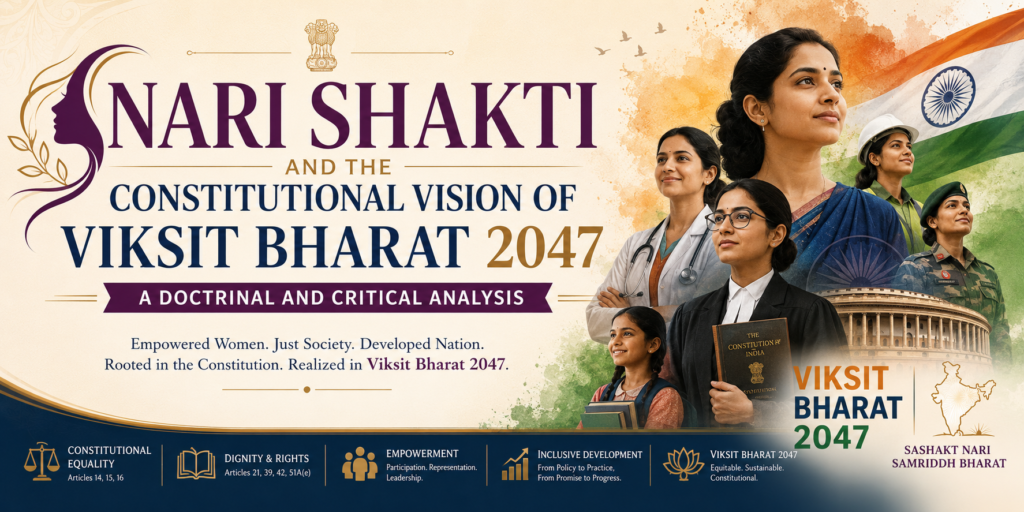
This article has been written by Shubhanker Tiwari, from CMP Degree College, University of Allahabad. (This article has been selected for LegalOnus Law Journal (LLJ))
Introduction:
The issue of women’s empowerment has become part of the long-term development agenda in India and especially the vision of Viksit Bharat 2047, which aims at making India a developed, inclusive, and equitable country by the centenary year of independence. The central aspect to this vision is the concept of Nari Shakti, a concept that emphasizes the potential, inherent powers and capacity of women as a source of social, economic and political change. Even though Nari Shakti is receiving more recognition in the public discussion and governmental initiatives, its real value lies in its constitutional guidelines and legal connotations. The constitutional view of women’s empowerment is therefore necessary to determine whether the interests of development in India are anchored in rights that are enforceable or are simply an idealistic option (Austin, 1966).
The Indian Constitution provides a robust normative framework in order to encourage gender parity and female empowerment. Since its creation, the Constitution aimed at dismantling entrenched social hierarchies and patriarchal systems, as all citizens were granted equality and dignity as well as justice. Article 14 and Article 15 complement one another and build on the principle of equality before the law, as well as equal protection of the laws, which is the foundation of constitutional government (Constitution of India, art. 14). This core principle is reinforced by Article 15, which outlaws any discrimination based on sex and, at the same time authorises the State to make special provision under Article 15(3) for women as inequality still persists (Constitution of India, art. 15).
Empowerment of women in the Constitution does not deal only with abstract equality, but it goes further to the involvement in social and economic life and opportunities. Article 16 provides an equal opportunity when it comes to public employment, which contrasts with the previous welfare-based approach to empowerment-based approach that consider women as the active participants in governance and development (Constitution of India, art. 16). Judicial interpretation has always stressed the fact that an equal opportunity must be free from systemic and institutional oppression that retards the agenda of the women in the scheme of governance and development including discriminatory practices, social conditioning, and unequal sharing of unpaid care work.
Article 21 is further extended to the constitutional vision of Nari Shakti as the judiciary has broadly read and interpreted it to mean the right to live with dignity, autonomy and freedom free of violence and coercion. In a decided number of landmark judgments, the Supreme Court has recognised that the empowerment of women is inextricably tied to bodily autonomy, privacy and the ability to be free of violence and coercion. This rights-based approach places the protectionist laws in the back seat and puts the empowering type of jurisprudence in the forefront where women are recognized as having the requisite choice-making power if those choices are made in an informed manner. This kind of realization is vital in the harmonization of constitutional values with modern issues of women in the the workplace and the internet.
Besides Fundamental Rights, the Directive Principles of State Policy are also instrumental in defining the constitutional idea of women empowerment. Article 39 advises the State to equal pay for equal work, equal means of livelihood, protecting and sustaining the health and strength of women, as required by the principles of equality (Constitution of India, arts. 39, 42) where Article 42 reflects just and humane terms of work and maternity leave, that women face in the labour market.
There is a new dimension in which the Nari Shakti constitutional promise is reflected on the Viksit Bharat 2047 context. A sustainable economic growth, democratization, and social justice cannot be achieved without the equal and greater engagement of women. Nevertheless, even in the wake of liberal constitutional clauses and judicial declarations, there is an enormous disparity between the law and practice. The entrenched patriarchal standards, disproportionate application of legislation, and institutional inertia are still holding in empowering women. This has consistently been highlighted by the Supreme Court that constitutional morality has to be seen as overridden by social morality in cases in which the latter perpetuates discrimination or exclusion. This theory is especially applicable to the promotion of Nari Shakti in areas that have all aspects of custom and societal inclination resistant to legal change.
This introduction thus comes as the stand that Nari Shakti is not merely a political slogan or institutional stasis but a socially constructed constitutional vision that needs institutional responsibility and institutional change. This chapter works on the assumption that it will be necessary to go beyond the symbolic inclusivity to substantively and transformative in line with realising the constitutional vision of Viksit Bharat 2047. The following paragraphs critically look at how the constitutional interpretation, legislative action and systems of governance have tried to bring this vision to life and the areas where this has failed.
Women’s Empowerment in the Constitutional Context and Judicial Interpretation.
Judicial interpretation has influenced the Constitution; however, it has made abstract equality guarantees enforceable by including women in the constitutional arena in India. Even after it is textually enshrined in the Constitution, the judges have ensured that Nari Shakti is being brought into practical cause of action through purposive and progressive interpretation with reference to the Constitution by the Supreme Court of India more so. Judicial involvement with gender justice in the Viksit Bharat 2047 context is given an increased urgency, since courts, as constitutional watchmen safeguard the rights of women in the developmental objectives of an economic or administrative efficiency (Baxi, 1980).
The article 14 is an essential component of equality which via its non-arbitrariness doctrine, is the core of constitutional adjudication over the rights of women. According to the Supreme Court (E.P. Royappa v. State of Tamil Nadu, 1974) equality is not related to treating everyone equally only but involves addressing structural and systemic disadvantages faced by women. The Supreme Court theorised the concept of equality as the opposite to arbitrariness therefore providing the basis upon which discriminatory state action is appraised even in cases where classification is not explicit, specifically on employment, education, and access to public resources by women.
Article 15 has been decisive in defining affirmative action for women. Although Article 15(1) is explicit that no discrimination should be made based on sex, Article 15(3) expressly empowers the State to engage in special provision for women, but this has enhanced the judicial interpretation of such provision as not a breach of equality, but supplementary justice. In Government of Andhra Pradesh v. P.B. Vijayakumar (1995), the Supreme Court affirmed quotas in favour of females in government jobs saying that Article 15(3) is an enabling provision aimed at counterbalancing social and economic inequalities that affect women and thus cannot be counteracted solely by the notion of formal equality.
The judiciary has additionally broadened the area of Article to matters that are fundamental to women’s autonomy and dignity. In Maneka Gandhi v. Union of India, the Court construed the right to life as relating to a wide variety of rights, the lack of which would make an existence dignified. This broad interpretation has played a key role in future gender justice jurisprudence. In Francis Coralie Mullin v. Union Territory of Delhi, it was stated that any statute that undermines human dignity contravenes Article 21 of the Constitution and is unconstitutional and for women, this jurisprudence has become constitutional or lawful protection against violence, coercion, and arbitrariness by the state.
The acknowledgement of sexual harassment in the workplace as a significant breach of basic rights became one of the key achievements in constitutional feminism. In Vishaka v. State of Rajasthan, the Supreme Court concluded that sexual harassment violates Articles 14, 15, and 21, and presented binding principles where legislation was not taken. The case is an example of how the judicial interference can turn the constitutional principles into practical protection of dignity and equality of the women. Notably, Vishaka too manifests the readiness of the Court to use the international conventions including CEDAW to strengthen the domestic constitutional interpretation.
Proceeding on judicial interpretation, it has gone to provide decisional autonomy of women in intimate and personal issues. In Justice K.S. Puttaswamy v. Union of India, Supreme Court declared privacy rights as being fundamental to life and liberty, a move that has a tremendous impact on the empowerment of women in the context of reproductive choice, physical integrity, as well as non-invasive state control. Later in Navtej Singh Johar v. Union of India, the Court emphasized the fact that constitutional morality should prevail over social morality, and such a principle is paramount when it comes to breaking the norms of patriarchy that limit the free will of women.
The court system has not only dealt with the gender stereotypes of the legal system itself. In Anuj Garg v. Hotel Association of India, Supreme Court invalidated protective labour laws which prevented women from working in alcohol-sale organisations citing the archaic ideals of bygone days, denying women their agency, on the ground that such legislation contradicted the constitutional principles. In Anuj Garg v. Hotel Association of India (2008) this strategy is an indication that the approach has shifted away from protectionism to one of empowering and this is where the judicial reasoning is in tandem with the transformative desires of Nari Shakti.
These developments notwithstanding, judicial interpretation has not been achieved without limitations. Judicial systems are frequently restricted in their actions by the law and executive policy, and the making of progressive decisions is often difficult to implement. In addition, judicial remedies are not enough to break the strong-based socio-cultural obstacles. However, constitutional jurisprudence has been imperative in providing a vision of women empowerment based on dignity, autonomy, and substantial equality. With India embarking on Viksit Bharat 2047, future studies of constitutional feminism by the judiciary will not be dispensable in any way to make sure that development does not compromise gender justice.
Legislative and institutional mechanisms of promoting Nari Shakti
Though the normative basis of empowerment of women is constitutional guarantees and judicial interpretation, the realisation of Nari Shakti requires a significant role played by legislative intervention and institutional processes. Parliament, in its legislative capacity, has made various laws to deal with institutionalised inequalities against women both in the social and the domestic life. The laws are then institutionalised with the view of bringing into effect the constitutional directives in Articles 14, 15 and 21 and the Directive Principles of State Policy of forceful operationalisation. The efficiency of such mechanisms needs to be considered, however, against the context of systematic gaps in implementation and transforming socio-economic facts (Constitution of India, arts. 14–15, 21, 39, 42).
Protection of Women from Domestic Violence Act 2005 is one of the greatest legislative interventions that have been made in the furtherance of women dignity and autonomy. The Act takes a simple and comprehensive interpretation of domestic violence implying that it includes physical, emotional, sexual and economic abuse (Protection of Women from Domestic Violence Act, 2005). The legislation is consistent with Article 21 that includes the guarantee of dignity because by acknowledging that domestic violence is a breach of the constitutional rights of women, the legislation is thus consistent with the Article 21. This rights-based approach has been supported by judicial interpretation in which the courts have insisted that the Act should be interpreted liberally in ensuring that it meets its protective objective (V.D. Bhanot v. Savita Bhanot, 2012). Although the Act has a progressive structure, the issues of insensitivity, under-reporting, and inefficient institutional support still hinder its transformational nature.
Certain reforms that have been made in relation to sexual offences have been instrumental in boosting Nari Shakti in the field of criminal law. Constitutional values of dignity and equality as enshrined in the constitution through judicial rulings in available cases dealing with sexual violence led to changes in the Indian Penal Code following the Criminal Law (Amendment) Act, 2013 which broadened the definition of sexual offences and increased penalties towards any crimes against women (Law Commission of India, 2014).
Another important aspect of women empowerment is labour and employment laws. The Maternity Benefit Act, 1961, which was amended in 2017, extended maternity leave and provided arrangements in creche facilities (Maternity Benefit [Amendment] Act, 2017). These are based in the constitutional requirements at Article 42 which envisions just and humane terms of work and maternity relief (Constitution of India, art. 42). Although such amendments were well received, opponents mention such an outcome as unintentional hindrances to hiring female staff to the private sector, which provokes the necessity to introduce complementary policies like shared parental leave and working arrangements.
One of the major positive changes in the field of workplace equality was the adoption of Sexual Harassment of Women at Workplace (Prevention, Prohibition and Redressal) Act, 2013, which officially established the provisions set forth in Vishaka v. State of Rajasthan. The Act institutionalised the following measures such as Internal Complaints Committee and Local Complaints Committees thereby internalising gender justice into organisational government systems. Nevertheless, through practical research and judicial case studies, lack of compliance, tokenism when forming the Committees and intimidation of complainants have been widespread, contradicting the intention of the Act to provide safe and respectful working environments to women (Medha Kotwal Lele v. Union of India, 2013).
The institutional processes are very crucial in transforming the intent of the law into action. Women bodies like the National Commission for Women (NCW) and State Commissions of Women are obligated to examine the legal safety nets, to hear grievances as well as give advice to governments on policy adjustments but they are limited in their implementation because of their reliance on executive facilitation. Enhancing institutional autonomy and accountability is hence necessary to make sure that the empowerment of women is not reduced to a symbolic gesture (Agnes, 1999).
The introduction of the Constitution (One Hundred and Sixth Amendment) Act, 2023, which reserves seats for women in the legislative bodies, is also a major milestone in the political empowerment of women due to the lack of representation in the past (Constitution [One Hundred and Sixth Amendment] Act, 2023). The amendment is focused on reversing the democratic imbalance that resulted as women in legislatures were under-represented in history. Although it can be limited, the amendment suggests a constitutional duty to inclusive rule, as well as is consistent with the long-term vision Viksit Bharat 2047.
The disjunction between law and lived reality is quite large despite a detailed legislative and institutional framework. Women-centric laws are typically diluted because of failure to implement, bureaucracy, and social cultural resistance. Furthermore, the disintegrated character of welfare systems and the inability to coordinate institutions do not promote overall empowerment. As India progresses to Viksit Bharat 2047, legal and institutional frameworks will have to adapt to the new challenges that include digital exclusion, informal labour, and intersectional discrimination. Reform in law requires thus to be coupled with capacity-building of institutions, policymaking based upon the facts and long-term political determination to ensure that Nari Shakti is turned not merely a promise in the Constitution, but a daily reality.
GAPS, CHALLENGES, AND GROUND REALITIES IN REALISING NARI SHAKTI
Although there are a robust constitutional framework and an ever-growing legislation focusing on women empowerment, actualising Nari Shakti in India has remained hampered by strong structural, institutional, and socio-cultural obstacles. One of the most urgent questions in accessing the issues on whether India is heading in Viksit Bharat 2047 is the gap between the normative legal assurances and realities. Whereas the concept of equality and dignity is translated at the legal level, the application of it remains wanting because of an endemic distribution of patriarchal orders, administrative inefficiency, and unequal access to justice (Agnes, 1999; Austin, 1966).
One of the main obstacles is the existence of formal equality as opposed to substantive equality. Numerous laws are gender-homogeneous and do not consider the lack of women in peripheral situations discriminated against on the basis of caste, class, religion, disability, and urban-rural divisions (Constitution of India, arts. 14 -15; Crenshaw, 1991). As an example, when women are at the margins (that is, within the marginalised communities), discrimination is compounded, where gender-neutral laws or gender-specific laws do not suffice. Intersectionality has been acknowledged in the judiciary, and policy and legislation frameworks have failed to link, and such a lack of connection fails to tackle the constitutional requirement of equality under Articles 14 and 15 to consider interests and approaches to equality which are sensitive in context (Anuj Garg v. Hotel Association of India, 2008).
The other key impediment is implementation deficits. Advanced legislations like the Protection of Women from Domestic Violence Act, 2005 and Sexual Harassment of Women at Workplace Act, 2013, have poor enforcement provisions. Research indicates under-resource of protection officers, non-regular operation of Internal Complaints Committees, and inadequate training of authorities charged with enforcement, so, in most situations, statutory protection is delivered only on paper but not as a functional solution (Medha Kotwal Lele v. Union of India, 2013). Such an institutional apathy dilutes once more the transformational aspect of women centred laws.
Socio-cultural conventions are still a dominant force on the success of reforms in the law. Patriarchal views that are deeply rooted in the society shape the way society views the role of women in the family, as well as the society, which sometimes curtails the effects of progressive laws. It is frequently noted by the courts that legal change can hardly ever be effective without social transformation (Navtej Singh Johar v. Union of India, 2018).
Such traditions as early marriages, unfair division of property, and restrictions on women’s mobility are simultaneously tolerated even though legally forbidden, demonstrating the weakness of law as an instrument of social change in the absence of the permanent awareness and education.
Economic disempowerment also puts limitations on the fulfilment of Nari Shakti. The labour force participation of women in India is much below the global rates, as one can observe structural constraints which may include lack of safe transportation and unpaid care work, as well as ineffective and insufficient state regulations and welfare programmes (World Bank, 2022). However, all these measures still do not significantly achieve the desired outcomes as labour force participation of women in India is much below the one in the rest of the world (International Labour Organization, 2014). Women are also vulnerable due to economic conditions and hence vulnerable to violence and exploitation caused by economic vulnerability, creating a dependency cycle that leads to loss of autonomy and dignity.
Viksit Bharat 2047 is facing new challenges in relation to the digital divide. With digitalization of governance, education, and employment, women will face the risks of further increasing the disparities without the digital divide existing between them, and the legal and institutional response is limited. Even though the constitutional jurisprudence on the privacy provides a protective framework, this is tied to the transformation of these principles into the workable mechanisms of digital governance.
The main contradiction of the constitutional proposal of Nari Shakti is such predicaments: the postmodern norms of law and backward traditions of social life are co-existing. The Supreme Court has pointed out that constitutional morality should direct the interpretation and application of laws especially in such cases where social morality maintains a discriminatory practice. The burden of achieving this vision cannot however remain with the judiciary. It needs institutional co-ordination, political determination, and participation by the civil society.
When it comes to evidence-based evaluation of the progress of India in terms of Viksit Bharat 2047, women empowerment cannot be obtained in a form of standalone legal practices. Filling the distance between social reality and constitutional promise requires structural reform, intersectional policymaking, and strong mechanisms of implementation. This critical analysis preconditions the reconsideration of Nari Shakti by using future-oriented approach which puts more emphasis on transformative constitutionalism which is explored in the last section of this chapter.
REIMAGINING NARI SHAKTI FOR VIKSIT BHARAT 2047: THE WAY FORWARD
As India is undergoing a long and challenging Viksit Bharat 2047, reimagining Nari Shakti has nothing to do with the slicing and dicing of interventions through piecemeal and protectionist approaches but a constitutionalist approach of transformative constitutionalism. The constitutional promise of women empowerment cannot be realized solely through some legal changes or by tokenism. Rather, it requires structural modifications that would entrench gender justice into governance, institutions, and the socio-economic policy (Bhatia, 2019).
An important need to achieve Nari Shakti is the need to fortify substantive equality as opposed to formal equality. Articles 14 and 15 of the Constitution should be operationalised using intersectional policymaking, which acknowledges the various experiences of women in caste, class, religion, disability and geography (Crenshaw, 1991). The processes of law-making should integrate gender impact assessment to determine the effects of the proposed legislations on various groups of women. These tests would help fulfil such constitutional requirement as non-arbitrariness and would make development policies make no contribution to reproducing extant inequalities (E.P. Royappa v. State of Tamil Nadu, 1974).
The role of judicial involvement in the future of women empowerment will remain very crucial. The constitutional principles of morality, dignity and autonomy should always be employed in the interpretation of laws that touch on women but there should be judicial restraint to ensure that the institutions are not overstepped but that legislative and executives are held accountable.
The State must ensure that legislative reform is not limited to criminalisation and protection but empowering women economically and socially. The policies to integrate women in the story of India should be restructured like equal access to education, skills development, and entrepreneurship, recognition of unpaid care work, which is respondent to shared parental leaves, flexible working schedules, and universal childcare coverage. Such reforms would effectively bring to fruition Articles 39 and 42 of the Constitution and come to appreciate the importance of care work as an essential part of economic productivity (Constitution of India, arts. 39, 42).
The vision of Nari Shakti has been focused on political empowerment. The constitutional change that gives women a seat in the legislatures is a great move in the right direction but the transformative value of this amendment lies in the timeliness of such undertaking and support of the institution’s capacity-building programmes, leadership training and in-house party changes are required to make sure that the women representatives have the capacity to exert substantive influence on legislatures and governance. Political involvement should lead to policy responsiveness especially in such areas like health, education, and social welfare where the views of women cannot be dismissed (Austin, 1966).
The digital revolution in governance poses opportunities and threats to women empowerment within the governance system. With the transition to digital infrastructure and e-governance in India, the physical access to technology should also be cited as a constitutional right in connection to equality and dignity, since law should be redoubled to protect the autonomy of women in digital environment. The fact that privacy is a legal right has served as a sound constitutional basis, and efficient enforcement systems are necessary to avoid technological marginalization and exploitation (Justice K.S. Puttaswamy v. Union of India, 2017).
Another important aspect of reimagining Nari Shakti is institutional accountability. Organizations like women commissions, labour inspection and grievance redressal must be provided with sufficient resources, independence, and enforcement capacity. Open scrutiny and information-based review of gender targeted programs will promote the effectiveness of institutions and public confidence. The gap between the law and the reality of living can also be bridged by partnership between the state structures and the women’s civil society organisations to make sure that empowerment efforts are extended to the least privileged women (Agnes, 1999).
Lastly, the realization of constitutional vision of Nari Shakti would need a more comprehensive cultural change based on constitutional values. They will not be able to break patriarchal norms by redesigning the laws only; it requires systemic social attitudes with long-term and regular educating the population, involving the community, and using gender-sensitive curricula. The Supreme Court has on multiple occasions pointed out that the values of the constitution should be the one governing the social change even when they conflict with the existing practices, making the inclusion of the concept of gender equality into civic consciousness an essential requirement of achieving the Viksit Bharat 2047 vision.
Conclusion
The constitutional conception of Nari Shakti is one of the most paradigmatic goals incorporated in the Viksit Bharat 2047 of India. As witnessed in this chapter, women empowerment in India is not just a policy agenda or a developmental slogan, but it is a constitutional requirement based on equality, dignity, and social justice. The Constitution of India is projecting women as independent rights-holding citizens whose role cannot be ignored in the process of democratic governance and sustainable development. Yet, as the problem of structural inequality persists, it is possible to conclude that the promises of a Constitution have yet to be fully fulfilled.
Judicial interpretation has significantly contributed to the cause of women’s rights promotion by expanding the interpretation of equality in Articles 14 and 15 and interpretation of Article 21 to cover dignity, privacy, and autonomy. The revolutionary judgments have turned constitutional principles into enforceable rights and have upset patriarchal presumptions that have found their way in the law and social order. Meanwhile, there has been a legislative intervention and institutional practices that have attempted to actualise these principles in criminal law reform, labour security, political representation, and welfare. Collectively, these initiatives represent a slow transition of a protectionist style of governance to empowerment-based governance.
However, there are still major disparities between legislation and lived realities. These are weak implementation, institutional inertia, socio-cultural resistance, and economic dependency, which maintain the undermining of the effectiveness of women-centric laws. The existence of intersectional disadvantages to women when it comes to caste, class, geography, and even access to the internet further complicates the actualisation of substantive equality. These predicaments emphasise the constraints of legal reforms as a formal replacement of institutional accountability and social transformation.
When it comes to Viksit Bharat 2047, the concept of women empowerment should be transformed through the prism of transformative constitutionalism. Women must be fully involved in making political, economic, and social decisions in order that the development of cities must be inclusive and sustainable. The substantive equality and giving recognition to the providers of unpaid care work, making economic independence, and digital inclusion should therefore be invested in by the laws and policies. The game is changing with the new constitutional amendment where women are supposed to be reserved in the legislature, and this will reflect the renewed interest in political empowerment; however, this will only be achieved through proper implementation and other institutional changes.
Finally, Nari Shakti needs to transform into an ideal that is normative to a constitutional reality that is lived. This would involve a comprehensive strategy, which entails the combination of constitutional values, governance practices, institutional capacity-building, and cultural change. With India’s history marching towards the 100th anniversary of its independence, the incorporation of gender justice as the core of the constitution and other developmental models will be the measure of whether Viksit Bharat 2047 will become a vision that is indeed inclusive and equitable. Empowerment of women does not customarily come into play as being peripheral to nation-building but is central to the constitutional pledge of just and democratic India.
References
Books
Agnes, F. (1999). Law and gender inequality: The politics of women’s rights in India. Oxford University Press.
Austin, G. (1966). The Indian Constitution: Cornerstone of a nation. Oxford University Press.
Baxi, U. (1980). The Indian Supreme Court and politics. Eastern Book Company.
Bhatia, G. (2019). The transformative Constitution: A radical biography in nine acts. HarperCollins India.
Journal Articles
Crenshaw, K. (1991). Mapping the margins: Intersectionality, identity politics, and violence against women of colour. Stanford Law Review, 43(6), 1241–1299. https://doi.org/10.2307/1229039
Reports
International Labour Organization. (2014). Maternity and paternity at work: Law and practice across the world. ILO.
Law Commission of India. (2014). Access to justice for women (Report No. 252). Government of India.
NITI Aayog. (2018). Strategy for New India @75. Government of India.
UN Women. (2021). Gender equality and digital transformation. United Nations.
World Bank. (2022). Female labour force participation in India. World Bank.
Cases
Anuj Garg v. Hotel Association of India. (2008). 3 SCC 1 (Supreme Court of India).
E.P. Royappa v. State of Tamil Nadu. (1974). 4 SCC 3 (Supreme Court of India).
Francis Coralie Mullin v. Administrator, Union Territory of Delhi. (1981). 1 SCC 608 (Supreme Court of India).
Githa Hariharan v. Reserve Bank of India. (1999). 2 SCC 228 (Supreme Court of India).
Government of Andhra Pradesh v. P. B. Vijayakumar. (1995). 4 SCC 520 (Supreme Court of India).
Indra Sawhney v. Union of India. (1993). Supp (3) SCC 217 (Supreme Court of India).
Justice K.S. Puttaswamy v. Union of India. (2017). 10 SCC 1 (Supreme Court of India).
Maneka Gandhi v. Union of India. (1978). 1 SCC 248 (Supreme Court of India).
Medha Kotwal Lele v. Union of India. (2013). 1 SCC 297 (Supreme Court of India).
Navtej Singh Johar v. Union of India. (2018). 10 SCC 1 (Supreme Court of India).
State of Punjab v. Gurmit Singh. (1996). 2 SCC 384 (Supreme Court of India).
V.D. Bhanot v. Savita Bhanot. (2012). 3 SCC 183 (Supreme Court of India).
Vishaka v. State of Rajasthan. (1997). 6 SCC 241 (Supreme Court of India).
Legislation
Constitution of India.
Constitution (One Hundred and Sixth Amendment) Act, 2023.
Criminal Law (Amendment) Act, 2013.
Maternity Benefit Act, 1961 (as amended in 2017).
National Commission for Women Act, 1990.
Protection of Women from Domestic Violence Act, 2005.
Sexual Harassment of Women at Workplace (Prevention, Prohibition and Redressal) Act, 2013.