


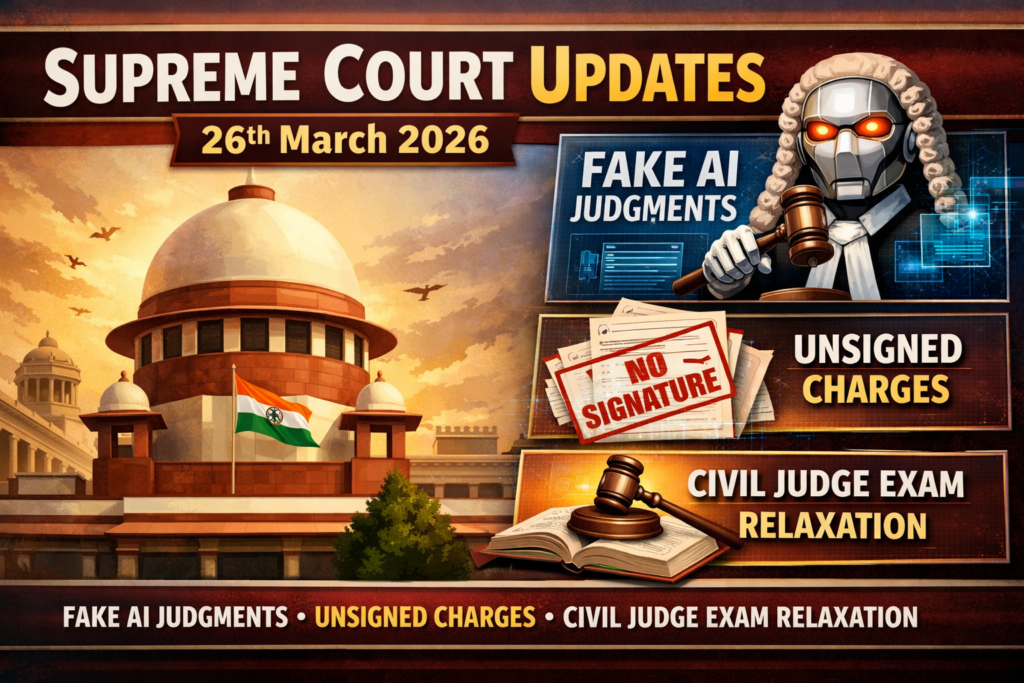
The Supreme Court has raised serious concerns over the growing practice of citing AI-generated, non-existent judgments, calling it a “menace” that is not confined to India but is spreading globally. The Court cautioned litigants and lawyers to exercise due diligence while relying on material generated through artificial intelligence tools.
These observations came from a bench comprising Justice Rajesh Bindal and Justice Vijay Bishnoi while hearing a Special Leave Petition. The petition was filed by a company director seeking removal of adverse remarks made by the Bombay High Court in connection with submissions that allegedly relied on a non-existent judgment generated using AI.
Background of the Case
The matter arose under the Maharashtra Rent Control Act. The Bombay High Court had earlier criticized the submissions of the appellant, observing that they appeared to be generated using AI tools such as ChatGPT.
The High Court pointed out several indicators—such as repetitive language, structured bullet points, and formatting patterns—that suggested AI-assisted drafting. More importantly, it noted the citation of a purported judgment titled “Jyoti w/o Dinesh Tulsiani vs. Elegant Associates”, which could not be traced despite efforts by the Court and its law clerks. This led to unnecessary consumption of judicial time.
High Court’s Observations
The High Court made it clear that while AI tools can assist in legal research, there is a corresponding duty to verify the accuracy of the material produced. It strongly deprecated the practice of placing unverifiable or irrelevant content before the Court, terming it an obstacle to the efficient administration of justice.
The Court further warned that such conduct could invite:
- Imposition of costs
- Strict action against advocates
- Possible reference to the Bar Council in serious cases
In the present case, Justice M.M. Sathaye imposed a cost of ₹50,000 on the appellant, directing the amount to be paid to the High Court Employees Medical Fund.
Supreme Court’s View
While the Supreme Court agreed to expunge the specific remarks made by the High Court as a matter of indulgence, it did not ignore the larger issue. The Court emphasized that the problem of fake AI-generated citations is widespread and increasing across jurisdictions.
It noted that courts are already dealing with instances where fabricated case laws and quotations generated by AI tools are being cited in proceedings. The bench underscored the need for vigilance and responsibility in the use of such technologies.
Broader Concern
The judiciary has repeatedly flagged the risks associated with unverified reliance on AI in legal drafting. The present case adds to a growing body of judicial concern regarding:
- Fabrication of case laws
- Misleading citations
- Erosion of court efficiency
The Supreme Court indicated that the issue is already under consideration on the judicial side, signaling the possibility of future guidelines or regulatory measures.
Case Reference
Heart and Soul Entertainment Ltd. v. Deepak S/o Shivkumar Bahry
(Special Leave to Appeal (C) No. 3090 of 2026)
Unsigned Charge Order Not Fatal If Accused Understood Charges: Supreme Court
The Supreme Court has clarified that failure to sign the order sheet while framing charges does not invalidate a criminal trial, provided the accused was properly informed of the charges and suffered no prejudice.
A bench comprising Justice Ahsanuddin Amanullah and Justice R Mahadevan held that such an omission is merely a procedural irregularity and not an illegality. It falls within the scope of Section 215 CrPC and Section 464 CrPC, and cannot vitiate proceedings unless it results in a failure of justice.
Key Observations by the Court
The Court emphasized that:
- The real test is whether the accused was misled in defending the case.
- Even absence of a formally framed charge does not automatically nullify the trial.
- If the accused clearly understood the allegations and had a fair opportunity to defend, the trial remains valid.
Background of the Case
The case arose from an FIR registered under serious offences including rioting, attempt to murder, and murder under the Indian Penal Code, 1860.
After investigation, the matter was committed to the Sessions Court, where charges were framed. Although the charges were read out to the accused and they pleaded not guilty, the order sheet recording the framing of charges remained unsigned.
Despite this, the accused:
- Participated fully in the trial
- Cross-examined prosecution witnesses
- Raised their defence, including pleas like alibi
The issue of the unsigned order sheet was raised only at a later stage, during examination under Section 313 CrPC.
High Court’s View
The accused approached the High Court under Section 482 CrPC seeking a fresh (de novo) trial. The High Court accepted this plea and directed retrial solely on the ground that the charge-framing order was unsigned.
Supreme Court’s Ruling
The Supreme Court set aside the High Court’s order, holding that such a technical defect cannot override substantive justice.
The Court noted that:
- The accused were fully aware of the charges
- Their active participation showed no confusion or prejudice
- The defence strategy and cross-examination clearly reflected understanding of the case
It concluded that the omission to sign the charge order sheet, though a lapse, did not affect the fairness of the trial.
Final Directions
Allowing the appeal, the Court directed the trial court to:
- Resume proceedings from the stage prior to the High Court’s order
- Conclude the trial expeditiously in accordance with law
Case Reference
Sandeep Yadav v. Satish & Others
Supreme Court Asks P&H High Court To Consider Relaxation of 45% Cut-Off for SC Candidates in Civil Judge Exam
The Supreme Court has urged the Punjab and Haryana High Court to sympathetically examine a request for relaxation of the minimum 45% qualifying marks prescribed for Scheduled Caste candidates in the Civil Judge (Junior Division) recruitment process conducted in Haryana.
The matter was heard by a bench led by Chief Justice of India Surya Kant, along with Justice Joymalya Bagchi and Justice Vipul M. Pancholi.
Background of the Case
The petition was filed by Diksha Kalson, a Scheduled Caste candidate who narrowly missed the qualifying benchmark. She secured 493.10 marks out of 1100, falling short of the required 495 marks by just 1.9 marks.
The recruitment was conducted pursuant to an advertisement issued by the Haryana Public Service Commission in January 2024 for the post of Civil Judge (Junior Division).
The petitioner highlighted that:
- Only 9 candidates from the Scheduled Caste category were recommended
- 39 vacancies existed in that category
- A significant number of posts remained unfilled
She also claimed that one of her answers in the English paper was wrongly awarded zero marks, despite being correct.
Proceedings Before the High Court
Kalson had earlier:
- Submitted representations to relevant authorities, including the High Court and HPSC
- Filed a writ petition before the Punjab & Haryana High Court
However, the High Court dismissed her plea, noting that:
- She had participated in the examination process
- Clause 33 of the advertisement barred re-evaluation
- Therefore, she could not challenge the criteria after appearing in the exam
Supreme Court’s Observations
The Supreme Court did not find any illegality in Clause 33, which restricts re-evaluation. However, it took note of the submission that a large number of SC vacancies remained unfilled.
In light of this, the Court granted liberty to:
- The petitioner
- Other similarly placed candidates higher in merit
to submit a representation before the High Court on its administrative side, seeking relaxation of the minimum qualifying marks.
The bench specifically requested that:
The High Court consider such representation sympathetically, irrespective of its earlier judicial findings.
Outcome
With these observations, the Supreme Court disposed of the Special Leave Petition, leaving the issue open for consideration by the High Court in its administrative capacity.
Case Reference
Diksha Kalson v. State of Haryana & Others
(SLP (Civil) Diary No. 11430 of 2026)