


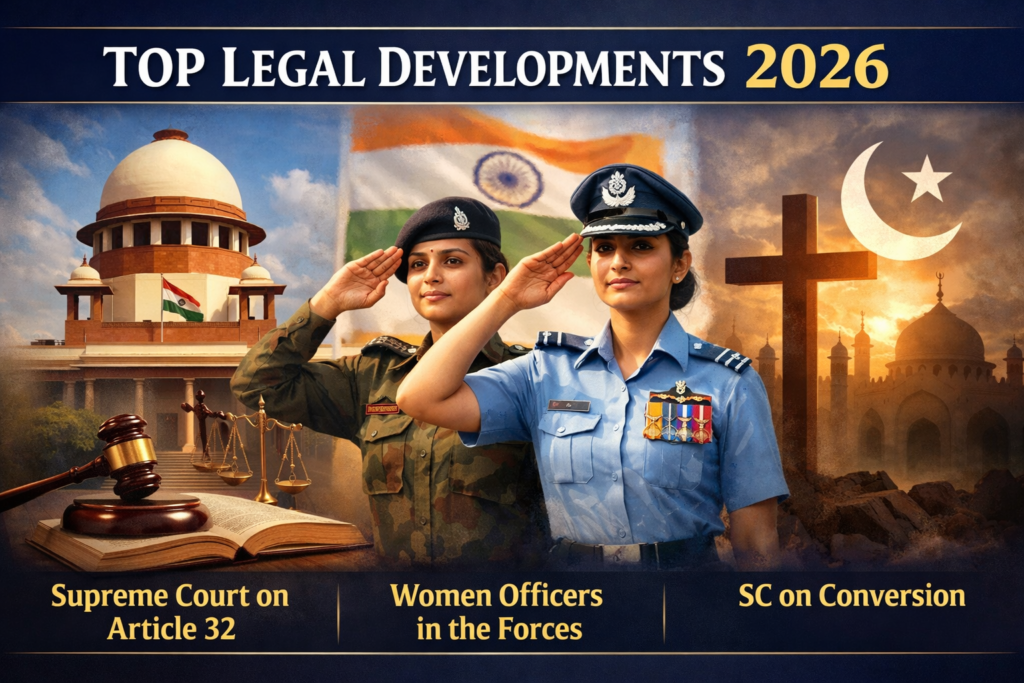
This article has been written by Kilimi Praneeth Reddy a law student pursuing the B.A. LL.B. (Hons.) program at Dr. Ram Manohar Lohiya National Law University (RMLNLU), Lucknow.


Abstract
The present set of legal developments highlights the dynamic interplay between fundamental rights, equality, administrative fairness, and evolving constitutional interpretation within Indian jurisprudence. Through recent rulings, the Supreme Court of India and various High Courts have addressed complex questions ranging from institutional power and individual rights to gender justice and socio-legal identity. In the context of federal tensions and constitutional remedies, the Supreme Court’s observations in the ED vs. Mamata Banerjee matter raise crucial questions regarding the scope of Article 32 and the fundamental rights of public officials, particularly when State action allegedly obstructs statutory duties. The issue reflects a deeper constitutional debate on the relationship between State power, individual rights, and rule of law. Simultaneously, the Court’s recognition of systemic discrimination against women officers in the armed forces marks a significant step towards substantive gender equality. By invoking constitutional guarantees and equitable powers, the judiciary has acknowledged structural bias within institutional frameworks and sought to remedy its consequences.
In the realm of family law, the Kerala High Court has advanced a progressive child-centric approach to custody disputes, shifting focus from parental rights to the holistic welfare and constitutional rights of children. This reflects an evolving understanding of justice rooted in dignity and emotional well-being. Further, the Bombay High Court has reaffirmed the importance of transparency and equal opportunity in public contracts, holding that livelihood concerns cannot create perpetual rights or monopolies in State-distributed resources.
Lastly, the Supreme Court’s ruling on loss of Scheduled Caste status upon religious conversion underscores the continuing tension between affirmative action and freedom of religion, reinforcing the constitutional framework governing caste-based benefits. Collectively, these developments illustrate a judiciary that is actively engaging with issues of equity, institutional accountability, and constitutional morality, while balancing competing rights and public interest.
Keywords:
Article 32, Fundamental Rights, Gender Equality, Scheduled Caste Status, Administrative Fairness, Child-Centric Justice, Rule of Law
ED vs. Mamata Banerjee: Fundamental Rights, Article 32 and the Limits of State Power
Background and Recent Development
In a significant constitutional development, the Supreme Court is examining the maintainability of a petition filed under Article 32 by the Enforcement Directorate against alleged interference by Mamata Banerjee during search operations at political consultancy firm I-PAC.
The case arises from an incident in January 2026 where the Chief Minister allegedly entered the premises during an ongoing investigation and removed documents and electronic devices. The ED has approached the Court alleging obstruction of its investigation and has sought further probe.
A key issue before the Court is whether such a petition under Article 32 is maintainable, especially when the petitioner is a State agency.
Core Constitutional Question:
The central legal issue is: Can an agency like ED invoke Article 32 for violation of fundamental rights? The State of West Bengal argued that:- Article 32 is available only to citizens for enforcement of fundamental rights
- ED is a statutory body and not a “citizen”
- There is no fundamental right to investigate—only a statutory power
However, the Supreme Court shifted the focus from the institution (ED) to the individual officers involved.
Supreme Court’s Observations
The Bench of Justices P.K. Mishra and N.V. Anjaria made strong observations questioning the State’s arguments.
Justice Mishra remarked:
“Will officers of ED cease to become citizens of India merely because they are officers of ED?”
He further emphasised:
“Please concentrate on the fundamental right of the officers… Don’t just say ED, ED, ED.”
This indicates that:
- Even government officers retain fundamental rights as individuals
- Violation against them can be examined under Article 32
Justice Anjaria added an important constitutional dimension:
“Fundamental rights need not always be person-centric… Is it not a fundamental right to have rule of law?”
This expands the idea that:
- Fundamental rights may arise in broader constitutional contexts
- Rule of law itself can be seen as part of constitutional protection Arguments by the State
Senior Advocate Kapil Sibal argued that:
- Obstruction of investigation is not a violation of fundamental rights
- ED has statutory remedies;like approaching police
- Allowing such petitions would open a “Pandora’s box”
He stated:
“A person does not have a fundamental right to investigate a case.”
Similarly, Abhishek Manu Singhvi argued:
- ED is neither a “person” nor a “citizen” under Part III
- Courts should not expand jurisdiction merely due to seriousness of allegations Court’s Response and Legal Tension
The Court questioned the practicality of the State’s argument:
“If CM is alleged to have committed the offence, should ED approach the same State machinery?”
This highlights a deeper issue:
- Conflict between State machinery and central agency
- Possibility of bias or lack of effective remedy
The Court also clarified that:
- The alleged offence against ED officers is distinct from the PMLA investigation
- Therefore, ordinary statutory provisions may not fully address the issue Election Argument Rejected
The Court strongly rejected the suggestion to postpone the hearing due to upcoming elections.
Justice Mishra stated:
“We don’t want to be party to election, we don’t want to be party to any crime also.”
This reinforces:
- Judicial independence from political processes
- Courts will not delay justice due to electoral considerations Key Legal Issues Emerging
This case raises several important constitutional questions:
- Can State agencies indirectly invoke Article 32 through officers?
- Do government officers retain enforceable fundamental rights during official duties?
- Is rule of law itself a fundamental right enforceable under Article 32?
- What happens when State authorities are themselves accused of obstruction?
- Can statutory remedies replace constitutional remedies in such cases? Broader Constitutional Implications
The case touches upon:
- Article 32 – Right to Constitutional Remedies
- Article 14 C 21 – Equality and protection of life/liberty
- Doctrine of Rule of Law (basic structure)
- Federal tensions between Centre and State It also raises concerns about:
- Misuse or obstruction of investigative processes
- Judicial expansion vs restraint in constitutional jurisdiction Conclusion
The ED vs. Mamata Banerjee case represents a complex intersection of constitutional
rights, federal power dynamics, and criminal procedure. The Supreme Court’s approach suggests a shift towards recognising that fundamental rights cannot be denied merely because a person is acting in an official capacity. At the same time, it raises critical questions about the limits of Article 32 and the role of courts in resolving conflicts involving State authorities. Ultimately, the case will shape the future understanding of who can invoke constitutional remedies, how far fundamental rights extend, and how the rule of law is protected when State power itself is questioned.
Breaking Barriers in Uniform: Supreme Court Recognises Systemic Discrimination in Grant of Permanent Commission to Women Officers
Background and Judicial Context
In a landmark development advancing gender equality within the armed forces, the Supreme Court of India has recognised that systemic discrimination led to the denial of Permanent Commission (PC) to women officers in the Army, Navy, and Air Force. The ruling was delivered by a Bench comprising CJI Surya Kant, Justice Ujjal Bhuyan, and Justice N Kotiswar Singh while adjudicating a batch of petitions filed by women officers serving under the Short Service Commission (SSC).
These officers challenged the denial of Permanent Commission, which effectively forced them to exit service after a limited tenure, despite years of service and experience.
Understanding Permanent Commission and the Dispute
Under the existing framework:
- SSC officers serve for a limited duration (up to 14 years)
- Permanent Commission allows a full career in service with pension benefits
Women officers argued that although policies were introduced around 2019 allowing their consideration for PC, the implementation was discriminatory, resulting in their exclusion.
The Union government, on the other hand, defended the policy, stating that grant of PC was subject to service requirements and evaluation criteria.
Supreme Court’s Core Finding: Systemic Bias
The Court found that the denial of Permanent Commission was not merely a result of individual assessment but stemmed from institutional bias embedded within the system.
In a strong observation, the Court held:
“The inequality of opportunities has affected their inter se merit… Denial of Permanent Commission was a consequence of systemic discrimination.”
This recognition is significant because:
- It shifts the issue from individual failure to structural injustice
- Acknowledges that evaluation processes themselves were flawed The Court further invoked its extraordinary powers:
“We invoke Article 142 to render complete justice.”
Nature of Discrimination Identified
The Court highlighted that women officers were:
- Assessed based on presumptions about their capabilities
- Denied equal opportunities to demonstrate merit
- Evaluated using criteria that were applied retrospectively or unfairly
For the Navy, the Court observed:
“This presumption… undermined the assessment of their suitability for long-term career progression.”
Similarly, for the Air Force:
“Service length criteria… ought not to have been used to deny Permanent Commission when they were never given a fair opportunity.”
Thus, the Court concluded that the entire evaluation framework suffered from procedural and substantive unfairness.
Relief Granted by the Court
Instead of ordering a blanket reinstatement, the Court adopted a balanced and pragmatic approach, issuing tailored directions across services.
Key Reliefs:
- Permanent Commission already granted will not be disturbed
- Women officers who were denied PC and have left service:
- Deemed to have completed 20 years of service
- Entitled to pension and consequential benefits
- In certain cases, promotion and reconsideration mechanisms were directed
- Future selection processes must be transparent and clearly defined
The Court ensured that while operational efficiency is preserved, individual injustice is remedied.
Limitations and Judicial Restraint
Importantly, the Court refrained from:
- Ordering large-scale reinstatement of officers
- Interfering excessively in military administrative decisions It observed that:
- Operational effectiveness of armed forces must be respected
- However, this cannot justify denial of constitutional rights and fairness This reflects judicial restraint while still ensuring constitutional Constitutional Principles Involved
The judgment is rooted in key constitutional guarantees:
- Article 14 – Equality before law
- Article 15 – Non-discrimination on grounds of sex
- Article 16 – Equal opportunity in public employment
- Article 21 – Right to dignity and fair treatment
By invoking Article 142, the Court ensured complete justice beyond procedural limitations.
Key Legal Issues Emerging
This ruling raises broader constitutional and institutional questions:
- Can institutional bias invalidate administrative decisions?
- How should courts balance military autonomy vs fundamental rights?
- Does denial of equal opportunity amount to indirect discrimination?
- What is the scope of Article 142 in service jurisprudence?
Conclusion
The Supreme Court’s decision marks a significant step in dismantling gender-based barriers within India’s armed forces. By recognising systemic discrimination, the Court has gone beyond individual relief to expose structural inequalities embedded in institutional practices. At the same time, it has maintained a careful balance between judicial intervention and respect for military functioning.
This judgment reinforces the constitutional vision that equality is not merely formal but must be real and effective, ensuring that women officers are not denied opportunities due to entrenched biases. It is a crucial milestone in the ongoing journey towards gender justice, institutional accountability, and substantive equality in public service.
From Parental Rights to Child Rights: Kerala High Court Advocates a Child-Centric Custody Jurisprudence
Background and Judicial Context
In a significant development in family law jurisprudence, the Kerala High Court has called for a fundamental shift in the approach towards child custody disputes–from a parent- centric model to a child-centric framework. The observations were made by a Division Bench comprising Justice Devan Ramachandran and Justice M.B. Snehalatha while deciding a habeas corpus petition filed by a mother alleging illegal detention of her minor children by their father.
Although the case was resolved through a mutually agreed custody arrangement, the Court used the opportunity to lay down broader principles governing custody disputes, highlighting the urgent need to reimagine the legal philosophy underlying such matters.
Understanding the Problem: Children as Silent Victims
The Court strongly emphasised that children are often the most affected yet least heard participants in custody battles. It observed that children are “drawn into the battle between their parents for nothing that they can comprehend,” suffering emotional and psychological harm without any fault of their own.
In a poignant observation, the Court stated:
“Litigation related to custody of children invariably becomes uncontrollable because of the ego and strife between their parents–creating irreparable trauma.”
The Bench expressed deep concern over how prolonged litigation exposes children to distressing environments, including being physically “paraded” during custody exchanges, thereby affecting their dignity, emotional stability, and self-worth.
Shift Towards a Child-Centric Approach
Moving beyond traditional legal frameworks, the Court clearly articulated the need to transform custody jurisprudence. It held that the focus must shift from parental rights to the overall welfare and rights of the child.
The Court observed:
“The parent-centric evaluation of custody matters has to give way to a children- centric approach, with emphasis on their physical, educational, social and psychological needs.”
This marks a doctrinal shift where:
- Custody is no longer about which parent is better
- It is about what arrangement best serves the child’s holistic development
The Court recognised that children have constitutionally protected rights, even though they are not formal parties to litigation, and these rights must be actively safeguarded by courts.
Judicial Experience and Psychological Insights
The judgment is notable for its deeply human and experiential reasoning. The Bench referred to its interactions with children in custody disputes, observing that children often react emotionally based on circumstances rather than rational preference.
It noted that:
- Children may initially resist one parent but later show attachment when given time
- They may unconsciously reflect the influence of the parent they reside with
- Their expressions cannot always be treated as final or decisive
The Court cautioned that custody decisions cannot be based solely on a child’s immediate statements, but must involve a comprehensive assessment of long-term welfare.
Custody as a Right of the Child, Not a Choice Between Parents
One of the most significant legal clarifications made by the Court is that custody should not be treated as a contest between parents.
The Court held:
“Custody is not an evaluation of choice between the parents, but recognition of the constitutionally protected rights of the child to have both parents.”
This principle reinforces that:
- A child has a right to love, care, and presence of both parents
- Custody arrangements must ensure balanced upbringing rather than separation
The Court further observed that the absence of either parent can create a psychological void, and therefore, arrangements should maximise interaction with both.
Doctrine of Best Interest and Parens Patriae
The judgment reaffirms the role of courts as parens patriae (protector of minors), emphasizing that courts must act in the best interests of the child, independent of parental conflict.
The Court noted that:
- Children’s welfare includes emotional, psychological, and social dimensions
- Courts must remain insulated from parental acrimony
- Custody decisions must ensure a life “free of strife and anxiety”
This aligns with established principles under Indian constitutional law and family law, where child welfare is paramount.
Resolution in the Present Case
In the present matter, the Court facilitated a consensual arrangement:
- Father retained primary custody
- Mother was granted weekend custody
- Vacations were equally shared
- Children were allowed unrestricted communication with both parents
Importantly, the Court ensured that the arrangement reflected the children’s desire for continued involvement of both parents, rather than rigid legal entitlements.
Conclusion
The Kerala High Court’s judgment marks a progressive evolution in custody jurisprudence by firmly placing the child at the centre of legal consideration. It recognises that custody disputes are not merely legal conflicts between parents but deeply human situations affecting the emotional and psychological development of children. By emphasising a child-centric approach, the Court has reinforced the idea that the legal system must prioritise the dignity, well-being, and holistic growth of the child above all competing interests.
This decision is likely to influence future custody adjudication across India, encouraging courts to move beyond rigid frameworks and adopt a more empathetic, balanced, and constitutionally grounded approach towards child welfare.
Livelihood vs Fair Competition: Bombay High Court Upholds Open Tendering Over Perpetual Contractual Rights
Background and Judicial Context
In an important ruling concerning public contracts and the right to livelihood, the Bombay High Court has held that long-standing contractors cannot claim an exclusive or perpetual right to continue merely because their livelihood depends on the activity. The decision came in a writ petition filed by the Bombay Shoe-Shine Workers Co-operative Society challenging the Railway’s Shoe-Shine Policy, 2018 and the introduction of an open tender system.
The petitioner society, engaged in shoe-shining services at railway stations since 1985, argued that the new policy would displace its members, many of whom belonged to economically weaker sections and depended entirely on this work for survival.
Evolution of Policy and the Dispute
The Court examined the policy framework governing shoe-shine contracts over time. Earlier policies, particularly from 1999 onwards, were welfare-oriented, granting preference to cooperative societies comprising members from Scheduled Castes, Scheduled Tribes, and other weaker sections, along with safeguards such as minimum wages.
However, with the introduction of the 2018 policy, the Railways shifted towards a competitive and transparent tendering system, allowing all eligible societies to participate without preferential treatment.
The petitioner contended that:
- The removal of preference diluted social justice objectives
- Open tendering exposed long-serving workers to displacement
- Livelihood concerns should outweigh strict competition
Court’s Reasoning: Primacy of Fair and Transparent Process
Rejecting the petitioner’s claims, the Court upheld the validity of the open tender system and emphasised the importance of fairness, transparency, and equal opportunity in public contracts.
The Court observed that allowing the petitioner to continue indefinitely would:
- Create a monopoly
- Exclude other similarly placed individuals or societies
- Defeat the principle of equal opportunity in public employment-like situations
Thus, the Court held that public authorities cannot restrict competition merely to protect existing contractors.
Livelihood Argument and Its Limits
While acknowledging the hardship faced by the petitioner’s members, the Court clarified that right to livelihood cannot translate into a right to exclusivity.
In a balanced observation, the Court stated:
“The members of the Petitioner Society… cannot be deprived of their livelihood merely because the contract would be gained by any other Society.”
However, it simultaneously held that:
- Livelihood concerns must be balanced with rights of others to compete
- Public contracts cannot be converted into permanent entitlements
- No individual or group can claim a vested right to continue indefinitely
This reflects a nuanced approach where the Court recognises livelihood but refuses to elevate it into an absolute right overriding public interest.
No Perpetual Right from Past Experience The Court made it clear that:
- Past engagement or long-standing service does not create a legal right to continuation
- Experience may be considered as a factor in evaluation
- But it cannot confer exclusivity or automatic renewal
This aligns with established principles in administrative law that government contracts must remain open to competition unless explicitly restricted by law.
Welfare Concerns and Minimum Wages
Interestingly, while upholding the policy, the Court also addressed a significant omission. It noted that the 2018 policy had removed provisions ensuring minimum wages for workers, which was present in earlier frameworks.
The Court held this omission to be inappropriate and directed:
- Railways must include a condition ensuring payment of minimum wages as per law
This reflects the Court’s attempt to balance:
- Economic fairness (competition)
- Social justice (worker protection)
Key Legal Issues Emerging
This judgment raises important questions in constitutional and administrative law:
- Can livelihood under Article 21 override fair competition?
- Do long-term contracts create legitimate expectation or vested rights?
- How should courts balance welfare policies vs market-based reforms?
- Can the State withdraw preferential treatment for weaker sections? Conclusion
The Bombay High Court’s ruling reinforces the principle that public contracts must remain open, competitive, and transparent, and cannot be monopolised by long- standing contractors, even on grounds of livelihood. At the same time, the judgment carefully acknowledges the socio-economic realities of workers and ensures that minimum labour protections are not ignored.
By striking this balance, the Court has clarified that while the right to livelihood is constitutionally significant, it does not extend to a right to exclusivity or perpetual continuation, especially when it conflicts with broader principles of fairness, equality, and public interest.
Conversion and Constitutional Identity: Supreme Court Clarifies Loss of Scheduled Caste Status Upon Religious Change
Background and Judicial Context
In a significant ruling impacting reservation law and constitutional identity, the Supreme Court of India has reaffirmed that conversion to a religion other than Hinduism, Sikhism, or Buddhism results in the complete loss of Scheduled Caste (SC) status. The Court upheld the decision of the Andhra Pradesh High Court, which had earlier quashed proceedings initiated under the SC/ST (Prevention of Atrocities) Act by a complainant who had converted to Christianity.
The case arose when a person, originally belonging to a Scheduled Caste, had converted to Christianity and was functioning as a Pastor, yet sought protection under the SC/ST Act alleging caste-based violence.
Legal Framework: Constitution (Scheduled Castes) Order, 1950
The judgment is rooted in the interpretation of the Constitution (Scheduled Castes) Order, 1G50, particularly Clause 3, which restricts SC status to persons professing:
- Hinduism
- Sikhism
- Buddhism
The Supreme Court made it unequivocally clear that:
“Conversion to any religion not specified in Clause 3 results in immediate and complete loss of Scheduled Caste status.”
This means that SC identity is not solely based on birth, but also on continued religious affiliation as recognised by law.
Supreme Court’s Key Observations
The Bench comprising Justices Prashant Kumar Mishra and Manmohan delivered a categorical ruling, stating:
“No statutory benefit, protection or reservation… can be claimed by a person who is not deemed to be a member of the Scheduled Caste. This bar is absolute and admits no exception.”
The Court further clarified:
- A person cannot simultaneously profess another religion and claim SC status
- Legal entitlements under reservation laws are strictly conditional
- The restriction under the 1950 Order is absolute in nature
In the present case, the Court noted that the complainant:
- Had converted to Christianity
- Was actively functioning as a Pastor
- Continued to profess the new religion at the time of the incident
Thus, the Court held that there was no ambiguity regarding his religious identity, leading to denial of SC status.
Issue of Caste Certificate
An important argument raised was that the complainant still possessed a valid Scheduled Caste certificate issued by authorities.
However, the Court rejected this contention and held:
- Non-cancellation of caste certificate does not revive SC status
- Such certificates must be examined separately under statutory mechanisms
This establishes that administrative recognition cannot override constitutional provisions.
Applicability of SC/ST (Prevention of Atrocities) Act.
The Court upheld that:- Protection under the SC/ST Act is available only to legally recognised SC/ST members
- A converted individual cannot invoke the Act if they fall outside the constitutional definition
The Andhra Pradesh High Court had earlier reasoned that:
- The caste system is alien to Christianity
- Therefore, caste-based protections cannot be extended post-conversion The Supreme Court’s affirmation strengthens this legal
Key Legal Issues Emerging
This ruling raises important constitutional and socio-legal questions:
- Is Scheduled Caste identity religion-dependent or birth-based?
- Can denial of SC status after conversion affect freedom of religion under Article 25?
- Does this create a conflict between social justice and religious freedom?
- Should caste-based disadvantages continue to be recognised even after conversion?
These questions remain part of ongoing constitutional debates.
Constitutional and Social Implications
The judgment reinforces a long-standing legal position but also highlights tensions between:
- Reservation policy (Articles 15 s 16)
- Freedom of religion (Article 25)
- Social identity vs legal classification
It reflects the State’s approach that:
- SC status is linked to historical caste disabilities within specific religious frameworks
- Conversion is seen as removal from that framework, at least legally
However, critics argue that social discrimination may persist even after conversion, raising concerns about the adequacy of this legal approach.
Conclusion
The Supreme Court’s ruling provides clarity on the legal consequences of religious conversion on Scheduled Caste status, firmly establishing that such status is conditional upon continued adherence to specified religions under the Constitution (Scheduled Castes) Order, 1950. While the judgment strengthens legal certainty and statutory interpretation, it simultaneously revives deeper constitutional questions regarding identity, equality, and the intersection of religion with social justice.
As India continues to grapple with issues of caste and conversion, this decision will play a crucial role in shaping future discourse on reservation policies, minority rights, and the evolving meaning of constitutional protections.
CONCLUSION
The judicial pronouncements of the day reflect a clear movement towards a more inclusive, balanced, and constitutionally grounded approach to justice, where courts are increasingly addressing not only legal disputes but also the underlying structural and societal issues that shape them. Across diverse domains, the emphasis remains on ensuring that constitutional principles are meaningfully realised in practice.
The Supreme Court’s engagement with questions surrounding Article 32 and the rights of enforcement officials highlights the ongoing evolution of constitutional remedies in complex federal contexts. At the same time, its recognition of systemic gender bias in the armed forces reinforces the commitment to substantive equality and institutional reform, ensuring that opportunities are not denied due to entrenched stereotypes.
The High Courts, through their respective rulings, have contributed to this broader constitutional vision by reinforcing fairness in governance and human-centric justice. While the Bombay High Court upheld competitive processes over individual claims of livelihood, the Kerala High Court redefined custody jurisprudence by placing the child’s welfare at the centre of legal consideration. Meanwhile, the Supreme Court’s stance on Scheduled Caste status post-conversion reiterates the rigidity of existing constitutional classifications, while also prompting deeper reflection on the intersection of identity, religion, and social justice. Taken together, these rulings demonstrate that Indian courts are increasingly striving to balance individual rights, institutional integrity, and societal interests, moving towards a jurisprudence that is not only legally sound but also socially responsive. The trajectory suggests a continued emphasis on constitutional morality, equality, and fairness as foundational pillars of the legal system.