This article has been written by Kilimi Praneeth Reddy a law student pursuing the B.A. LL.B. (Hons.) program at Dr. Ram Manohar Lohiya National Law University (RMLNLU), Lucknow.

Abstract
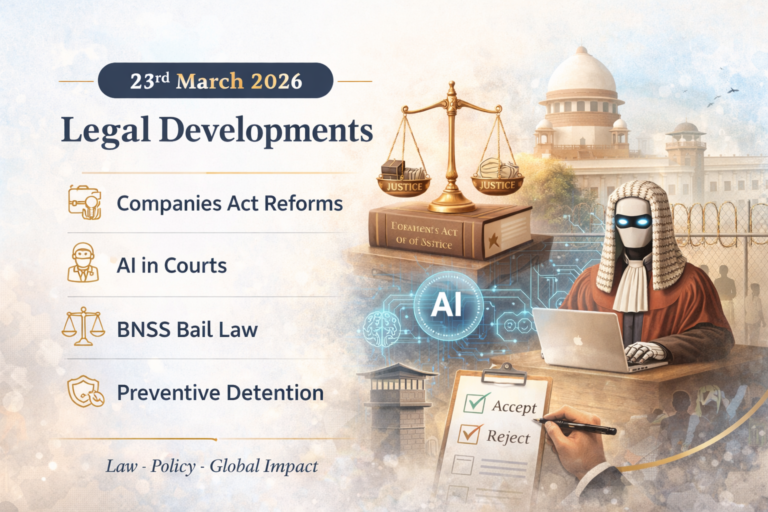
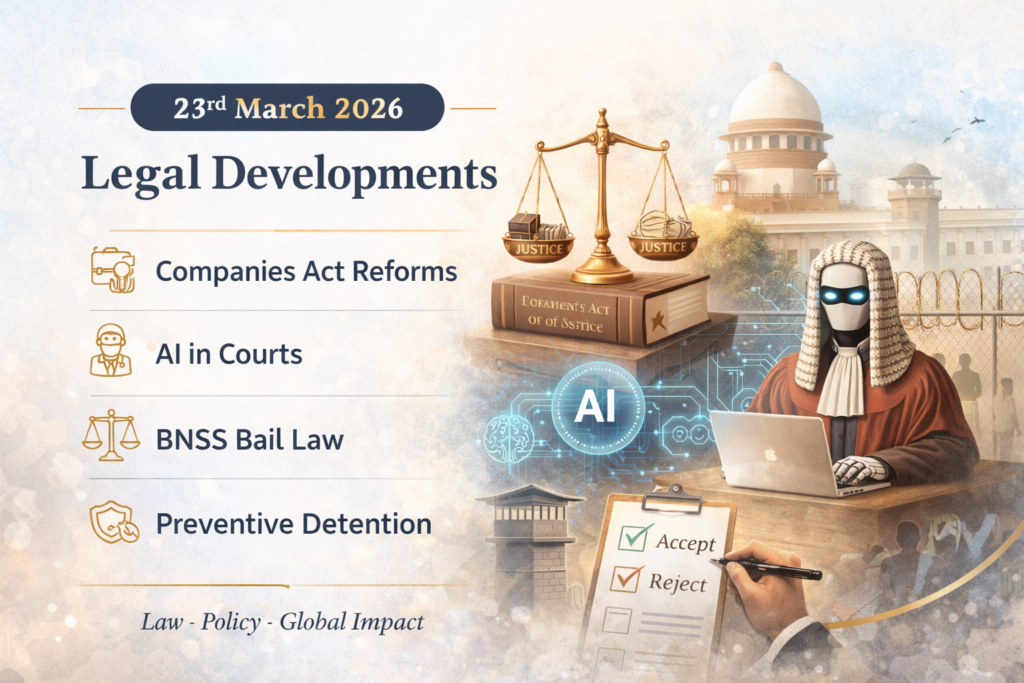
Today’s legal developments reflect a broad spectrum of changes across constitutional law, criminal law, corporate regulation, and institutional functioning. In the corporate law domain, recent amendments to the Companies Act, 2013 through the Corporate Laws Amendment framework highlight the State’s shift towards decriminalisation of minor offences, promotion of ease of doing business, and reliance on in-house adjudication mechanisms. These reforms aim to reduce the burden on courts while ensuring regulatory compliance through monetary penalties rather than criminal prosecution, signalling a move towards a more facilitative corporate governance regime.
At the constitutional level, the Supreme Court’s observations on Artificial Intelligence reaffirm that adjudication is fundamentally a human function rooted in conscience, empathy and accountability. While recognising the utility of AI in improving efficiency and access to justice, the Court cautioned against replacing human judges with algorithmic systems, thereby preserving the core values of judicial decision-making.
In the field of criminal law, the Gauhati High Court clarified that bail is not absolute and can be cancelled if obtained through fraud or misrepresentation. By cancelling anticipatory bail granted on false claims, the Court reinforced the principle that judicial processes cannot be misused and must be protected from deception, particularly under the evolving framework of the Bharatiya Nagarik Suraksha Sanhita (BNSS).
Further, the Supreme Court addressed the limits of judicial review in preventive detention matters by disposing of a habeas corpus petition after the revocation of the detention of activist Sonam Wangchuk. The Court held that once the detention order ceases to exist, the petition becomes infructuous, thereby emphasising procedural finality in constitutional remedies.
Additionally, the Supreme Court clarified the boundary between judicial and administrative functions by declining to entertain a plea seeking installation of the National Emblem on its dome. The Court directed that such matters be handled administratively, reinforcing institutional discipline and limiting unnecessary judicial intervention. Overall, these developments collectively demonstrate a legal system that is simultaneously reform-oriented and principled promoting economic efficiency through corporate law reforms while safeguarding constitutional values, procedural integrity, and institutional boundaries.
Keywords
Corporate Laws Amendment, Companies Act, 2013, Ease of Doing Business, Artificial Intelligence in Judiciary Bail Cancellation (Fraud/Misrepresentation) ,BNSS (Criminal Procedure Reform), Habeas Corpus, Preventive Detention, Judicial vs Administrative Functions and Constitutional Remedies
Corporate Laws (Amendment) Bill, 2026: Reforming Corporate Governance in a Time of Global Uncertainty
“Balancing Ease of Doing Business with Corporate Responsibility”
Introduction
During the Budget Session 2026, the Lok Sabha referred the Corporate Laws (Amendment) Bill, 2026 to a Joint Parliamentary Committee (JPC) for detailed scrutiny. The decision reflects the importance of the proposed reforms in shaping India’s corporate regulatory framework. At a time when global economic stability is affected by geopolitical tensions, particularly in West Asia, such reforms assume greater significance for ensuring economic resilience and investor confidence in India.
Background and Legislative Context
The Bill was introduced by Finance Minister Nirmala Sitharaman following recommendations of the Company Law Committee (2022). It seeks to amend provisions of the Companies Act and the Limited Liability Partnership Act, 2008. The primary objective is to simplify regulatory processes, reduce compliance burdens, and modernise corporate governance in line with evolving business needs.
The referral to a Joint Parliamentary Committee ensures that the Bill undergoes detailed examination with inputs from multiple stakeholders, thereby strengthening democratic deliberation.
Core Features of the Bill
The Bill introduces several structural reforms aimed at improving the corporate regulatory ecosystem. Its key aspects include:
- Decriminalisation of minor corporate offences, shifting procedural lapses from criminal liability to monetary penalties
- Rationalisation of penalties to make them proportionate and less punitive
- Changes in CSR calculation criteria, particularly regarding the determination of net profits
- Ease of doing business measures, especially for startups, MSMEs, and small companies
- Streamlining regulatory procedures to reduce compliance complexity
These changes indicate a transition from a strict enforcement model to a more facilitative and business-friendly approach.
Debate on Corporate Social Responsibility (CSR)
A major point of contention relates to the provisions on Corporate Social Responsibility (CSR). Opposition members argued that modifying the criteria for calculating net profits may effectively dilute the obligation of companies to spend 2% of their profits on CSR activities.
However, the government clarified that the amendment is technical in nature and does not alter the fundamental requirement of CSR spending. This debate highlights the broader issue of balancing corporate efficiency with social responsibility.
Relevance to Budget 2026
The Bill aligns closely with the broader objectives of Budget 2026, which emphasises economic growth, investment promotion, and regulatory simplification. By reducing compliance burdens and encouraging ease of doing business, the Bill supports the government’s strategy of fostering a conducive environment for industries, startups, and investors. Thus, it can be seen as a structural reform complementing fiscal policy measures announced in the Budget.
Link with the West Asia Conflict and Its Impact on India
The significance of the Bill becomes clearer when viewed against the backdrop of the ongoing West Asia conflict. The conflict has disrupted global supply chains, particularly in energy markets, affecting oil prices and economic stability.
Its relevance to India can be understood in the following ways:
- Supply chain disruptions: India, being dependent on energy imports, faces risks due to instability in oil supply routes such as the Strait of Hormuz
- Need for economic resilience: A flexible and efficient corporate framework helps industries adapt to global shocks
- Investor confidence: Simplified regulations and reduced legal risks enhance India’s attractiveness as an investment destination
- Business continuity: Reduced compliance burdens enable companies to focus on operational stability during crises
Thus, corporate law reforms act as a stabilising mechanism in times of international economic uncertainty.
Legal and Policy Significance
From a legal perspective, the Bill reflects a shift towards facilitative regulation, reducing excessive criminalisation in corporate law. It supports economic freedom under Article 19(1)(g) while attempting to maintain accountability through monetary penalties and compliance mechanisms.
At the policy level, it represents an effort to harmonise economic growth with governance reforms, ensuring that regulatory systems keep pace with changing business environments.
Conclusion
The Corporate Laws (Amendment) Bill, 2026 marks an important step in reforming India’s corporate legal framework. By focusing on ease of doing business, rationalisation of penalties, and regulatory efficiency, it aims to strengthen the country’s economic foundation. However, concerns regarding CSR and corporate accountability underline the need for a balanced approach. In the context of global uncertainties such as the West Asia conflict, such reforms are crucial for enhancing economic resilience, ensuring business continuity, and maintaining investor confidence. The final outcome of the Bill, after scrutiny by the Joint Parliamentary Committee, will determine how effectively India balances economic growth with social responsibility in its corporate governance regime.
AI in Judiciary: “AI Doesn’t Have Qualities of a Judge” – CJI Surya Kant
“While AI can analyse patterns and generate responses, it cannot understand human suffering or bear responsibility for its outcomes”
INTRODUCTION
With the rapid advancement of Artificial Intelligence (AI), its use in legal systems across the world has increased significantly. AI tools are now being used for legal research, case management, translation of judgments, and even in dispute resolution mechanisms.
This growing use has raised an important question can AI replace human judges in the future? Addressing this concern, Chief Justice of India Surya Kant recently clarified that AI cannot replace judges, as it lacks essential human qualities required for delivering justice.
What the Chief Justice Observed
While speaking at a seminar on “Artificial Intelligence Prevention and Resolution of Disputes” in Bengaluru, the Chief Justice explained the nature of judicial work.
He stated that;
“The law is not merely a system of rules, it is a system of judgment. Judgment, in its truest sense, is not an exercise in computation. It is an exercise in conscience,” the CJI said, underscoring that courts routinely decide issues involving liberty, dignity, and the future of individuals, which cannot be reduced to data points or algorithms.”
This means that judicial decision-making involves moral reasoning and human understanding, not just data analysis.
He further highlighted that courts deal with issues such as:
- Liberty of individuals
- Human dignity
- Family disputes
- Future of individuals
These are sensitive matters which cannot be decided purely through algorithms or machine-based logic.
Limitations of Artificial Intelligence in Judicial Decision-Making
The Chief Justice clearly pointed out that AI has certain fundamental limitations when it comes to delivering justice.
AI may be capable of analysing patterns and generating answers, but:
- It cannot understand human suffering
- It lacks empathy and compassion
- It cannot appreciate the social and emotional context of a case
- It cannot take responsibility for its decisions
Most importantly, AI cannot be held accountable. In a legal system, judges are answerable for their decisions, which is a core feature of rule of law. This accountability cannot be transferred to machines.
Because of these reasons, the Chief Justice expressed concern about any system where final decisions affecting life and liberty are left to AI.
Role of AI in the Justice System
Despite these limitations, the Chief Justice acknowledged that AI has an important supportive role in the judiciary.
AI can help in:
- Improving efficiency of courts
- Reducing pendency of cases
- Assisting in legal research
- Translating judgments into regional languages (e.g., SUVAS system)
- Supporting mediation and online dispute resolution
AI tools can analyse large amounts of legal data quickly and help judges make more informed decisions. However, they are only assistive tools and not decision-makers.
Need for Regulation and Safeguards
The Chief Justice also cautioned that AI systems are not always reliable and may produce incorrect or misleading information. Therefore, human supervision is necessary.
He emphasised that the real issue is not whether AI should be used, but how it should be used responsibly. This requires:
- Clear legal boundaries
- Transparency in AI functioning
- Human oversight at all stages
- Protection of judicial independence
The judiciary must actively regulate the use of AI instead of passively adopting it.
Conclusion
In conclusion, the observations of Chief Justice Surya Kant make it clear that Artificial Intelligence can assist the judicial system but cannot replace human judges. Judicial decision-making requires empathy, moral reasoning and accountability qualities that AI does not possess. While technology can improve efficiency and access to justice, the final authority must always remain with human judges. Justice, ultimately, is not determined by algorithms but guided by human conscience.
Bail Can Be Cancelled If Procured by Fraud or Misrepresentation: Gauhati High Court
Introduction
The law relating to bail in India clearly distinguishes between the principles governing grant of bail and cancellation of bail. While grant of bail is based on factors like prima facie case, gravity of offence and likelihood of misuse, cancellation of bail requires stronger grounds such as misuse of liberty or interference with investigation.
In a significant ruling, the Gauhati High Court reiterated that bail can also be cancelled if it has been obtained by fraud or misrepresentation. This decision strengthens the principle that judicial orders must not be secured by misleading the court.
What the Court Held
Justice Pranjal Das observed that a bail order is not immune from cancellation merely because it has been granted. The Court clearly stated that:
“…a bail order can also be cancelled, if it was procured by misrepresentation or fraud.”
This observation is important because it expands the scope of bail cancellation beyond traditional grounds like violation of bail conditions. It emphasises that fairness and honesty in approaching the court are essential, and any attempt to mislead the court strikes at the root of justice.
Facts of the Case
The case arose from an FIR filed by the Director of Himani Agency Pvt. Ltd., which operates a Tanishq jewellery showroom. The allegation was that the accused, who was working as a Store Manager, had stolen jewellery worth approximately ₹1.34 crore and subsequently went absconding.
The accused had obtained anticipatory bail by claiming that he had resigned from his job before the alleged incident took place. This claim played a crucial role in securing the bail order.
However, before the High Court, the petitioner produced materials showing that:
- The resignation email was sent to an incorrect email ID
- The accused was present at showroom events after the alleged resignation
- Attendance records indicated his continued association with the showroom
Additionally, investigation revealed that the accused had taken a gold loan on the stolen jewellery, invested the money in the stock market, and lost it.
Court’s Analysis and Reasoning
Upon examining the case diary and evidence, the High Court found that the claim of resignation was false and deliberately created to avoid criminal liability. The Court observed:
“The theory of resignation was a false one invented to escape the criminal liability.”
It further held that the accused had misled the lower court and committed fraud in obtaining anticipatory bail. The Court also noted that:
- The stolen jewellery had not been recovered
- The accused had not cooperated with the investigation
- Custodial interrogation was necessary
Relying on Supreme Court precedents such as Puran v. Rambilas and Himanshu Sharma v. State of Madhya Pradesh, the Court reiterated that bail can be cancelled when it is obtained by fraud or suppression of material facts.
Key Legal Principle
The judgment reinforces the following important principle:
- Bail can be cancelled not only for misuse of liberty or violation of conditions
- But also when the bail was obtained by fraud, misrepresentation, or suppression of material facts
- This ensures that judicial discretion is not abused by dishonest Decision of the Court
Applying these principles, the Gauhati High Court held that the accused had clearly misrepresented facts to secure bail. Therefore, the anticipatory bail granted under Section 306 of the BNSS was cancelled.
The Court exercised both its inherent powers and its concurrent jurisdiction with the Sessions Court to set aside the bail order.
Conclusion
This judgment is significant as it reinforces the integrity of the judicial process. It sends a clear message that courts will not tolerate misuse of legal remedies through fraud or misrepresentation. While bail remains an important safeguard for personal liberty, it cannot be obtained by misleading the court. The decision ensures that justice is not compromised by dishonest conduct and that the rule of law is upheld.
Habeas Corpus Plea Becomes Infructuous After Release: Supreme Court Closes Petition in Sonam Wangchuk Detention Case
Introduction
The remedy of habeas corpus is one of the most important constitutional safeguards against illegal detention under Article 32. However, its relevance depends on the subsistence of detention. In a recent development, the Supreme Court closed a habeas corpus petition filed against the detention of Ladakh-based activist Sonam Wangchuk after noting that he had already been released by the Central government.
Background and Facts
Sonam Wangchuk, a climate activist from Ladakh, was detained under the National Security Act (NSA) following protests in Leh in September 2025. The protests were related to demands for statehood and inclusion of Ladakh under the Sixth Schedule.
Challenging his detention, his wife, Gitanjali Angmo, filed a habeas corpus petition before the Supreme Court seeking his release. During the pendency of the case, concerns were also raised regarding his deteriorating health in custody.
However, while the matter was still being heard, the Central government revoked his detention on March 14, 2026, stating that the decision was taken to promote peace, stability and mutual trust in the region.
What Happened in Court
When the matter came up before a Bench of Justices Aravind Kumar and PB Varale, the Court noted that since the detention order had already been revoked, the relief sought in the petition no longer survived.
Senior Advocate Kapil Sibal, appearing for the petitioner, requested the Court to keep the matter pending for further consideration. However, the Court refused this request, observing:
“What else is left?”The Solicitor General Tushar Mehta also submitted that the matter should be closed. The Court ultimately held that:
“The order of detention having been revoked, the prayer sought for in the petition has become infructuous.”
Accordingly, the petition was disposed of. Important Legal Points
- Habeas corpus becomes infructuous once the detention is revoked or the person is released
- Courts generally do not continue proceedings when no effective relief remains
- Preventive detention laws like NSA allow detention without trial but are subject to judicial review
- Delay in adjudication may sometimes result in cases becoming redundant due to subsequent developments
- The case reflects judicial restraint when the cause of action itself no longer exists Significance of the Case
This case highlights the practical limitation of habeas corpus proceedings its effectiveness depends on the continuance of detention. Even though the petition raised serious issues regarding preventive detention and personal liberty, the Court refrained from examining the merits once the detention order was revoked.
It also reflects how executive actions, such as revocation of detention, can render constitutional challenges unnecessary. At the same time, it raises concerns about delays in adjudication, as the matter remained pending despite repeated hearings.
Conclusion
The Supreme Court’s decision to close the petition underscores a settled legal principle that courts do not decide academic or infructuous issues. While habeas corpus remains a powerful tool to protect personal liberty, its scope ends once the detention itself ceases. The case serves as an example of how procedural developments can override substantive constitutional questions, leaving broader issues of preventive detention and state power open for future adjudication.
“Administrative, Not Judicial”: Supreme Court on Plea to Install National Emblem on Court Dome”
Introduction
The distinction between judicial and administrative functions of constitutional courts is an important aspect of institutional functioning. In a recent development, the Supreme Court clarified this boundary while dealing with a petition seeking installation of the National Emblem on the dome of the Supreme Court building. The Court emphasised that such matters fall within the administrative domain and are not suitable for judicial adjudication.
Background and Facts
The petition was filed by Badaravada Venugopal (appearing in person), seeking a direction to install the National Emblem (Lion Capital of Ashoka) on the main dome of the Supreme Court building. The petitioner argued that such installation should be carried out in accordance with the constitutional framework and relevant statutory provisions, including the State Emblem of India (Prohibition of Improper Use) Act, 2005 and the Rules of 2007.
It was also submitted that if structural or architectural changes were required, appropriate measures should be taken to facilitate the installation.
The petitioner further informed the Court that he had earlier written to the Supreme Court administration and was told that the Court uses its own emblem instead of displaying the National Emblem on the building.
What Happened in Court
The matter was heard by a Bench comprising Chief Justice of India Surya Kant, Justice Joymalya Bagchi and Justice Vipul Pancholi.
At the outset, the Chief Justice made it clear that the issue did not require judicial intervention and could be handled administratively. He also pointed out that a new Supreme Court building complex is currently under construction, and such suggestions could be considered in that context.
The Chief Justice observed:
“We are constructing a new building, we will deal with it then.”
When asked about the present building, he assured: “We will see what is to be done.”
He further advised the petitioner: “This issue you could write to me on the administrative side, instead of filing a petition.”
The Court ultimately disposed of the petition, holding that the matter should be examined on the administrative side and directed the Secretary General to place the representation before the competent authority.
Important Legal Points
- The Court refused to exercise judicial power in a matter considered administrative in nature
- Reinforced the distinction between judicial functions and administrative decisions of the Court
- Recognised that institutional and infrastructural decisions fall within internal administrative domain
- Directed consideration through proper administrative channels instead of PIL route
- Highlighted that ongoing construction of new Supreme Court building may provide an opportunity to consider such proposals
Significance of the Decision
This case is significant in reaffirming the principle that not every issue concerning a constitutional institution warrants judicial adjudication. The Supreme Court clearly indicated that matters relating to infrastructure, symbols and institutional representation are better addressed through administrative mechanisms rather than through writ jurisdiction.
It also reflects judicial discipline in avoiding unnecessary expansion of PIL jurisdiction into areas that are essentially policy or administrative concerns.
Conclusion
The legal developments of the day collectively reflect the dynamic nature of the Indian legal system, which is continuously adapting to contemporary challenges while preserving its foundational principles. The Corporate Laws Amendment signifies a progressive shift towards ease of doing business and a less punitive regulatory framework, indicating the State’s intent to balance compliance with economic growth.
At the same time, the judiciary has reaffirmed core constitutional and legal values across multiple domains. The Supreme Court’s observations on Artificial Intelligence emphasise that while technology can assist the justice delivery system, it cannot replace the human elements of empathy, conscience and accountability that define judicial decision-making. Similarly, the Gauhati High Court’s ruling on cancellation of bail reinforces the principle that judicial processes must remain free from fraud and misuse, ensuring fairness and integrity in criminal justice.
The Supreme Court’s handling of the habeas corpus petition in the preventive detention matter highlights procedural finality, demonstrating that constitutional remedies operate within defined legal limits. Further, by directing the issue of installing the National Emblem to be considered on the administrative side, the Court has drawn a clear line between judicial and administrative functions, reinforcing institutional discipline.
Taken together, these developments illustrate a legal framework that is both reform- oriented and principled—seeking efficiency and modernisation in areas like corporate regulation and technology, while firmly upholding the rule of law, accountability, and constitutional boundaries.