
ABSTRACT :
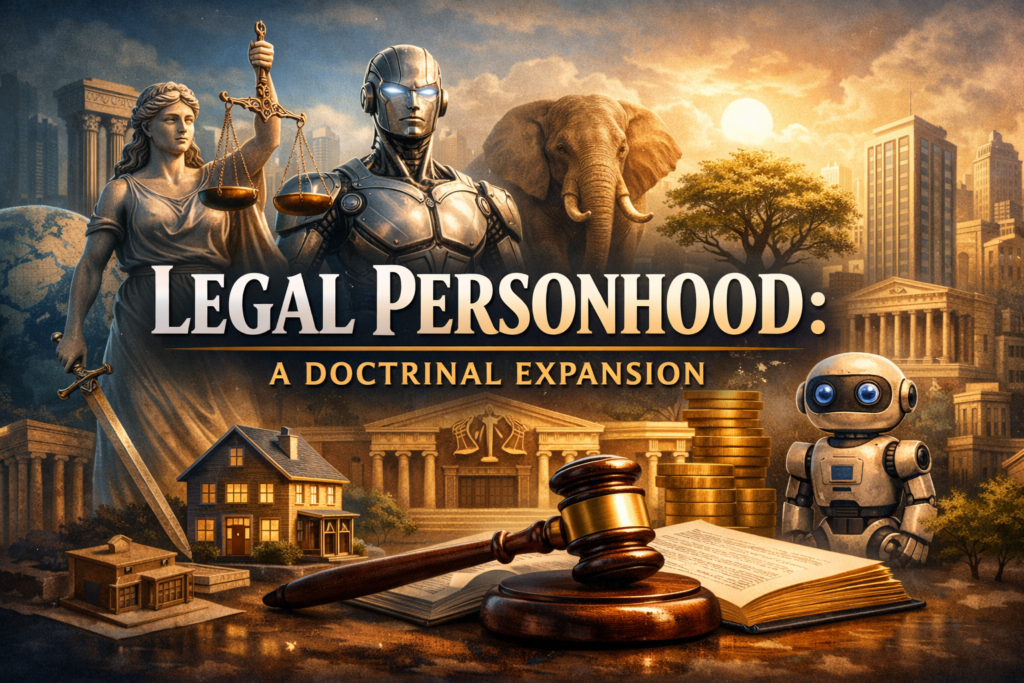
The modern legal landscape is experiencing an unprecedented expansion of the concept of personhood, moving far beyond its historical moorings in human and corporate identities to embrace non-human entities such as animals, natural features, and artificial intelligence. This article critically examines the doctrinal evolution of legal personhood, tracing its roots from ancient jurisprudence to contemporary judicial innovations, particularly within the Indian and comparative global context. By interrogating foundational theories—fiction, concession, realist, and aggression—and engaging with recent landmark cases, the analysis illuminates how courts and legislatures are renegotiating the boundaries between rights, duties, and legal recognition. The article pays special attention to the emergent phenomenon of conferring personhood on non-human entities, motivated by ecological, ethical, and technological imperatives. As society confronts complex legal and moral challenges spurred by environmental crises and the rise of autonomous AI, legal personhood is being leveraged as a functional tool for guaranteeing rights, imposing responsibilities, and ensuring justice for entities historically marginalized or excluded from traditional legal frameworks. Through a nuanced doctrinal and comparative approach, the article demonstrates that the expansion of legal personhood is not merely a theoretical project but a pragmatic response to the growing interconnectedness of human, non-human, and artificial agents in the fabric of law and society.
KEYWORDS: Legal personhood, Doctrinal evolution, Non-human entities, Corporate personality, Legal rights and duties, Judicial recognition of personhood
INTRODUCTION:
Legal personhood is a legal status granted by law that enables an entity—such as a human being, organisation, or even certain non-human entities like corporations or natural features like rivers—to possess rights and responsibilities within a legal system. This allows the entity to engage in legal actions, such as entering into contracts, owning property, being involved in lawsuits, and participating in legal matters in a manner similar to a natural person, who is a human being.
Legal personhood is a flexible and evolving concept, and its scope depends on the type of entity and the jurisdiction in which it is applied. The scope delimits what kinds of entities can be recognised as legal persons, the rights and obligations they can possess, and the legal activities they can participate in.
Entities Recognised as Legal Persons
- Humans (Natural Persons): Every human being is automatically a legal person with the ability to own property, contract, sue, and be sued.
- Corporations: Companies, limited liability partnerships, and other business organisations are widely recognised as legal persons. They can acquire assets, enter contracts, and initiate or face lawsuits.
- Non-Governmental Organizations (NGOs) and Charities: These entities often obtain legal personhood for administrative and operational purposes.
- Governmental Bodies: Municipalities, states, and government agencies are commonly granted legal personhood.
- Non-Human Entities (in select jurisdictions):
- Animals: In rare cases, animals have been granted limited legal personhood (for example, in animal rights cases).
- Natural Features: Rivers, forests, or other ecological sites have sometimes been recognized as legal persons for environmental protection.
- Artificial Intelligence (emerging debates): There are ongoing discussions about whether advanced AI systems might one day be given some aspects of legal personhood.
Rights and Responsibilities
The scope of the rights and duties of a legal person is not universal—it varies by jurisdiction and the type of entity:
- Contractual Capacity: Most legal persons can enter into contracts, acquire rights, and incur obligations.
- Ownership: Legal persons can own, lease, or sell property and assets.
- Litigation: They can bring suit or be sued in courts.
- Responsibility: Legal persons can be held liable for breaches of law and torts.
- Participation: Some legal persons (like corporations) can participate in commercial activities but cannot vote or marry.
- Protection: Legal persons may have certain protections under law, such as due process rights or privacy.
Limitations
- Not all entities have full legal personhood—limitations often restrict certain rights (e.g., voting, marriage, or political speech).
- Recognition and scope may vary by country and legal system, based on cultural, social, and legislative factors.
Historical Origins in Jurisprudence
The concept of legal personhood, including corporate personality, finds its roots in ancient Roman law, where a clear distinction was made between individuals and entities recognized by law as capable of holding rights and duties. This early legal framework allowed not only natural persons but also collective bodies, such as religious or civic groups, to function as single legal entities. During the medieval period, canon law further developed this idea by formally recognizing corporations, such as monasteries and guilds, as artificial persons capable of owning property and entering into contracts independently of their members. The Renaissance and natural law thinkers like Hugo Grotius and Samuel Pufendorf expanded on these ideas by emphasizing that legal personhood is the capacity to hold rights and obligations. Later, in the nineteenth century, this understanding was integrated into modern legal systems, especially through scholars like John Austin, who helped adapt the doctrine of corporate personality within the common law tradition, allowing corporations to act as separate legal actors under the law. This historical development highlights how the concept of legal personhood evolved from a basic legal distinction in ancient times to a sophisticated doctrine that underpins today’s recognition of corporations as entities with their own legal identity.
The scope of legal personhood is not static—it evolves as new societal needs, technological advancements, and values emerge. Courts and legislatures constantly reassess which entities merit legal personhood and what rights and responsibilities they should possess.
Importance of legal personhood in conferring rights and duties
The importance of legal personhood in conferring rights and duties lies in its function as the foundational legal status that allows both natural and artificial entities to participate in the legal system, enabling them to hold rights and bear duties. Legal personhood is what makes an entity—whether a human being, a corporation, or another organization—recognized by law as capable of suing, being sued, owning property, entering contracts, and fulfilling legal obligations. Without this status, entities cannot be subjects of legal rights or duties, as it is the law that grants this legal personality to facilitate orderly social and legal interactions.
Legal personhood ensures that rights and duties are legally attributed to the correct entities. For natural persons (humans), this includes civil rights like the right to life, privacy, and voting, as well as duties under the law. For legal/artificial persons such as companies or governments, legal personhood allows them to engage in legal proceedings, own assets, and be held accountable. The concept also extends to positions held by individuals, where legal duties attach to the role regardless who occupies it.
This framework creates a predictable legal environment where rights correspond to duties and where legal responsibility can be enforced. In essence, legal personhood is the “meeting point” where an entity acquires the capacity to possess rights and duties, making it indispensable for the functioning of law and justice in society.
Types of Legal Persons
Natural Person
A natural person refers to a human being who is recognized by the law as having the capacity to hold rights and obligations. From birth, natural persons are vested with legal personality, enabling them to own property, enter contracts, initiate or face lawsuits, and fulfil legal duties. However, some humans, such as minors or individuals deemed mentally incompetent in certain legal systems, may have limited recognition under the law. Natural persons act for themselves in legal matters.
Artificial Person
An artificial person, also known as a juridical or legal person, is an entity created by law that is not a human being but possesses certain legal rights and responsibilities similar to those of natural persons. Examples include corporations, governmental agencies, and other institutional bodies. These entities act through designated representatives or agents since they cannot perform actions independently. Artificial persons have the capacity to own assets, engage in contracts, and be parties to litigation, with the law treating them as separate from the individual members or stakeholders they comprise. This status is typically conferred upon registration or through legislation.
Emerging Legal Persons: Non-Human Entities
In recent years, legal systems—especially in India—have expanded the concept of legal personhood to include certain non-human entities. This group comprises animals, rivers, and religious or sacred institutions, which courts have accorded legal personality for the purpose of protecting their interests. For instance, animals and birds have been declared to possess welfare rights, with humans bearing the legal duty to protect them in a guardianship role, often termed “loco parentis.” Similarly, natural features like rivers have been granted legal rights, allowing them to be represented in court to safeguard environmental and ecological concerns. Since these entities cannot advocate for themselves, guardian representatives act on their behalf.
This broadened understanding of legal personhood reflects a fusion of traditional legal doctrine with evolving moral, ethical, and ecological perspectives, recognizing that legal rights and obligations need not be confined strictly to human beings or corporate bodies.
Doctrinal Foundation and Key Theories
Fiction Theory
Fiction theory views legal personhood as a creation of law rather than a reflection of reality. According to this perspective, legal entities like corporations are not actual persons but are treated as such through a legal construct designed for functional and practical purposes. The concept exists purely as a legal convenience, granting these entities rights and responsibilities despite lacking moral personhood or physical existence. This theory historically dominated legal thought but has faced criticism as perspectives on collective legal entities developed.
Concession Theory
This theory holds that legal personhood is something conferred by the state, typically through a formal grant such as a charter or legislative act. Under this approach, the existence and recognition of a corporation’s legal personality depend on official state permission, underscoring the sovereign authority in creating and regulating legal persons. The concession theory reflects older legal practices where corporate status was a special privilege subject to governmental control.
Realist Theory
Realist theory argues that legal personhood corresponds to entities possessing genuine qualities related to moral agency and rationality. From this viewpoint, entities deserving legal recognition are those that exhibit attributes central to being a moral person. Legal status derives from these inherent qualities rather than solely legal formalities. This theory includes variations where some accept all moral persons as legal persons, while others impose stricter criteria.
Aggression Theory
Less frequently referenced in typical legal discussions, aggression theory explores legal personhood through behavior and social interaction lenses, particularly focusing on traits like aggression. It is often used to analyze how law interprets or responds to persons based on their conduct in social or psychological contexts. This approach introduces a dynamic dimension to understanding legal subjectivity concerning individual behaviors.
Expansion of Legal Personhood
Recognition of Non-Human Entities as Legal Persons
There is a growing acceptance in courts around the world to recognize non-human entities such as rivers, forests, and sacred idols as legal persons. This shift aims to provide these entities with legal rights, primarily to ensure environmental protection and preserve cultural or religious values. Such recognition marks an important change from traditional human-cantered legal frameworks to approaches that acknowledge the inherent value of nature and non-human entities in society.
Electronic Personhood for AI and Robots in the EU
The European Union has engaged in discussions about granting a form of legal status called “electronic personhood” to AI systems and robots, particularly those with autonomous decision-making capacities. This concept is intended to address legal responsibilities and liabilities arising from the activities of AI entities. While initially proposed to resemble corporate legal status in some respects, the idea has met with criticism and skepticism, leading to a more cautious, risk-based regulation approach rather than formal personhood recognition for AI or robots. The focus remains on balancing technological progress with ethical, legal, and social considerations.
Legal Recognition of Animals as Sentient Beings
Legal systems are increasingly moving beyond viewing animals as mere property. Some landmark judicial rulings have recognized certain animals as deserving legal protections akin to persons due to their sentience. For instance, the case involving Sandra, an orangutan in Argentina, acknowledged her as a “non-human person” with fundamental rights such as freedom from captivity and harm. Similarly, in India, courts have empowered citizens to act as legal guardians for animals, recognizing their welfare interests. These developments reflect a broader ethical and legal trend towards respecting animals’ intrinsic worth and rights under the law.
RECENT JUDICIAL DEVELOPMENTS
- Case: Mohammad Salim v. State of Uttarakhand, 2017
In a landmark 2017 decision, the Uttarakhand High Court conferred legal personhood upon the Ganga and Yamuna rivers. The Court recognized these rivers as living entities vested with enforceable rights aimed at their protection, preservation, and conservation amidst severe threats from pollution and environmental harm. Highlighting their profound cultural, spiritual, and social significance to India, the Court acknowledged the rivers’ essential contributions to both the livelihood and spiritual well-being of millions. To uphold these rights, the Court appointed certain state officials as “legal guardians” tasked with acting on the behalf of the rivers. This recognition extended not only to the main rivers but also to their tributaries, glaciers, forests, and wetlands in Uttarakhand, adopting a comprehensive ecological protection approach. This ruling marked a major innovation in Indian environmental law by transitioning from an anthropocentric to a rights-based model of nature protection. However, this recognition was later overturned by the Supreme Court due to legal and constitutional limitations.
- Case: Animal Welfare Board of India vs A. Nagaraja & Ors, 2014
On May 31, 2019, the Punjab and Haryana High Court delivered a significant decision affirming that all animals, including birds and aquatic creatures, should be regarded as legal entities with rights, duties, and liabilities comparable to human persons. The Court further declared that every resident of Haryana acts in the capacity of a legal guardian (in loco parentis) collectively responsible for ensuring animal welfare and protection throughout the state. This judgment reflects an eco-centric viewpoint, affirming that legal personhood and intrinsic value extend beyond humans to encompass non-human species.
The Court relied on the Supreme Court’s 2014 ruling in Animal Welfare Board of India v. Nagaraja, which interpreted Article 21 of the Constitution as guaranteeing animals the right to live with dignity and protection from cruelty. It emphasized that animals are sentient beings with emotions and needs and underscored the state’s constitutional and moral obligation—through the doctrine of parens patriae—to act on their behalf since animals cannot represent themselves. The judgment also drew from India’s rich cultural and religious ethos, particularly the principle of Ahimsa (non-violence) prevalent in Hinduism, Buddhism, and Jainism, blending traditional values with contemporary legal reasoning. While the Court did not specify a detailed list of rights arising from personhood, this ruling signifies a transformative advancement in Indian animal law, opening avenues for expanded ethical and legal recognition on a broader scale.
CONCLUSION
The expansion of legal personhood represents a transformative shift in legal theory and practice, reflecting the law’s adaptation to contemporary challenges that extend beyond human and corporate entities. Modern legal systems increasingly recognize non-human beings—such as animals, rivers, and artificial intelligences—as holders of certain rights and responsibilities, acknowledging their intrinsic value and societal importance. This broader, more flexible notion of personhood allows the law to address complex ecological, ethical, and technological issues by granting legal standing and protections to entities that were historically excluded. By doing so, it not only promotes justice and accountability but also strengthens the law’s role as a dynamic instrument capable of balancing human interests with those of nature and emerging forms of artificial agency. This doctrinal evolution is critical for ensuring that legal frameworks remain relevant and responsive in an interconnected and rapidly changing world.