This article has been written by Abhishek Singh Solanki, a 5th-year law student at Central University of South Bihar.

***This article has been selected for LegalOnus Law Journal (LLJ), ISSN: 3048-8338, in Volume 1, Issue 9.
Abstract
|
Gherao is a distinctive and controversial method of demonstration primarily associated with labour movements in India. The term, derived from vernacular origins meaning “to encircle” or “to surround,” refers to the act of physically confining an employer or authority within a specific place to compel the acceptance of workers’ demands. The practice gained prominence during the labour unrest in West Bengal in the late 1960s, reflecting deep dissatisfaction with exploitative working conditions and ineffective industrial dispute mechanisms. Gherao operates at the intersection of constitutional freedoms and criminal liability. While Articles 19(1)(b) and 19(1)(c) of the Indian Constitution protect the rights to peaceful assembly and association, the coercive element of gherao may infringe Article 21, which guarantees personal liberty. Moreover, provisions under the Indian Penal Code relating to wrongful restraint and wrongful confinement may render such actions unlawful. Judicial decisions, particularly in Jay Engineering Works Ltd. v. State of West Bengal and Tata Iron and Steel Co. Ltd. v. Workmen, have largely characterized gherao as an illegal and coercive form of protest. Despite its legal constraints, gherao has served as a powerful tool for worker empowerment, collective bargaining, and social awareness. It exposes failures in industrial relations and compels administrative accountability. However, its disruptive and coercive nature can damage industrial harmony, cause economic loss, and infringe individual rights. Thus, gherao remains a complex instrument of protest requiring careful legal and policy balancing. Keywords: Gherao; Labour Protest; Wrongful Confinement; Industrial Disputes; Right to Assembly; Industrial Relations |
Introduction
“We have bigger houses but smaller families; more conveniences, but less time; we have more degrees, but less sense; more knowledge, but less judgment; more experts, yet more problems; more medicine, but less wellness.”[1] As the society is approaching towards the modern world it is getting much more materialistic due to which man power is being exploited to satisfy those materialistic goals.[2] This means that exploitation has become the main essence of today’s world. The period of laissez faire helped the capitalist employer in exploiting the labourers. This period restricted any sort of interference on the freedom of trade and commerce by the state.[3] However the scenario got changed when the concept of state developed into welfare state. The period of 1970’s emphasised the importance of the Right to dignified life[4] as well as various International declarations such as Universal Declarations on Human Rights, 1948 has also played the significant role in upliftment of the labours conditions.
This does not mean that after these initiatives the problems of workers have been solved. Still they are facing day to day problems at their work places and in various forms they try to retaliate.[5] Gherao is one such kind of retaliation.
Meaning
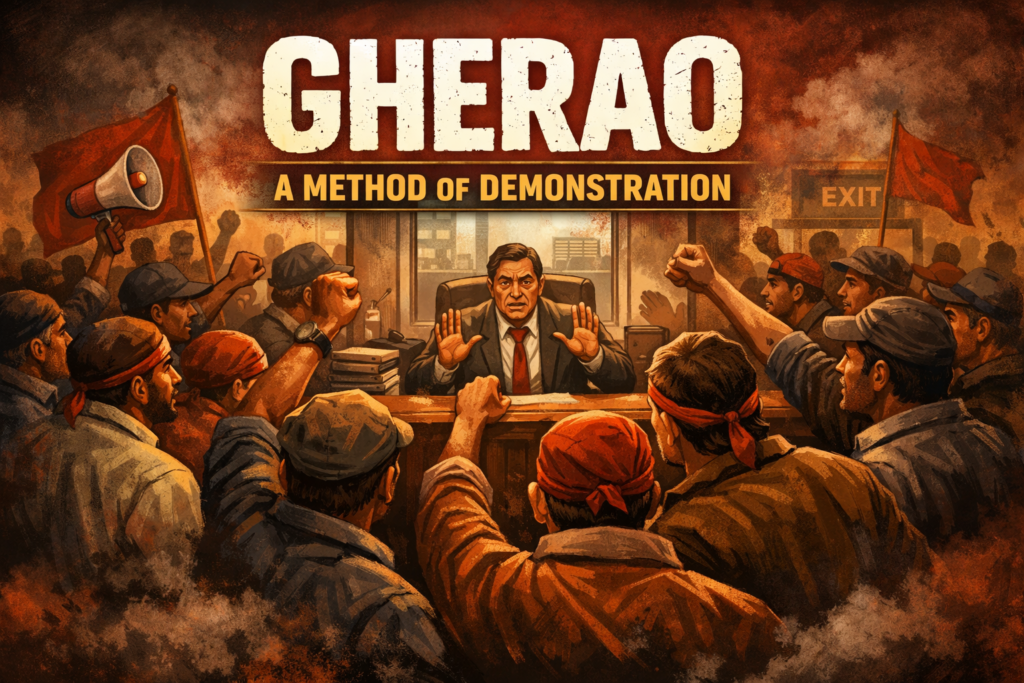
The term “Gherao” has a vernacular origin[6] and refers to the practice of confining a person to a specific location where they are not allowed to move freely.[7]
The term in general means, form of industrial action in which workers imprison their employers on their premises until their demands are met.[8]
Monier Williams, Boden, stated that the word “ghar” (gharayatiyitam) means “to cover”. In Wilson’s Glossary of Legal Terms, “gher” or “ghero” or “gherna” are Persian words which mean “to surround encircle fence or to bind a hedge.’
The case Jay Engineering Works Ltd. and State of West Bengal and Others,[9] examined the origin of the term “Gherao”. The judges mentioned that “gherao” can be found in some Bengali dictionaries and is derived from the Hindi word “ghirao” or even from the Sanskrit word “ghiri,” which means “to cover or encircle.” In simple terms, “gherao” means encircling a target and not allowing them to move in any direction.
As per the Rule 7 (3) of the Central Civil Services (Conduct) Rules, the definition of gherao can be inferred as confinement by surrounding the places of duty and have held demonstration/meetings both within office premises during office hours and also outside the office premise beyond office hours, tending to forcibly confinement of public servants within office premise.
In simple terms the practise of gherao is coercive[10] in nature and where the victim is encircled by workers to prevent them from entering or leaving a particular place. The important element of Gherao are wrongful restraint and wrongful confinement.[11] In some cases, gheraos take a troubling turn where the victim is subjected to cruel and inhuman confinement without basic amenities like water and fans.[12] This kind of mercy less act not only violated the societal norms rather it also a sheer violation of the Article 21.
History
As the origin of the term was emphasised in the case of Jay Engineering Works Ltd. and State of West Bengal and Others,[13] The judges mentioned that “gherao” can be found in some Bengali dictionaries.
The gherao movement became wide spread in Bengal during the United Front regime in 1967 and its resurgence in 1969. Gherao, a militant movement[14] where workers encircle management to coerce demands, is deemed illegal under Indian law. Despite judicial condemnation, the police remained inactive during the movement’s resurgence, leading to a conflict between the judiciary and the executive. The movement was influenced by the political transition in West Bengal, with Leftist parties supporting the working class and neutralizing the administrative machinery’s coercive power.[15] The gherao movement highlighted the failure of the existing industrial relations system and the alienation between the managerial elite and the working class. It also served as a training ground for local trade union leaders.
Positive aspects of Gherao
Some of the key positive aspects of gherao that can be understood from the West Bengal movement are-[16]
- Empowerment of workers: the agitation gave the sense over their working conditions and rights. It gave the courage to directly confront the authorities for their demand.
- Awareness and Unity: The gherao movement created the awareness and unity among the workers. It brought together various trade union and political parties created a unified front to address the workers grievances.
- Industrial relation issues: the gherao movement highlighted the failures of existing industrial relation.
- Social change and Intervention: the movement can be considered as a tool for social intervention[17] and challenges the legitimacy of the bureaucrats.
Negative aspects of Gherao
Some of the key negative aspects of gherao that can be understood from the West Bengal movement are-[18]
- Illegality and Coercion: Gherao involve illegal confinement and coercive force which are considered illegal. Sometimes due to its coercive nature it can also violates the personal liberties.
- Disruption of Industrial Relations: One of the reasons for the agitation was failure of Industrial relation which can often lead to prolonged business suspension and disrupted industrial relation.
- Economic impact: Such kinds of agitations often impact the productivity which ultimately leads to economic loss.
- Judicial and police conflict: the agitation in West Bengal created a chaos between the Judiciary and the Police.
- Psychological Harm: The gherao creates a situation of mental pressure and in certain cases denial of basic amenities.
Gherao vs Strike
These two are the forms of protest used by workers. However, they are significantly different.[19]
- In strike there is concerted cessation[20] of work by employees to pressurize the employers for meeting their demands whereas in Gherao workers physically block the employers preventing them from leaving a particular area.
- Strikes are recognised under labour law and is used as a last resort when negotiations fail. But gherao is not widely recognised or considered illegitimate form of protest due to its consequences.
- Strike can take place in various forms like- general strike, go slow, mass casual leave and more. Whereas gherao takes place by encircling the target.
Legal Frameworks Governing Gherao
Since ancient times gherao has been considered as an effective form of agitation. Although it has not been explicitly recognized as a legal form of agitation under Indian labour Laws. Following are the key provisions with regards to Gherao:
- Under Indian Constitution
- 19(1)(b)- talks about the right to assemble peacefully without arms
- 19(1)(c)- Provides the right to form association or unions.
These two articles give the right to workers to protest in a peaceful manner. Although the coercive element of gherao may breach the essence of these provisions.
- 21- guarantees the right to life and personal liberty.
In case of confinement[21] during the gherao, this provision can be violated as there will be unlawful restraining a person’s freedom of movement.
- Under the Indian Penal Code, 1860
- 339- This section defines Wrongful Restraint as unlawfully preventing any person from proceeding in any direction in which they have a right to go. Gherao can be classified as wrongful restraint.
- 341- prescribes punishment for wrongful restraint which may lead to simple imprisonment of up to 1month or a fine, or both.
- 340- this section defines Wrongful Confinement as wrongfully restraining any person in such a manner as to prevent them from proceeding beyond certain circumscribed limits. Gherao also involves the element of physical confinement of an individual within a limited space.
- 342- provides the punishment for wrongful confinement, which can result in imprisonment for up to one year, a fine or both.
- Under Industrial Dispute Act, 1947
The Industrial Dispute Act, 1947 does not explicitly deals with the Gherao. However, there are certain provisions of which relevant due the nature of the gherao i.e. disruptive and coercive nature. Those provisions are:
- 2(q)- defines the term Strike. Gherao involves stopping of the work which may fall under the broad definition of the strike but due to its additional coercive nature makes it difficult to fit in the definition of strike.
- 2(ra)- defines Unfair Labour Trade Practices as any actor omission by employers or workers that are harmful to industrial peace or violate the principles of fair conduct. Gherao could be considered as unfair trade practices due its characteristics like coercion, unlawful nature, physical confinement, acts of intimidation, obstruction of work.
- 25T- Prohibition of Unfair Labour Practices. This section prohibits the workers from engaging in the unfair labour trade practices.
- 25U- Penalty for Committing Unfair Labour Practices. Any person committing unfair labour trade practices shall be punishable with imprisonment up to 6 months or with a fine up to Rs. 1,000 or with both.
- 23- Prohibitions of Strike and lockout during certain conditions like when the conciliation proceeding is going or during the pendency of a dispute before the labour Court. Although this section explicitly talks about the strike but the same time gherao cannot be also used as an alternative method of protest.
- 10- Provides a mechanism for referring industrial dispute to Board, Courts and Tribunals. If gherao is being is used while the formal mechanism for dispute resolutions are available then the management can refer the matter to Labour Court.
Judicial Interpretations
- Jay Engineering Works vs. State of West Bengal[22]
- This case is considered to be the landmark for the concept relating to gherao. This case was decided by the Calcutta High Court where the term gherao was defined and ultimately the held the same was illegal form of protest. As the confinement involves the direct violation of the Article 21 of the Indian Constitution. The court also added that the gherao could be prosecuted under criminal law.
- Tata Iron and Steel Co. Ltd Vs Workmen[23]
- In this case the Court held the gherao as illegal. While discussing about the in industrial misconduct, the Court said that any act which impairs the business or intimidate management, like gherao would be considered illegal.
- Bharat Sugar Mills Ltd. Vs Jai Singh[24]
- This case did not directly deal with gherao but in this case court disapproved all those industrial actions which disrupts the operation of business by unlawful means. So, this precedent can also be applied to Gherao.
Analysis of the impact of gherao (with the help of Incident)
Women are considered to be the one of the vulnerable sections[25] of the society and they are various initiative organised in order to uplift their status. However, this upliftment is not for the betterment of a particular gender rather it is for the betterment of the society as whole.
One such incident took place in Atarra, Uttar Pradesh where a group named Pink Gang organised an agitation which led to fruitful outcome for the whole village.[26] Pink gang is also known as Gulabi Gang which is a women’s vigilant group founded by Sampat Pal Devi in 2006 in Banda District of Uttar Pradesh. In 2008 this group organised a Gherao of the electricity office because the area was without the electricity supply for over the fortnight as well as there was a problem of fraudulent bills for the power they never received. The gherao led to a successful outcome.[27] The officials were pressurised to restore the electric supply and also made them address the issue of fraud bills.
This incident had significantly impacted the society such as-
- Empowerment of women- this demonstrated the power to stand against corruption and injustice.
- Increased awareness- this incident increased awareness with regards to issues of corruption and also created a demand for effective grievance addressing mechanism.
- Changing Tradition Gender Roles- this action showed that women could also be powerful agent of change.
- Community solidarity- this incident showcased that the collective action demonstrates the power of unity in achieving common goals.
Conclusion
The practice of gherao as a form of demonstration has played a significant role in labour movements and social justice struggles, particularly in India. Originating as a non-violent method to assert workers’ demands and grievances, gherao involves the encirclement of an authority or workplace, symbolizing the collective strength of protestors and the intensity of their demands. While gherao empowers marginalized voices and brings attention to social and economic injustices, it has raised complex legal and ethical issues. Questions of its legitimacy, its potential for coercion, and the balance between civil rights and public order often come to the forefront.
Legally, gherao occupies a grey area, especially when peaceful assembly crosses into coercive tactics that disrupt public order or impede personal freedoms. Courts have occasionally upheld it as a illegitimate form of expression, while also issuing restrictions to prevent unlawful detainment or physical harassment. This ambivalence underscores the need for clear legal frameworks that respect the right to protest while safeguarding individual rights and social harmony.
In conclusion, gherao remains a powerful tool for expressing dissent and addressing grievances, yet its continued relevance requires a nuanced[28] approach in law and policy. Efforts should focus on balancing the rights of workers and protestors with those of employers and the public, promoting dialogue over confrontation. By doing so, societies can honour the spirit of gherao as a voice for justice while adapting its practice to contemporary standards of legality and ethics.
[1] By the Dalai Lama.
[2] O.P. Parmar, “I.L.O. and Indian in Pursuit of Human Rights Through Labour Standards” 23 Journal of Indian law institute 555 (1981).
[3] ibid
[4] Maneka Gandhi v. Union of India AIR 1978 SC 597.
[5] Lifestyle desk, “Indian Employees reported felling either ‘struggling’ or ‘suffering’ at work in latest report”, The Indian Express, June 14, 2024, available at https://indianexpress.com/ (last visited on Nov 9, 2024)
[6] Definition, Oxford English Dictionary, available at https://www.oed.com/dictionary (last visited on Nov 10, 2024)
[7] Shrikant Malegaonkar, “Types of Strikes Regarding Industrial Disputes in India” 4 International Journal of management and Humanities 8 (2019)
[8] Definition, Collins Dictionary, available at https://www.collinsdictionary.com (last visited on Nov, 10 2024)
[9] AIR 1968 Cal 407
[10] Nitish R De, “Gherao as a Technique for Social Intervention”, 5 Economic and Political Weekly 201 (1970)
[11] Central Civil Services Conduct Rules, 1964 R. 7(3).
[12] Supra note 8
[13] Supra note 10
[14] Supra note 11
[15] Supra note 11 at 1-3
[16] Supra note 11 at 1-7
[17] Definition of social intervention- Social Intervention refers to deliberate actions taken to bring about positive change in society often addressing issues such as inequality, injustice, and community needs. -fiveable
[18] Supra note 11 at 1-7
[19] Supra note 8 at 1-3
[20] Definition of Concerted Cessation- Stoppage of Work- Marriam Webster Dictionary
[21] Definition of confinement- the situation in which a person or animal is kept somewhere usually by force. -Cambridge dictionary
[22] Supra Note 10
[23] 1972 11 LLJ 259
[24] 1961 Lawsuit (SC) 411
[25] Memi Rani Chintey, “Women and Children as Vulnerable groups in India: Their Health and Human Rights”, 19 IOSR Journal of Humanities and Social Science 1 (2014)
[26] Amana Fontanella khan, Encircled in Pink: The Gulabi Gang& The Gherao (last visited on Nov 5, 2024)
[27] ibid
[28] Definition od Nuance: a subtle distinction or variation. -Marriam Webster Dictionary