This article has been written by Kilimi Praneeth Reddy a law student pursuing the B.A. LL.B. (Hons.) program at Dr. Ram Manohar Lohiya National Law University (RMLNLU), Lucknow.

Abstract
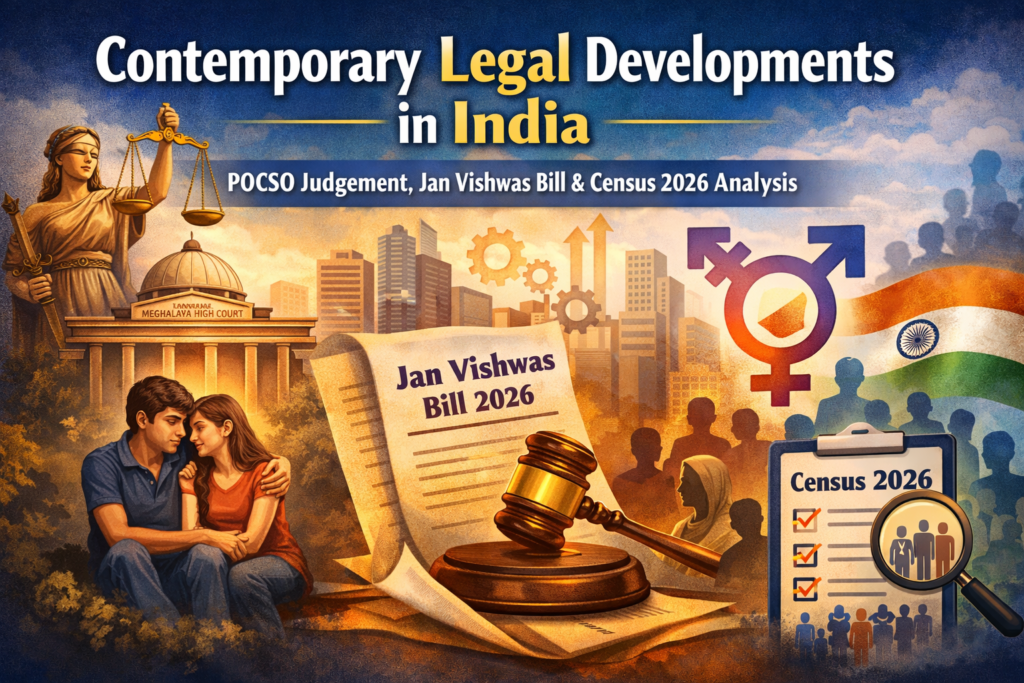
Recent legal and policy developments reflect a dynamic interplay between constitutional rights, statutory interpretation, and governance reforms in India. The decision of the Meghalaya High Court introduces a nuanced approach to the Protection of Children from Sexual Offences Act, 2012 by allowing limited judicial intervention in consensual, adolescent relationships, thereby balancing child protection with contextual justice. Simultaneously, the Jan Vishwas (Amendment of Provisions) Bill, 2026 represents a significant shift from criminalisation to administrative regulation, promoting ease of doing business and reducing judicial burden.
In the realm of fundamental rights, the Rajasthan High Court has reaffirmed the constitutional guarantee of self-identified gender identity, cautioning against legislative dilution under the Transgender Persons (Protection of Rights) Amendment Bill, 2026, and reinforcing the principles laid down in NALSA v Union of India. Further, the Andhra Pradesh High Court has clarified succession law under the Hindu Succession Act, 1956, ensuring that parental property inherited by a female devolves within the natal lineage, thereby protecting statutory intent and gender-sensitive inheritance norms.
At the policy level, the upcoming census, conducted under the Census Act, 1948, marks a critical administrative exercise, especially with the inclusion of caste enumeration, which has far-reaching implications for reservation policies, governance, and social justice. Collectively, these developments demonstrate a broader legal trend towards balancing rigidity of law with fairness, strengthening constitutional morality, and promoting data-driven governance.
Keywords: POCSO, Adolescent Consent, Decriminalisation, Jan Vishwas Bill, Administrative Law, Transgender Rights, Self-Identification, NALSA, Hindu Succession Act, Section 15(2)(a), Natal Property, Census Act, Caste Enumeration, Article 14, Article 21
Consensual Adolescent Relationships and POCSO: Meghalaya High Court Balances Law with Ground Realities
Introduction
In a significant development addressing the rigid application of child protection laws, the Meghalaya High Court has held that proceedings under the Protection of Children from Sexual Offences Act, 2012 may be quashed in exceptional cases involving consensual adolescent relationships to prevent “manifest injustice.” While reaffirming that the statutory age of consent remains binding, the Court emphasised that courts must account for ground realities and ensure that the law does not produce disproportionately harsh outcomes.
Factual Background
The issue arose before a Division Bench comprising Chief Justice Revati Mohite Dere and Justice H S Thangkhiew in a reference concerning:
Whether POCSO proceedings can be quashed based on consent under Section 528 of the Bharatiya Nagarik Suraksha Sanhita, 2023, despite the overriding nature of the statute.
The Court examined recurring cases where:
- Adolescents aged 16–18 years engage in consensual relationships
- Complaints arise due to parental opposition
- Victims later turn hostile during trial
Core Legal Issue
- Whether High Courts can exercise inherent powers to quash POCSO proceedings in consensual adolescent relationships, without undermining the statutory framework?
- Reasoning of the High Court
The Court recognised a fundamental tension within the POCSO framework:
- The age of consent is fixed at 18 years
- Consent of the minor is legally immaterial
However, the Court stressed that rigid application may lead to injustice.
Key Judicial Observation
“Although the statutory age of consent remains binding… the facts of each case, particularly age proximity, voluntariness of the relationship and future wellbeing… must be considered so that the object of the law is preserved without doing manifest injustice.”
The Court further clarified:
- The High Court’s inherent powers are of “wide plenitude”
- They can be exercised to secure the ends of justice or prevent abuse of process
Recognition of Ground Realities
The Court highlighted the practical realities of such cases:
- Many cases involve teenagers in consensual relationships
- Boys often face serious criminal prosecution
- Victims frequently withdraw support or turn hostile
It observed:
“In a lot many cases… adolescent relationships… complaints arise due to parental opposition… the boy is made to face the full rigour of criminal process… making the damage irreversible.”
Socio-Cultural Context
A significant aspect of the judgment is its emphasis on regional realities in Meghalaya:
- Prevalence of adolescent relationships leading to cohabitation or marriage
- Existence of matrilineal societal structures
- Limited access to legal awareness in rural and tribal areas
The Court cautioned that:
Mechanical application of law without considering context may defeat its purpose
- Limits and Safeguards
Despite allowing quashing in certain cases, the Court imposed strict limitations:
- No blanket rule–case-by-case assessment required
- Verification of genuine and informed consent
- Consideration of age proximity
- Ensuring that justice is not compromised The Court reiterated:
“POCSO offences are not merely private disputes but offences against society.”
Final Determination
- The Court concluded that:
- Quashing of POCSO proceedings is permissible only in exceptional cases
Particularly where:
- The relationship is consensual
- Parties are close in age
- Continuation of prosecution would cause injustice Key Conclusion by Court
“Rendering justice demands… fairness, compassion and empathy… where parties are living together… sending the boy to jail would not serve the cause of justice.”
Legal Significance
This judgment is crucial because it:
- Introduces judicial flexibility in rigid statutory framework
- Balances child protection with individual justice
- Prevents misuse of POCSO in romantic adolescent cases
- Reinforces inherent powers of High Courts
It reflects a shift from mechanical enforcement into contextual justice.
Conclusion
The ruling of the Meghalaya High Court represents a nuanced approach to a complex socio-legal issue. While upholding the protective intent of the POCSO Act, the Court has ensured that its application does not result in unjust and disproportionate consequences. By recognising the realities of adolescent relationships and allowing limited judicial intervention, the decision reinforces that law must be applied with sensitivity, not rigidity. Ultimately, the judgment highlights a critical principle:
Justice must not only be lawful, but also fair, humane, and context-sensitive.
Jan Vishwas 3.0: Decriminalisation of Minor Offences and the Shift Towards Regulatory Governance
Introduction
In a significant step towards regulatory reform and ease of doing business, the Union Government has introduced the Jan Vishwas (Amendment of Provisions) Bill, 2026 in the Lok Sabha. The Bill proposes large-scale decriminalisation of minor offences across multiple statutes, reflecting a policy shift from punitive criminal enforcement to administrative and civil penalty-based regulation. The initiative aligns with the principle of “Minimum Government, Maximum Governance” and seeks to reduce compliance burdens while enhancing trust in the regulatory framework.
Legislative Background
The Bill builds upon earlier reform efforts:
- Jan Vishwas Act, 2023
- Jan Vishwas reform exercise of 2025 Key proposals include:
- Amendment of 784 provisions
- Across 7G Central laws
- Administered by 23 Ministries
- 717 provisions to be decriminalised
- 67 amendments focused on ease of living
Objective of the Bill
The Statement of Objects and Reasons highlights:
Fear of imprisonment for minor offences creates a “trust deficit” and hampers business growth.
The Bill aims to:
- Promote ease of doing business
- Enhance ease of living
- Reduce judicial burden
- Encourage voluntary compliance
Core Reform: Decriminalisation
The central transformation under the Bill is:
Shift from Criminal Liability into Civil/Administrative Penalties Earlier framework:
- Punishment through criminal prosecution
- Trial before Magistrates
- Imprisonment + fine New framework:
- Adjudication-based mechanism
- Liability determined administratively
- Imposition of monetary penalties
Key Legislative Changes
-
- Colonial-Era Laws Reformed
- Cattle Trespass Act, 1871
- Colonial-Era Laws Reformed
- Criminal liability replaced with penalty up to ₹5,000
- Works of Defence Act, 1903
- Non-violent violations → monetary penalties
Violent acts is still still criminal
- Court Fees Act, 1870
- Non-fraud violations shifted to civil penalties
- Regulatory and Welfare Laws
- Drugs and Cosmetics Act, 1940
- Minor violations are financial penalties linked to value
- Pharmacy Act, 1948
- Increased penalties + daily fines for continued breach
- Dock Workers (Regulation of Employment) Act, 1948
- Graded penalties for repeated violations
- Modern Statutes
- Motor Vehicles Act, 1988
- Procedural simplification
- New Delhi Municipal Council Act, 1994
- Compliance and taxation reforms
Regulatory Shift: Criminal to Administrative State
- The Bill reflects a broader transformation:
- Criminal prosecution
- Magistrate trial
- Imprisonment
- Deterrence-based
- Administrative adjudication
- Executive authority decision
- Monetary penalty
- Compliance-based
- Legal and Policy Implications
- Reduces criminalisation of minor conduct
- Promotes business-friendly environment
- Decreases court pendency
- Encourages self-compliance Concerns and Challenges
- Risk of over-delegation to executive authorities
- Possible dilution of deterrence in serious cases
- Need for safeguards against arbitrary penalties
- Ensuring transparency and accountability
Broader Significance
- The Bill represents:
- A move from punitive governance to facilitative governance
- Alignment with global trends of decriminalisation of regulatory offences
- Attempt to modernise colonial-era legal frameworks
Conclusion
The Jan Vishwas 3.0 Bill marks a transformative step in India’s regulatory landscape by redefining the approach to minor offences. By replacing criminal sanctions with administrative penalties, the law seeks to strike a balance between regulation and economic freedom. While the reform enhances ease of doing business and reduces judicial burden, its success will depend on effective implementation, institutional safeguards, and ensuring that decriminalisation does not lead to regulatory laxity. Ultimately, the Bill reflects a fundamental shift in legal philosophy: From punishment-based control to trust-based compliance, signalling a modern and pragmatic approach to governance.
Transgender Rights and Constitutional Identity: Rajasthan High Court Warns Against Dilution of Selfhood under Transgender Bill, 2026
Introduction
In a significant constitutional intervention, the Rajasthan High Court has raised serious concerns regarding the Transgender Persons (Protection of Rights) Amendment Bill, 2026, cautioning that it risks diluting the fundamental right to self-identified gender. The Court emphasised that selfhood and identity are intrinsic constitutional rights, and any legislative framework that subjects them to State control may render such rights “illusory.”
Factual Background
The observations were made by a Division Bench comprising Justice Arun Monga and Justice Yogendra Kumar Purohit in Ganga Kumari v State of Rajasthan, while dealing with:
A petition challenging lack of reservation for transgender persons in education and public employment
The case also examined:
- A State notification classifying transgender persons as OBC
- Absence of effective affirmative action
- Impact of the 2026 Amendment Bill on gender identity
Core Constitutional Issue
Whether conditioning gender identity on State certification violates:- Article 14 (Equality)
- Article 15 C 16 (Non-discrimination)
- Article 21 (Dignity C Personal Liberty)
Judicial Reasoning
The Court strongly relied on the landmark judgment of NALSA v Union of India, which recognised:
Right to self-identified gender identity as a fundamental right
Key Judicial Observation
“What was recognized… as an inviolable aspect of personhood now risks being reduced to a contingent, State-mediated entitlement.”
The Court criticised the Bill for:
- Introducing certification and scrutiny mechanisms
- Undermining self-perceived gender identity
- Converting a right into a conditional privilege
Principle of Selfhood
The Court made a powerful constitutional declaration:
“Selfhood is not a matter of concession, it is a matter of right.”
It further held
Gender identity is an intrinsic part of:
- Dignity
- Autonomy
- Personal liberty
Social Reality vs Cultural Recognition
- The Court highlighted a paradox:
- Indian tradition recognises transgender identities (e.g., Mohini, Ardhanarishvara)
- Yet, transgender persons face:
Social exclusion, Economic marginalisation Institutional discrimination Judicial Reffection
“Their social exclusion, economic vulnerability and institutional discrimination continue to define their daily existence.”
Reservation and Policy Concerns
The Court examined the State’s classification of transgender persons as OBC and found:
- It failed to provide actual reservation benefits
- It removed existing benefits of SC/ST/SEBC transgender persons
Critical Observation
“This results in a manifestly anomalous consequence… individuals lose more beneficial protections previously available.”
The Court termed the policy:
- “An exercise in form without substance”
- “Illusory and ineffective”
- Directions Issued by the Court The Court directed the State to:
- Constitute a Committee for comprehensive study
- •Include experts and transgender representatives
- Recommend affirmative measures
Interim Relief
3% additional weightage in:- Public employment
- Educational admissions
Constitutional Warning to the State
- The Court emphasised:
“Statutory developments cannot be implemented in a manner that dilutes constitutional guarantees.”
It further added:
The State must ensure:
- Constitutional congruity
- Substantive equality
- Protection against procedural barriers
- Legal Significance
This judgment is crucial because it:
- Reaffirms NALSA principles
- Protects gender identity as a fundamental right
- Challenges bureaucratic control over identity
- Highlights need for effective affirmative action It reflects a broader shift:
Conclusion
The Rajasthan High Court’s ruling marks a powerful reaffirmation of constitutional morality over statutory formalism. By emphasising that identity cannot be subject to administrative approval, the Court has protected the core principle of dignity embedded in Article 21. While recognising the State’s role in policy-making, the judgment cautions that such policies must not undermine fundamental rights. Ultimately, the decision underscores a transformative constitutional idea:
Rights must be real, effective, and lived—not symbolic or procedural.
Devolution of Female Hindu’s Property: Andhra Pradesh High Court Clarifies Husband Has No Right Over Parental Property
Introduction
In an important clarification of succession law, the Andhra Pradesh High Court has held that property inherited by a female Hindu from her parents does not devolve upon her husband or his heirs if she dies intestate without children. The ruling reinforces the special scheme under Hindu Succession Act, 1956, particularly Section 15(2)(a), which prioritises the natal family line in such cases.
Factual Background
The dispute arose in Chikkala Devika Manasa v State of Andhra Pradesh involving:
- Property originally owned by a grandmother
- Gifted to her first granddaughter (2002)
- Granddaughter died intestate and childless (2005)
Subsequent developments:
- The gift deed was cancelled by the grandmother
- Property bequeathed to second granddaughter (petitioner)
- Mutation granted in the petitioner’s favour. However:
- The husband of the deceased granddaughter challenged the mutation
- Joint Collector ruled in his favour
- Matter reached the High Court
- Core Legal Issue
- Whether a husband can claim rights over property inherited by his deceased wife from her parents, when she dies intestate without children?
Statutory Framework:
The Court relied on:
Section 15(2)(a), Hindu Succession Act, 135CThis provision states:
- Property inherited by a female from her parents
- Shall devolve upon heirs of her father
- If she dies without children
Judicial Reasoning
Justice Tarlada Rajasekhar Rao interpreted the provision strictly and clearly:
Key Judicial Observation
“The bare reading of Section 15(2)(a)… clearly outlines that if the property is inherited by a female Hindu from her father or mother… the property shall go to the legal heirs of father. The husband will not get any right.”
The Court emphasised:
- Section 15(2)(a) is an exception to general succession rules
- It preserves property within the parental lineage
- Husband has no independent right unless derived through valid title
Application to Present Case
The Court found:
- Deceased granddaughter died without children
- Property was inherited through maternal lineage
- Husband had no legal entitlement
It further held:
- Husband cannot challenge cancellation of gift deed
- He derived no title from his wife
Judicial Clarification
“…when the respondent is not entitled under Section 15(2)(a)… he cannot claim any right over the property.”
- Decision of the Court The High Court:
- Set aside the Joint Collector’s order
- Restored petitioner’s claim
- Directed mutation of property in petitioner’s name
- Legal Significance
This judgment is significant because it:
- Clarifies scope of Section 15(2)(a)
- Protects property rights of natal family
- Prevents indirect claims by husband’s lineage
- Reinforces gender-sensitive succession framework
Conceptual Understanding
Special Rule under Section 15(2)(a)
- Situation
° Female inherits from parents C dies childless
° General rule (Section 15(1))
- Property devolves to
° Heirs of the father
° Husband C heirs
Thus, Section 15(2)(a) overrides general ruleConclusion
The Andhra Pradesh High Court’s ruling reaffirms the legislative intent behind the Hindu Succession Act—to ensure that property inherited by a woman from her parental family remains within that lineage in the absence of direct descendants. By denying rights to the husband in such cases, the Court has upheld both statutory clarity and equitable principles. Ultimately, the judgment establishes a clear legal position:
Succession must follow statutory intent, not relational proximity.
Census 2026: Registrar General Announces Commencement of First Phase; Caste Enumeration in Second Phase
Introduction
In a significant administrative development with wide constitutional and policy implications, the Registrar General of India has announced that preparations for the upcoming national census are at an advanced stage, with the first phase scheduled to commence from April 1. Notably, the exercise will include caste enumeration in the second phase, marking a crucial shift in India’s demographic data collection framework.
Constitutional and Legal Framework
The census in India is conducted under:
Census Act, 1948Additionally:
- It flows from Union List (Entry 6G) under the Constitution
- It is a statutory and sovereign function of the State
- Structure of the Census Process The census is conducted in two phases:
Phase I: House Listing and Housing Census
- Begins from April 1, 2026
- Collection of data relating to:
Household characteristics
Phase II: Population Enumeration
- Involves detailed demographic data
- Includes:
Caste enumeration (key addition)
Key Feature: Caste Enumeration
The inclusion of caste data in the second phase is a major policy development. Significance
- Provides empirical basis for reservation policies
- Helps assess social and educational backwardness
- Assists in targeted welfare schemes
Legal and Policy Importance
1. Governance and WelfareCensus data supports:
- Policy formulation
- Allocation of resources
- Social justice measures
- Identifying backward classes
- Ensuring substantive equality under Article 14
- Supporting affirmative action policies
- Influences delimitation of constituencies
- Affects representation and political balance
- Impacts Centre-State relations
Challenges and Concerns
-
- Data Sensitivity
- Risk of misuse or politicisation of caste data
- Need for data privacy safeguards
- Administrative Complexity
- Large-scale enumeration exercise
- Requirement of accuracy and reliability
- Legal and Policy Debate
- Debate over caste census vs socio-economic census
- Concerns regarding impact on social cohesion
Broader Implications
The census exercise, especially with caste enumeration, reflects:
- Shift towards data-driven governance
- Strengthening of evidence-based policymaking
- Re-evaluation of affirmative action frameworks
Conclusion
The upcoming census marks a critical moment in India’s administrative and constitutional landscape. With the inclusion of caste enumeration, the exercise goes beyond mere data collection to become a tool for addressing historical inequalities and shaping future policies. While it presents opportunities for more targeted governance, it also demands careful handling to ensure accuracy, neutrality, and protection of sensitive information.Ultimately, the census represents:
The foundation of informed governance—where data becomes the basis of justice, representation, and development.
CONCLUSION
The contemporary legal landscape reflects a transformative shift in both judicial reasoning and legislative policy. Courts are increasingly moving away from rigid statutory interpretation towards context-sensitive and justice-oriented approaches, as seen in the recognition of adolescent realities under POCSO and the protection of transgender identity as an intrinsic constitutional right. At the same time, legislative reforms such as the Jan Vishwas Bill indicate a transition from punitive governance to facilitative regulation, aligning law with economic and administrative efficiency.
The clarification of succession rights by the Andhra Pradesh High Court further reinforces the importance of statutory intent and equitable distribution of property, while the upcoming census highlights the growing reliance on empirical data for policy-making and social justice frameworks. However, these developments also raise important concerns regarding balance between rights and regulation, efficiency and accountability, and uniformity and diversity.
Ultimately, these issues converge on a central constitutional principle:
Law must evolve not only to enforce rules but to ensure justice, dignity, and inclusivity in a changing society.