
ABSTRACT:
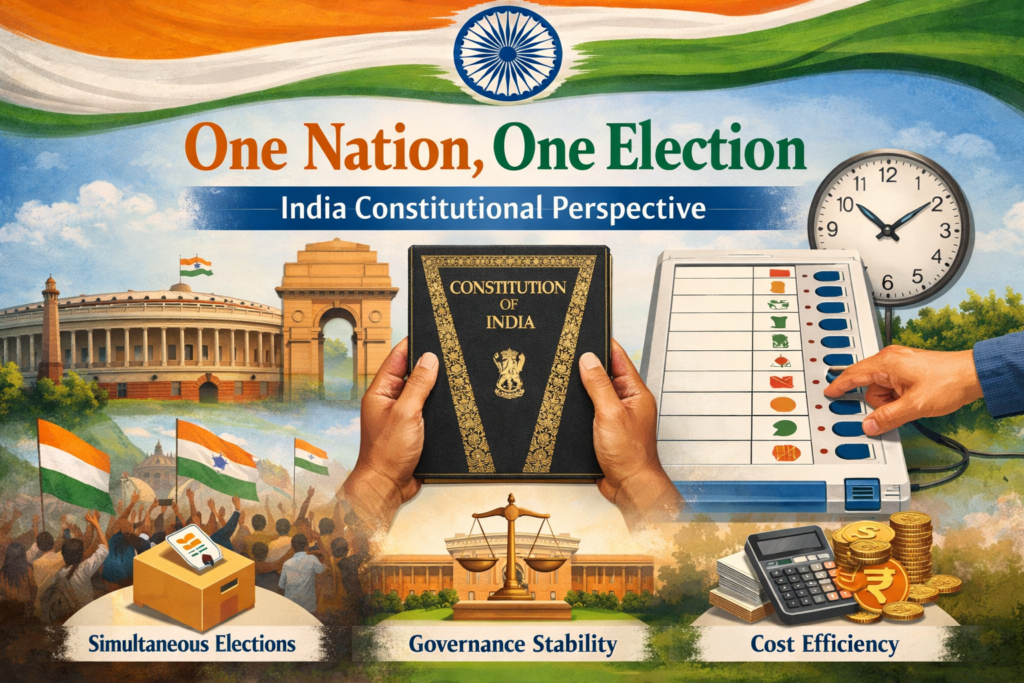
The proposal for “One Nation, One Election” (ONOE), also known as simultaneous elections, represents a fundamental alteration in the structure of Indian democracy. The report has been created as a detailed description of the constitutional, legal, logistical and political aspects of synchronising election cycles for the Lok Sabha, State Assembly elections and various levels of local government. Since 1967, when the synchronisation of election cycles was broken, the political environment has generally remained in a perpetual election cycle, which, together with the Model Code of Conduct (MCC) being introduced frequently, has placed tremendous financial pressure on the Government. Furthermore, due to the MCC being repeatedly imposed on a multitude of occasions, the Government has consistently faced delays in policy implementation. This comprehensive report focuses on the recommendations made by the High-Level Committee (HLC), chaired by the former President of India Ram Nath Kovind, which submitted an extensive 18,626-page comprehensive report to the government in March 2024, recommending structured roadmaps for the implementation of a phased process for ONOE.
To determine how to amend basic articles of the Constitution, we need to look into both the constitutional requirements as set out in Article 83, Article 85, Article 172, Article 174, Article 356 and the possible addition of Article 82A, which is supposed to bring everything into sync regarding term lengths of those in Government or elected positions.
Furthermore, we want to find out if there is a direct connection between how often we hold elections and how stable a government is. The 129th Amendment Bill 2024 aims to find a balance between administratively running a government effectively, as well as catering to the multiple needs of the Indian Union.
KEYWORDS: Article 82, EVM, Phases, Vote Behaviour
Introduction:
The current discussion on the idea of simultaneous elections has often been cast in the light of a new or innovative departure from established tradition. However, based on historical evidence, it is not a new pursuit—it is a desire to restore. The first twenty years of the Republic were characterised by simultaneous elections as the norm rather than the exception. Four successive General Elections were held concurrently between the period of 1951 and 1967 for both the Union and the various State Legislative Assemblies. The fact that elections were synchronised annually is reflective of the founding of the Constitution as a new impetus for all three levels of government at the same time. During this time, there was a significantly lower degree of technological advancement in the administration than exists today. “Nonetheless, the government was engaged in the business of nation-building for 80% of the time and was kept insulated from the influence of what is now referred to as “the permanent campaign” approach to politics,s which dominates the current political landscape in India.”[1]
The synchronised pattern of elections that existed in India until 1968 and early 1969 broke down when a number of state assemblies were prematurely dissolved in Bihar, Uttar Pradesh and West Bengal. Political disruption during this period, along with the breakdown of coalition governments in 1968-69, triggered further fracturing of the synchronised election calendar. This also allowed for the invocation of Article 356, or President’s Rule, to be applied in a manner that caused a dramatic shift in the electoral pattern. This decoupling became more solidified with the early dissolution of the Lok Sabha and the subsequent mid-term Lok Sabha elections in 1970-71. Since this time, there has been a continuing fragmentation of this cycle of synchronised elections. Currently, there are estimated to be between five and six primary elections held across the country each year. Many administrators believe this to be a source of “voter fatigue” and an unsustainable financial drain on the government.
COMMISSION AND COMMITTEE INVOLVED:
The Law Commission Report:
In August 2018, the Law Commission of India published a draft report on ‘Simultaneous Elections‘. The draft noted that to hold simultaneous elections in India, the Representation of the People Act, 1951, Procedures for Transacting Business in Lok Sabha, Procedures for Transacting Business in the State Assemblies and the Constitution must be appropriately amended. In the event of holding simultaneous elections in India, it was stated by the Law Commission of India that the representation of the People’s Act of 1951, the Constitution and the Procedures for Transacting Business in Lok Sabha and in State Assemblies must be amended accordingly. Further, the Law Commission of India suggested that an amendment should only be treated as valid once ratified by at least 50% of the states.
The Kovind Committee:
The Government of India established a High-Level Committee (HLC) in September 2023, led by ex-President Shri Ram Nath Kovind, to investigate whether simultaneous elections could be implemented and how to achieve them. The HLC was given a wide-ranging brief, including constitutional aspects, logistical issues, financial implications, and political considerations. In total, the HLC held meetings and consulted with many stakeholders, such as political parties, legal experts, and economists. The report was delivered in March 2024. The enormity of the report is indicated by its size—comprising 18,626 pages and 21 volumes—showing the challenge of the task.
After the Union Cabinet (Cabinet) approved the HLC report, the Union Government (Government) prepared a bill to implement ONOE by introducing the Constitution (129th Amendment) Bill 2024 into the Lok Sabha on 17 December 2024. The Constitution (129th Amendment) Bill 2024 was sent to a Joint Parliamentary Committee (JPC) chaired by Mr P P Chaudhary after being introduced in the Lok Sabha. The JPC is tasked with providing expert opinion on the Constitution (129th Amendment) Bill 2024 to provide greater detail on the legislation for Operation ONOE.
“According to the Statement of Objects and Reasons (SOR) accompanying the Constitution (129th Amendment) Bill 2024, there are two major reasons for the enactment of the bill
- these are the increasing cost of holding general elections
- the interference of the MCC with developmental work being done by state governments.”[2]
The Constitution (129th Amendment) Bill 2024 builds upon existing Articles 83 and 172 by adding additional clauses that clarify that if the Lok Sabha were to be dissolved in the middle of its five-year term, the newly constructed Lok Sabha would not be considered a continuation of the old Lok Sabha. Instead, it would only serve as a continuation until the end of the five-year term of the old Lok Sabha. Similar provisions are included for Article 172 to ensure that state assemblies are also subject to these same limitations
ARTICLE 82 A OF THE INDIAN CONSTITUTION:
Article 82A:
- It will serve as the “trigger” for conducting simultaneous elections
- The Appointed Date is defined as the date on which the President will issue a notification of the first meeting of the Lok Sabha after a General Election.
- Synchronising compulsory, meaning that any State Legislative Assembly, which has been formed on or after the Appointed Date, shall automatically cease after the end of the full term of the Lok Sabha, even if the State’s Assembly has not reached the end of a complete five-year term.
Amended Tenure Definitions
Both of these articles call for the Assembly (Lok Sabha/State Assemblies) to form an Assembly for five years from the first day of the meeting. There are two new concepts introduced in these proposed amendments. The Full Term is a five-year period beginning at the time of convening.
The Unexpired Term is the part of the five-year cycle that remains if there has been a premature dissolution of a House holding a new election. The new election will only be to fill the unexpired term left by the previous five-year term, specifically to protect against the possibility of a continued disruption or “hunger actions” resulting from Assembly activities and making it impossible for the Assembly to have its full complement of members at one time during the five-year period.
CHALLENGES:
- The Federalism and Basic Structure Challenge: The foremost argument against the ONOE Programme is that it threatens to undermine Federalism, which the S.R. Bommai judgement of the Indian Supreme Court concluded was part of the Basic Structure of the Constitution. As currently constituted, the Legislative Assemblies of India’s States enjoy Sovereign Authority in their own respective Legislative Jurisdiction. Forcing the Legislative Assemblies of India’s States to curtail their Mandates or to extend their Mandates to coincide with those of the Lok Sabha, effectively converts the States into the administrative units of the Union; this is the essence of the one-size-fits-all approach that has the potential to obliterate local issues in favour of the National Narrative and to effectively eliminate Regional Voices and Interests.
- The “Hanging House” and Stability Question: The “Unexpired Term” definition found in Articles 83 and 172 presents a major contradiction to democracy. If a State Assembly is dissolved because of either a No Confidence Motion or because of a breakdown of a coalition before its full two-year term has expired, a new assembly would only have three years until it expires\
- Lesser Mandate: The shorter amount of time voters receive may cause them to become apathetic about voting for a short-term government.
- Political Instability: With many short-term governments, the ability of those governments to carry out long-term policies will be near impossible, thereby creating an almost continuous state of being “caretaker” governments.
- Impact on Vote Behaviour: “When elections are held at the same time, voters have a 77% chance of selecting the same party for both local and national legislative candidates (IDFC Institute). This is called the “coattail effect,” and it tends to benefit larger political parties that have larger-than-life leaders at the national level while hurting smaller, regional political parties that are generally concerned with localised issues (for example, language or water rights).”[3]
- Administrative Challenges: Due to the size and variety of India’s electoral system, the execution of a “One Nation, One Election” program poses enormous administrative challenges. The number of electronic voting machines, VVPAT units, election workers, and federal security personnel needed to hold simultaneous elections throughout the nation, at both the state and local levels, will be far greater than anything previously experienced.
SUGGESTIONS:
- Elections can be held in multiple phases (i.e., 2-3), based on State Tenures. Phased Election Implementation can help Federal Government agencies and the individual States to phase in these changes without overwhelming the balance between States and Federal Government resources.
- By introducing a constructive vote of no confidence—where a Government can only be removed if there is a clearly defined alternative government being set up- at the same time will promote political stability while reducing premature legislative dissolution.
- There needs to be explicit constitutional protection in place to guarantee that States will not be required to abruptly shorten or extend the length of their Legislative Tenure. Any reduction or extension from five (5) years must be clearly defined and legally subject to review to maintain the Federal Framework.
CONCLUSION:
The One Nation, One Election (ONOE) initiative is intended to streamline the election cycle in an effort to limit the administrative costs and disruption associated with holding multiple elections throughout India each year. The country has previously had simultaneous elections during its early Republic period; however, today’s political environment and Federal Structure within the country have become substantially more complicated than they were then. This complexity creates serious doubts that ONOE could be effectively implemented in practice, utilising the Constitution of India, specifically with regard to Article 82A, as there are very real concerns regarding how this could have a negative impact on Federalism, democratic legitimacy, and State Autonomy, which are core components of the Constitution’s Basic Structure.
Additionally, obtaining the required Constitutional Amendments and Ratifications from States creates unique political and procedural challenges along with tremendous logistical and administrative demands.
For these reasons, while ONOE may present administrative efficiencies, careful consideration of its implementation is essential. A phased-in approach with protections for the tenure of state governments and mechanisms for a constructive vote of no confidence are necessary to support the stability of a democratic system of governance. Efforts to reform electoral systems must bolster the ability of any state government to govern, and not erode the very foundations that support the Federalist and Democratic Systems within India.
[1]https://constitution.congress.gov/constitution/amendment-20
[2]https://www.taxtechnical.ird.govt.nz/new-legislation/act-articles/taxation-venture-capital-and-miscellaneous-provisions-act-2004-taxation-annual-rates-of-income-tax-a/policy-issues/policy-issues-new-rules-for-international-venture-capital
[3]https://constitution.congress.gov/constitution/amendment-20