Satyam Sharma is a second (2nd) Year BALLB (Hons) student at IILM University, Greater Noida, Read More

Abstract
Section 17 of the Registration Act, 1908, operates as the ultimate procedural gatekeeper for immovable property transactions in India. While its traditional application in standard real estate disputes is well-established, its intersection with modern corporate law, intellectual property transfers, and new evidentiary rules creates complex legal friction. This paper critically examines the strict mandate of compulsory registration and its timeline constraints, analyzing how these procedural rules restrict substantive rights granted under the Indian Contract Act, 1872. Furthermore, the paper explores the absolute evidentiary barriers created by the Indian Stamp Act, 1899, and the Bharatiya Sakshya Adhiniyam, 2023, which paralyze unregistered and unstamped documents in the courtroom.
Moving beyond traditional property disputes, the research investigates the role of Section 17 in corporate restructuring. It analyzes whether National Company Law Tribunal (NCLT) orders sanctioning amalgamation schemes under the Companies Act, 2013, act as instruments of conveyance requiring mandatory registration. The paper also explores commercial slump sales, demonstrating how the Doctrine of Severability rescues trademark assignments from the fatal flaws of unregistered composite deeds. Finally, the research unpacks the equitable escape valves provided by the proviso to Section 49 of the Registration Act. By analyzing landmark jurisprudence such as the K.B. Saha and Hemalatha judgments, the paper defines the strict boundaries of using defective documents for “collateral purposes” and traces how unregistered agreements are weaponized to enforce suits for specific performance. Ultimately, this paper highlights how the Indian legal system balances strict statutory compliance with the need to prevent procedural rules from becoming instruments of commercial fraud.
Keywords: Section 17 Registration Act; Section 49 Proviso; Corporate Amalgamation; Slump Sale; Doctrine of Severability; Specific Performance; Collateral Purpose; Indian Stamp Act; Composite Deeds.
Introduction: Section 17 as the Procedural Gatekeeper
When we discuss property transactions in India, simply exchanging money and handing over possession is never enough to solidify ownership. The law demands a rigid, formal paper trail. At the very core of this procedural framework lies the Registration Act, 1908, which acts as the ultimate gatekeeper for property rights. It does not matter how genuine a transaction is; if a document falls within the mandatory requirements of the law and skips the registration office, it loses its legal enforceability. Through this introduction, we will explore how Section 17 of the Registration Act mandates compulsory registration, how it limits substantive contractual rights, and how modern evidentiary rules—read alongside the Indian Stamp Act, 1899—permanently block the enforcement of unregistered agreements in court.
The Mandate: The Strict Boundaries of Section 17 and Section 23
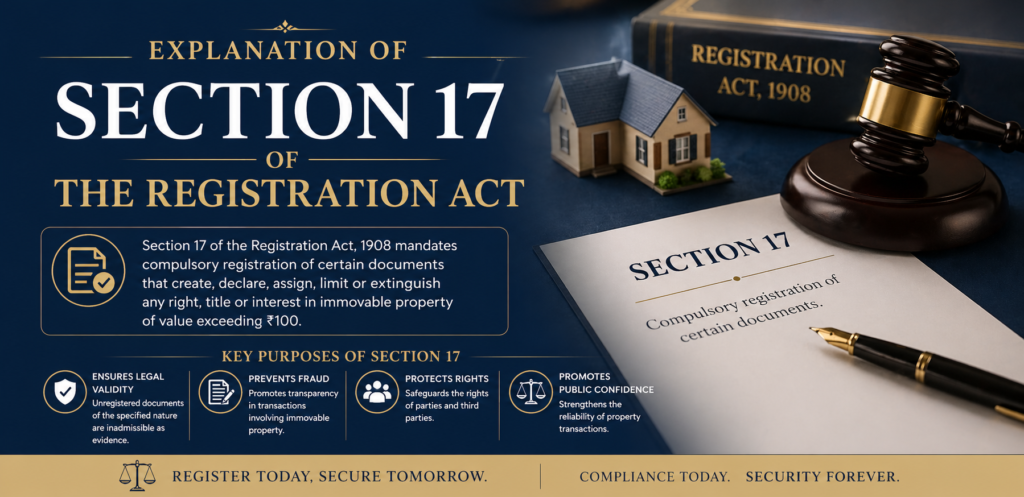
To understand why Section 17 is so powerful, we must look at its explicit statutory text. Section 17 of the Registration Act, 1908, lists specific documents that absolutely must be registered to have any legal validity. This includes instruments of gift of immovable property, leases exceeding one year, and any non-testamentary instrument that creates, declares, assigns, limits, or extinguishes any right, title, or interest in immovable property worth one hundred rupees or more. The primary purpose of this mandate is to ensure transparency, provide public notice of property transactions, and protect innocent parties from fraud.
However, Section 17 does not operate on an open-ended timeline. It is strictly governed by Section 23 of the Act, which imposes a rigid four-month window for presenting the document for registration from the date of its execution. If parties sleep on their rights and miss this deadline, the consequences are fatal.
This strict adherence to the timeline was bluntly illustrated by the Madhya Pradesh High Court in Jagdish Vishwakarma v. Smt. Julekha Ahmed (Misc. Petition No. 4209 of 2023). In this dispute, an unregistered sale deed dated back to 1985 was brought before the trial court. Because it had never been presented for registration within the four-month window required by Section 23, the High Court noted that the document could not simply be validated or registered decades later. The court powerfully observed that an unregistered sale deed that misses this statutory deadline cannot be given the shape of a valid deed and remains “merely a piece of paper”.
The Supreme Court recently reinforced this zero-tolerance approach toward statutory timelines in Mahnoor Fatima Imran & Ors. v. M/S Visweswara Infrastructure Pvt. Ltd. & Ors. (2025). In a complex property dispute involving 53 acres of land, the parties attempted to rely on an agreement of sale executed in March 1982. The Supreme Court ruled that because the agreement was compulsorily registrable under Section 17 but was never presented for registration within the four months required by Section 23, it suffered from a fundamental breach. The Court held that a subsequent fraudulent validation years later could not cure this defect, and the unregistered agreement could not confer valid title.
The Contractual Intersection: Where Substantive Rights Meet Procedural Bars
It is easy for a student of law to assume that if an agreement fulfills all the fundamental requirements of the Indian Contract Act, 1872—like free consent, lawful object, and consideration—it should be fully enforceable. However, Section 17 of the Registration Act acts as a strict procedural boundary that restricts these substantive rights.
Section 10 of the Contract Act, which defines valid contracts, contains a crucial saving clause. It explicitly states that nothing contained within the Act shall affect any law in force requiring a contract to be made in writing or any law relating to the registration of documents. This means the Contract Act proactively bows down to the Registration Act. You can draft a flawless agreement, but if it transfers real estate and violates Section 17, it strips the document of its legal efficacy to create or assign rights in that immovable property.
The most striking example of this intersection is found in Section 25(1) of the Contract Act. The general rule is that an agreement without consideration is void. However, Section 25(1) carves out an exception for agreements made out of “natural love and affection” between near relatives—but strictly on the condition that the agreement is expressed in writing and registered under the law. Here, Section 17 of the Registration Act acts as the absolute lifeline. Without the procedural anchor of registration, a family settlement based purely on love and affection completely fails to transfer property rights.
The Evidentiary Barrier: The BSA, Stamp Act, and Courtroom Realities
What happens when an unregistered document actually makes its way into a courtroom? The legal barriers immediately multiply. The primary roadblock is Section 49 of the Registration Act, which clearly states that a document requiring registration under Section 17 shall not affect any immovable property comprised therein, nor shall it be received as evidence of any transaction affecting such property.
Litigants often try to bypass this by presenting secondary evidence, such as photocopies of the original agreement. However, the evidentiary rules under the newly enacted Bharatiya Sakshya Adhiniyam, 2023 (BSA), read alongside the Indian Stamp Act, 1899, shut this down completely.
A fascinating application of this evidentiary barrier occurred in the recent judgment of Smt. Santosh Singh v. Shri Manoharlal Sheetalani (2026 MPHC-JBP 2341). The defendants filed an application under Section 64 of the BSA to lead secondary evidence using a photocopy of an unregistered and unstamped agreement to sell from 2019. The agreement involved a massive transaction for 15,251 square feet of land with an advance of Rs. 1 crore, but it was casually written on a mere Rs. 100 stamp paper.
Both the trial court and the High Court rejected the application under Section 64 of the BSA. The reasoning was grounded deeply in Section 35 of the Indian Stamp Act, which imposes an absolute bar stating that an instrument not duly stamped cannot be admitted in evidence for any purpose. While the law sometimes allows a party to pay a penalty to impound an original document to cure a stamp duty defect, the High Court made it clear that you cannot impound a photocopy. Because the photocopy could not be impounded, the deficit stamp duty could never be made good, rendering the secondary evidence under Section 64 of the BSA entirely inadmissible.
This aligns perfectly with the landmark apex court ruling in Suraj Lamp & Industries (P) Ltd. v. State of Haryana (2012) 1 SCC 656, which was heavily relied upon in recent litigation to remind parties of the sanctity of registration. As the Supreme Court noted, legal property rights exhibit a complete in rem character, meaning they bind the whole world. You cannot create rights that bind the whole world through secret, unregistered documents. Any contract of sale that falls short of a registered deed of conveyance does not confer title nor transfer any interest in an immovable property. In conclusion, Section 17 is not merely a bureaucratic hurdle. It is a fundamental pillar of property law that dictates the boundaries of contract law, sets strict timelines under Section 23, and arms the evidentiary frameworks of the BSA and the Stamp Act to ensure that unverified, unregistered transactions hold zero weight in the eyes of the judiciary.
- Corporate Restructuring: Amalgamations and Immovable Property
When we step away from traditional property disputes between individuals and enter the complex arena of corporate law, the application of the Registration Act, 1908, takes on a much more complicated flavor. Real estate does not just move through standard sale deeds; it frequently shifts hands in massive chunks during corporate mergers, demergers, and acquisitions. This brings us to a fascinating legal fiction and a highly litigated friction point: when a tribunal sanctions a corporate merger, does that judicial order automatically transfer real estate, or does it still have to bow down to the strict procedural mandates of Section 17 of the Registration Act?
The Mechanism: Sections 230 to 232 of the Companies Act, 2013
To understand this conflict, we first have to look at the substantive corporate law that governs these transactions. Under the Companies Act, 2013, corporate restructuring is primarily governed by Sections 230 to 232[1]. These provisions allow companies to propose a “scheme of compromise, arrangement, or amalgamation.”
The process is highly regulated. The companies involved must draft a scheme, seek the approval of their board of directors, and get the scheme cleared by their shareholders and creditors. Once this internal consensus is achieved, the companies approach the National Company Law Tribunal (NCLT) for final sanction. Under Section 232 of the Companies Act, 2013, once the NCLT applies its judicial mind and sanctions the scheme, the entire undertaking of the transferor company including all its assets, liabilities, and legal proceedings—automatically “vests” in the transferee company[2].
This concept of “vesting” is where the property law problem begins. If the transferor company owns massive physical assets like a manufacturing plant, corporate headquarters, or large tracts of land ownership legally shifts to the transferee company the moment the NCLT order takes effect.
The Core Friction Point: Operation of Law vs. Instrument of Conveyance
As a student analyzing this intersection, the legal dilemma is immediately apparent. Section 17(1)(b) of the Registration Act mandates that any non-testamentary instrument that creates or assigns any right, title, or interest in immovable property valued at one hundred rupees or more must be compulsorily registered.[3]
For decades, brilliant corporate lawyers argued that an NCLT order (or previously, a High Court order under the old 1956 Act) sanctioning a merger does not require registration. Their argument rested on two main pillars. First, they argued that the transfer of property happens by “operation of law” (the statutory vesting under Section 232 of the Companies Act) rather than by an “act of the parties.” Second, they tried to hide behind Section 17(2)(vi) of the Registration Act, which traditionally exempts “any decree or order of a Court” from compulsory registration. They argued that because the NCLT is a judicial tribunal, its sanction order is shielded by this exemption, meaning the transferee company gets the real estate without paying massive stamp duties and registration fees.
Piercing the Corporate Veil: The Judicial Interpretation
However, the judiciary eventually pierced through this clever legal loophole. The courts recognized that allowing corporate entities to transfer hundreds of crores worth of real estate without paying state registration fees or stamp duty defeated the very purpose of the Registration Act and the Indian Stamp Act, 1899.
The turning point in this debate was the landmark Supreme Court judgment in Hindustan Lever & Anr. v. State of Maharashtra & Anr.[4] While interpreting the nature of a scheme of amalgamation, the Supreme Court fundamentally dismantled the “operation of law” argument. The Court clarified that a scheme of amalgamation is not forced upon the companies by the state or the statute; it is, at its core, a voluntary agreement—a compromise or arrangement—negotiated by two willing corporate entities.
The NCLT’s role is simply to ensure that this private agreement is fair, does not violate public policy, and does not defraud creditors. Therefore, the tribunal’s order is not a standard judicial decree born out of adversarial litigation. Instead, it is merely a statutory seal of approval placed on a private, voluntary contract. Because the foundation of the transfer is an agreement between parties, the NCLT order essentially acts as an “instrument of conveyance.”
If we look at Section 2(10) of the Indian Stamp Act, 1899, a “conveyance” includes every instrument by which property is transferred inter vivos (between living persons or existing corporate entities). Because the NCLT order is an instrument that transfers immovable property from one company to another, it squarely hits the triggers of property law.
Consequently, the exemption under Section 17(2)(vi) of the Registration Act does not provide a blanket shield. The courts have interpreted that an order sanctioning an amalgamation operates as a conveyance deed. Therefore, if the scheme involves the transfer of immovable property, the NCLT order must be adequately stamped under the relevant State Stamp Act and compulsorily registered under Section 17 of the Registration Act to legally perfect the transferee company’s title in the municipal and revenue records.
The Modern Codification: The Registration Bill, 2025
This judicial interpretation, while established by the Supreme Court, often still led to localized confusion at sub-registrar offices, where officers struggled to classify NCLT orders. However, modern legislative reforms are finally catching up to bridge this gap between corporate law and procedural property law.
To completely eradicate this friction point and plug the revenue leakage, the legislature has proposed a modernized framework. The draft Registration Bill, 2025, which aims to overhaul the century-old 1908 Act, explicitly targets this corporate loophole. Under the proposed new provisions governing the compulsory registration of documents, the Bill expressly lists “instruments linked to mergers, amalgamations, or reconstructions involving property” as documents that absolutely must be registered.
This is a massive step forward for legal clarity. By explicitly codifying that instruments of corporate reconstruction involving real estate are subject to mandatory registration, the legislature is harmonizing the Companies Act with the Registration Act. It removes the need for revenue authorities to engage in complex judicial interpretations regarding “operation of law” versus “instruments of conveyance.”
In conclusion, Section 17 of the Registration Act casts a shadow far beyond individual property sales; it reaches directly into the boardrooms of merging corporations. A scheme of amalgamation may be born under the Companies Act and blessed by the NCLT, but until it passes through the procedural gate of the Registration Act, the legal title to the corporate real estate remains incomplete.
Slump Sales and Brand Strategy: The IP Intersection
In the modern corporate world, business acquisitions rarely happen piecemeal. When a massive corporation buys out a smaller competitor, they do not just buy individual assets; they execute what is commercially known as a “slump sale,” purchasing the business as a “going concern.” This means the buyer acquires absolutely everything in one sweeping stroke the physical factories, the land, the employee contracts, and most importantly, the brand’s intellectual property (IP), such as its trademarks, patents, and business goodwill. To make this happen smoothly, corporate lawyers usually draft a single, comprehensive document known as a “composite deed.”
The Procedural Trap of Composite Deeds
This is exactly where the strict procedural mandates of the Registration Act, 1908, clash heavily with fast-paced commercial realities. A composite deed inherently packages immovable property (like the factory land) with movable or intangible property (like the brand’s trademark).
Under Section 17 of the Registration Act, any non-testamentary instrument that creates, assigns, or transfers an interest in immovable property valued at one hundred rupees or more must be compulsorily registered,. If the merging companies fail to register this composite deed perhaps to avoid paying exorbitant state stamp duties or simply due to administrative oversight—the document hits the impenetrable brick wall of Section 49. Section 49 clearly dictates that an unregistered document cannot affect any immovable property comprised within it, nor can it be received as evidence of any transaction affecting that real estate,.
For a law student looking at this scenario, a massive, multi-million dollar question arises: Does the failure to register the deed invalidate the entire corporate acquisition? More specifically, while the buyer might legally lose the rights to the physical real estate, do they also lose their legal right to the brand name and trademarks?
The Saving Grace: The Doctrine of Severability
Fortunately, Indian jurisprudence is highly pragmatic. The courts do not let a procedural failure in real estate law destroy valuable intellectual property rights. Instead, they step in to protect the brand strategy by using the “Doctrine of Severability,” which is read alongside the proviso to Section 49 of the Registration Act,.
This proviso acts as a vital statutory exception. It states that an unregistered document affecting immovable property may still be received as evidence of any “collateral transaction” that does not itself require a registered instrument,.
To fully understand how a trademark assignment survives this procedural mess, we must apply the judicial test laid down by the Supreme Court in the landmark case of K.B. Saha and Sons Pvt. Ltd. v. Development Consultant Ltd[5]. In this judgment, the Supreme Court carefully defined what actually constitutes a valid collateral purpose. The Court established strict rules, notably that a collateral transaction must be completely independent of, or divisible from, the primary transaction that required registration. Furthermore, this collateral transaction must not itself be a transaction that creates or extinguishes rights in immovable property.
Trademarks as Independent Collateral Transactions
When we apply the K.B. Saha test to intellectual property, the legal mechanics work perfectly. Intellectual property, such as a trademark or business goodwill, is legally classified as intangible movable property. The assignment of a trademark is governed entirely by the Trade Marks Act, 1999[6], and absolutely does not require registration under Section 17 of the Registration Act, 1908.
Because the transfer of the IP does not touch or affect the immovable property, it satisfies the Supreme Court’s requirement of being an independent transaction. The transfer of the brand name is conceptually and legally divisible from the transfer of the physical factory building. Therefore, even if the composite deed is unregistered and completely void for the purpose of transferring the real estate, it can legally be admitted in a court of law to prove the collateral transaction—the valid assignment of the intellectual property,.
The SMS Tea Estates Analogy
To solidify this argument, we can draw a brilliant analogy from how Indian courts treat arbitration clauses hidden within unregistered agreements. In the highly celebrated case of SMS Tea Estates Pvt. Ltd. v. Chandmari Tea Co. Pvt. Ltd.[7], the Supreme Court had to examine an arbitration clause buried inside an unregistered lease deed.
The lease deed itself was compulsorily registrable under Section 17, and because it was unregistered, it was legally barred from affecting the immovable property. However, the Supreme Court ruled that the arbitration agreement was entirely severable from the rest of the substantive document. Because an arbitration agreement does not independently require registration under the Registration Act, it could safely be severed from the dead lease deed and enforced independently by the parties.
Courts use this exact same logic for slump sales and brand acquisitions. When a defective, unregistered composite deed is presented during a corporate dispute, the judge conceptually takes a pair of scissors to the document. The clauses dealing with the land, buildings, and physical infrastructure are severed and rendered legally ineffective due to the strict mandate of Section 49,. However, the clauses detailing the transfer of the trademarks, brand names, and business goodwill are severed and saved. Since these intangible corporate assets do not fall under the strict mandate of Section 17, their transfer remains legally valid, binding, and enforceable.
While the Doctrine of Severability saves the IP, it places a massive burden on the corporate lawyers drafting the initial composite deed. For the trademark assignment to survive an unregistered deed, the clauses must be drafted to show clear independence. If the lawyer inextricably links the intellectual property to the land—for example, by stating that the trademark is only assigned if the factory land is successfully conveyed—the court may find that the transactions are not divisible. In such poorly drafted scenarios, the failure to register the real estate could drag the IP down with it.
Ultimately, Section 17 of the Registration Act is an unforgiving gatekeeper for real estate, but it is not a blind executioner of commercial intent. Through the intelligent application of the Doctrine of Severability and the proviso to Section 49, the courts ensure that procedural failures in property law do not needlessly destroy a company’s intellectual property. A brand’s strategy and trademark assignments can safely survive the collapse of a composite deed, proving that the law is flexible enough to protect independent commercial assets even when strict statutory compliance falls short.
The Exceptions: Collateral Purpose and Specific Performance
At first glance, the Registration Act of 1908 appears to be an entirely unforgiving statute. As we have seen, Section 49 imposes a harsh statutory interdict: if a document requires registration under Section 17 but remains unregistered, it absolutely cannot affect the immovable property it describes, nor can it be admitted as evidence of any transaction affecting that property. If the law stopped there, it would result in massive miscarriages of justice, allowing dishonest sellers to take advance payments and then hide behind procedural loopholes to cancel deals.
However, the law is not blind to equity. The legislature built a crucial escape valve directly into the statute: the proviso to Section 49. This proviso breathes life into defective documents, stating that an unregistered document affecting immovable property may still be received as evidence of a contract in a suit for specific performance, or as evidence of any “collateral transaction” that does not require a registered instrument. Through this section, we will unpack how the courts have interpreted these two vital exceptions.
The Mystery of “Collateral Purpose”: The K.B. Saha Test
The term “collateral purpose” is frequently thrown around in property litigation, but the statute itself does not define it. For decades, litigants tried to use this phrase as a backdoor to sneak unregistered sale deeds and leases into evidence. To stop this misuse, the Supreme Court laid down a definitive, five-point test in the landmark judgment of K.B. Saha and Sons Pvt. Ltd. v. Development Consultant Ltd.[8]
As a student analyzing this precedent, the most critical takeaway from K.B. Saha is that a collateral transaction must be strictly independent of, or divisible from, the primary transaction that required registration. Furthermore, the collateral transaction must not, in and of itself, create, extinguish, or assign any right, title, or interest in immovable property valued at one hundred rupees or upwards.
What does this mean in practical terms? It means you cannot use an unregistered lease deed to prove the terms of the lease, the duration of the tenancy, or the rent amount, because those terms form the core of the transaction requiring registration. However, you can use that same unregistered document to prove the “nature of possession”—meaning, you can show it to the judge simply to prove that the person living on the property is a tenant and not a trespasser. Proving the status of the occupant does not transfer property rights; it is entirely collateral and divisible from the defective lease. As the Supreme Court sternly warned in K.B. Saha, if a document is inadmissible for want of registration, none of its core terms can be admitted, and trying to prove an important clause under the guise of a “collateral purpose” will be firmly rejected by the courts.
Specific Performance: Weaponizing Unregistered Agreements
The second, and perhaps most heavily litigated, exception in the Section 49 proviso is its intersection with Chapter II of the Specific Relief Act, 1963. This exception is the ultimate weapon for a jilted buyer.
Imagine a scenario where a buyer pays a massive advance to a seller based on a written, but unregistered, agreement to sell. The seller then gets a better offer from a third party and refuses to execute the final sale deed, arguing that the buyer’s unregistered agreement is legally worthless.
The Supreme Court addressed the exact nature of an agreement to sell in the monumental Suraj Lamp & Industries (P) Ltd. v. State of Haryana[9] judgment. The Court made it clear that an agreement to sell does not, by itself, convey any title or transfer any legal interest in the immovable property. Legal property rights can only be transferred by a duly stamped and registered conveyance deed. However, the Court beautifully articulated that while no legal title passes, the agreement creates a powerful equitable proprietary interest in favor of the buyer.
Because the agreement to sell does not actually transfer the title, it does not strictly offend the primary bar of Section 49. Instead, the proviso to Section 49 activates, allowing the buyer to take this unregistered agreement to court and file a suit for specific performance under the Specific Relief Act. In this suit, the buyer is not asking the court to declare them the owner; they are using the document merely as evidence of a promise to sell, asking the court to force the seller to honor that promise and execute a proper, registered sale deed.
The Hemalatha Confirmation: Supremacy of the Proviso
This specific performance exception is so powerful that it has survived recent attempts by state legislatures to dilute it. A prime example is the judicial battle that culminated in the 2023 Supreme Court decision of R. Hemalatha v. Kashthuri[10].
In this case, the dispute originated in Tamil Nadu. The state had passed the Registration (Tamil Nadu Amendment) Act, 2012, which inserted Section 17(1)(g), making agreements relating to the sale of immovable property compulsorily registrable. When a plaintiff filed a suit for specific performance based on an unregistered agreement, the defendant naturally argued that the state amendment completely barred the document from being admitted as evidence.
The Supreme Court, however, upheld the Madras High Court’s ruling in favor of the plaintiff. The apex court conducted a harmonious reading of the statutes and pointed out that while the Tamil Nadu amendment made the document compulsorily registrable under Section 17, the legislature never amended Section 49 to remove the equitable proviso. Therefore, the Supreme Court held that the unregistered agreement to sell remains fully admissible as evidence of a contract in a suit for specific performance. The proviso acts as a targeted, independent exception to the main body of Section 49.
Conclusion
It becomes clear that the Registration Act is a masterclass in balancing strict procedural compliance with equitable justice. The main body of Section 17 and Section 49 aggressively protects the state’s revenue and the sanctity of public property records by rendering unregistered documents legally sterile. Yet, the legislature and the judiciary, through the proviso to Section 49 and interpretations like K.B. Saha and Hemalatha, ensure that this strictness does not become an instrument of fraud.
By allowing defective documents to be used for collateral purposes and suits for specific performance, the law ensures that while you cannot silently transfer property outside the registration system, you also cannot make a promise, take a buyer’s money, and use the Registration Act as a shield to escape your contractual obligations.
[1] The Companies Act, 2013, §§ 230-232, No. 18, Acts of Parliament, 2013 (India)
[2] Id. at § 232(4).
[3] The Registration Act, 1908, § 17(1)(b), No. 16, Acts of Parliament, 1908 (India).
[4] Hindustan Lever & Anr. v. State of Maharashtra & Anr., (2004) 9 SCC 438
[5] K.B. Saha and Sons Pvt. Ltd. v. Development Consultant Ltd., (2008) 8 SCC 564.
[6] The Trade Marks Act, 1999, No. 47, Acts of Parliament, 1999 (India).
[7] SMS Tea Estates Pvt. Ltd. v. Chandmari Tea Co. Pvt. Ltd., (2011) 14 SCC 66
[8] K.B. Saha and Sons Pvt. Ltd. v. Development Consultant Ltd., (2008) 8 SCC 564.
[9] Suraj Lamp & Industries (P) Ltd. v. State of Haryana, (2012) 1 SCC 656.
[10] R. Hemalatha v. Kashthuri, 2023 SCC OnLine SC 381