
ABSTRACT:
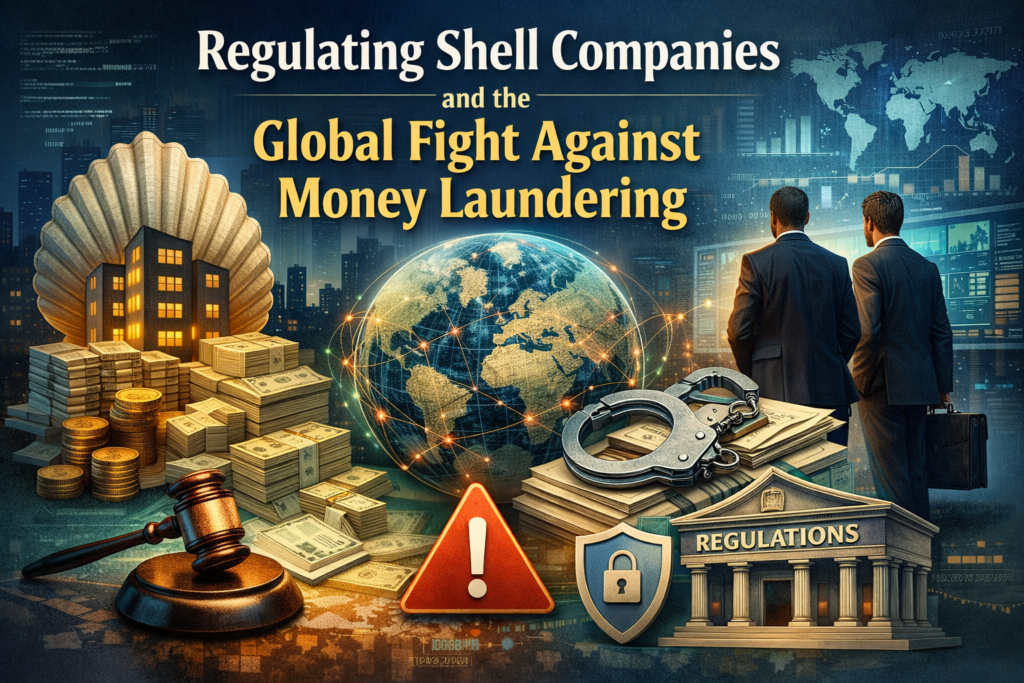
This article examines the multifaceted role of shell companies in global financial systems, highlighting how they are frequently misused for illicit purposes such as money laundering, tax evasion, and corporate fraud. While shell companies can serve legitimate business functions, their opaque structures often facilitate anonymity and hinder regulatory oversight. The paper delves into notorious leaks like the Panama and Pandora Papers, and major scandals including the Danske Bank case, to illustrate the scale and complexity of financial crimes involving shell entities. It analyses key techniques like round-tripping, trade-based money laundering, and the use of offshore havens. The article also reviews international regulatory responses, including frameworks implemented by the FATF, EU, U.S., UK, and India, and discusses the challenges of enforcement across jurisdictions. By mapping global and domestic regulatory efforts, the study emphasizes the urgent need for corporate transparency, beneficial ownership disclosure, and cross-border collaboration to curb financial abuses enabled by shell companies.
KEYWORDS: Shell companies, Pandora paper leak, Panama paper leak, Money laundering, Offshore havens, corporate transparency, Round Tripping.
INTRODUCTION:
A shell company is a legally registered business entity that does not engage in any substantial commercial activities and typically has no physical assets or employees. It typically serves as a vehicle for holding funds or managing financial arrangements.
Shell companies are often associated with illegal financial practices, but in reality, these companies may serve both lawful and unlawful purposes in the global economy. On the legal side, they can also be used to hold funds during the initial phases of a startup. However, they are also frequently misused for illicit activities such as money laundering, price manipulation, corporate fraud, and tax evasion. The key difference lies in how they are used: legitimate shell companies function transparently within legal boundaries, while illegitimate ones are often structured to hide ownership, avoid taxes, or disguise the origins of illicit funds.
TRANSPARENCY CHALLENGES IN SHELL COMPANY OWNERSHIP:
Shell companies often conceal the identities of their real beneficiaries through complex layers of anonymous ownership. Their misuse has come to light through major global investigative leaks, such as the Panama Papers in 2016 and the Pandora Papers in 2021, which exposed how politicians, celebrities, and criminals used these structures to hide wealth offshore. These disclosures have sparked worldwide demands for increased financial transparency and stronger regulation to prevent the abuse of corporate entities.
SHELL COMPANIES AND MONEY LAUNDERING: A GLOBAL PERSPECTIVE
Money laundering refers to the act of hiding the source of money earned through an unlawful activity in such a way that it will appear that they are earned legitimately. Shell companies are usually at the center of the activity, utilized as conduits to transmit and conceal illegal proceeds while simultaneously obfuscating the identities of the beneficiaries. Establishing a distance between the illegal source and the final destination of the proceeds is characteristic of a major method of money laundering at the layering stage. Its purpose is to obscure the trail from tracing the proceeds to their criminal origin. Proceeds are moved through a string of operations involving frequently different shell corporations, bank connections, and jurisdictions. Each following layer establishes a distance that obfuscates the audit trail and slows the investigation. When the proceeds reach their final destination—like a luxury item or piece of property—it seems to be coming from a legitimate source.
Shell companies are mainly established in regions where exist strict bank secrecy laws, so it becomes easy for these companies to secure their illicit funds, where no questions will be raised about their source.
Multiple shell companies can be established across various jurisdictions. Money is moved from one such company to another, usually with false invoices for imaginary products or services, to facilitate the dealings. Shell companies often utilise nominee directors and shareholders in order to conceal the beneficial ownership. These nominees are listed in the statutory books but act only as a proxy for the person that is really controlling the company. This makes it difficult for the authorities to track the beneficial owner especially in jurisdictions that are not stringent with ownership disclosures. With the nominees, the criminals can hide behind a number of jurisprudential degrees of separation, such that they can freely transfer the proceeds of crime with no alert or prosecution ensuing.
TECHNIQUES USED:
- Round-tripping – Round-tripping refers to the process of moving money out of a country and then bringing it back in under the guise of foreign investment, typically using shell companies to conceal the true origin of the funds. It involves transferring funds to a shell company operating in a tax haven or lightly regulated nation and then re-investing the same funds back in the nation of origin as though it were genuine foreign direct investment (FDI). Its chief purpose is to obscure where the money actually came from, avoid taxation or achieve regulatory and taxation advantages enjoyed by genuine foreign investors. Shell companies having no genuine business activity are frequently used to help facilitate round-tripping because they can mask ownership and trails of money. Though some types of round-tripping could involve abusing legal technicalities, it is frequently linked to money laundering and avoidance of taxation and has therefore become a focal point for financial authorities and anti-money laundering enforcement agencies.
- Trade-based money laundering – Trade-Based Money Laundering (TBML) is a process employed by criminals to conceal the income from illegal activities and transfer money internationally through manipulated trade-based transactions. It includes practices like over-invoicing, under-invoicing, multiple invoicing, misdescription of goods, or even phantom deliveries, wherein no goods are really shipped. By inflating or deflating the price, quantity, or quality of goods in import or export documents, illegal money can be sent under the guise of regular international trade. TBML is extremely hard to identify because of the intricacy of international trade, the genuineness of documentation used by criminals, and because it involves several jurisdictions. TBML is also commonly employed for money laundering, evasion of duty and taxation, and financing of terrorism and is thus of great concern to customs authorities and financial regulators globally.
- Offshore havens – Shell companies are frequently set up in offshore jurisdictions. The attraction of offshore tax havens is their ability for anonymity. In addition, they offer minimal or no taxes, strict secrecy laws and regulations so that it is difficult to reveal the actual ownership of the financial assets with a specific purpose. People or businesses could reap the benefits of transferring wealth, hiding assets, and avoiding taxes back in their home country simply by establishing a hollow account in a tax haven without actually doing any real business activity in that haven. A few of the well-publicised instances concern how they prove the magnitude of offshore havens in money laundering cases. We can take the example of the Panama Papers leak in 2016.
CASE STUDIES and NOTABLE SCANDALS
Panama Paper Leak
It is considered one of the largest data leaks of 2016, exposing many high‑net‑worth individuals and multinational corporations (MNCs) individuals and MNCs from around the world who registered companies in tax havens for round-tripping mainly to hide their assets, evade taxes, and launder money. This was facilitated by Mossack Fonseca, a law firm that helped individuals establish shell companies in offshore havens like Panama, the British Virgin Islands, the Bahamas, etc.
Pandora Paper Leak
Around 12 million documents and files from the Pandora Papers have been leaked to expose the concealed wealth and dealings of world leaders, politicians, and billionaires. The records were sourced by the International Consortium of Investigative Journalists in Washington DC and have kick-started one of the largest global investigations ever. Over 600 journalists from 117 countries have investigated the secret fortunes of some of the most powerful people on the planet, with BBC Panorama and the Guardian leading the investigation in the UK.
DANSKE BANK SCANDAL
It was one of the biggest incidents of money laundering, involving suspicious transactions to the tune of some €200 billion through the Estonian branch of Danske Bank between 2007 and 2015. The funds—mostly from Russia and other former Soviet states—were transferred through various shell companies with concealed ownership. Senior executives were warned, but no action was taken by them and the bank could continue to operate only because of a lack of oversight. The case became public in 2017 through a whistleblower, which led to several international investigations. In 2018, the bank acknowledged its misconduct, leading to the resignation of its CEO. By 2022, Danske Bank entered a guilty plea in the United States and agreed to pay a fine of over $2 billion.
GLOBAL REGULATORY LANDSCAPE
Financial Action Task Force
The FATF Recommendations are standardized international measures put in place by the Financial Action Task Force (FATE) to restrain: 1. Money laundering (ML) 2. Terrorist funding (TF) 3. Funding the spread of weapons of mass destruction. In general, these recommendations of the FATF are the cornerstone of regulations on money laundering worldwide. The FATF Recommendations, as stated, ensure a global harmonised response to whatever organized crime, corruption, or terrorism could be. It enables authorities to chase down money from criminals dealing in illegal drugs, human trafficking, and others. It oversees countries to ensure they fully and effectively implement the FATF Standards. More than 200 countries and regions have promised to follow these standards. Their compliance is checked with help from nine FATF Associate Members and global partners such as the IMF and the World Bank.
EU’s Anti-Money Laundering Directives (AMLDs)
The EUs money laundering directives are aimed at the EU’s ability to combat money laundering and terrorist financing. These directives significantly strengthen the EU’s anti-money laundering framework by promoting greater transparency in the financial system and ensuring closer cooperation between national authorities across borders. They enhance the powers of Financial Intelligence Units (FIUs), enabling them to more effectively detect, analyze, and investigate suspicious financial activity. Crucially, the reforms grant FIUs the authority to suspend transactions suspected of being linked to criminal or terrorist financing, helping to swiftly disrupt the flow of illicit funds and ensure the stability and trustworthiness of the EU’s financial system.
U.S. Corporate Transparency Act and FinCEN regulations
The Corporate Transparency Act, which came into effect in 2021 through the National Defense Authorization Act. The law aims to fight money laundering, terrorist financing, and other illegal activities by improving transparency around corporate ownership. It requires companies operating in the U.S., both domestic and foreign, to give FinCEN, a bureau of the Department of Treasury, details about their beneficial owners. FinCEN is responsible for implementing and enforcing the CTA. It establishes regulations that are a crucial step in strengthening the U.S. financial-crime framework and aligning it more closely with international FATF standards.
UK’s Persons with Significant Control (PSC) Register
One of the UK’s public registers, the Public Register of Persons with Significant Control, was established in 2016. With this register comes a major and ambitious effort by the country towards improving corporate transparency among European nations as well as helping to eradicate money laundering, tax evasion, and other financial crimes. The PSC Register is a compulsory register that requires all UK companies-not listed ones-only and some other legal entities to offer information regarding the individuals who actually own these organizations. These records then go to Companies House, the UK’s corporate registry, which makes them available to the general public. Its use is very significant in combating the illegitimate uses of anonymous or shell companies by making visible their actual beneficial owners.
India’s Legal and Regulatory Framework
To address the challenges posed by shell companies involved in illicit activities, the Indian government introduced targeted legal provisions, including the following:
- Companies Act, 2013
The Companies Act is the primary law regulating company incorporation as well as compliance.
- Section 248: Authorizes the ROC to have companies struck off if they are not carrying on any business or operation for two consecutive years.
- Section 455: Defines dormant companies — can be used for voluntarily registering inactive companies that sometimes can be abuse to act like shell companies.
- Section 447–452: Provide for corporal punishments, penalizes for false statements and fraudulent acts — that is when shell company cases can be invoked.
In a major effort to clean up the corporate sector, the Ministry of Corporate Affairs (MCA) has removed around 2.33 lakh inactive and possibly illegal companies from official records over the last five years.
- Income Tax Act, 1961
Shell companies become a handy tool often in tax evasion, and with this in view, the Act has certain pertinent provisions:
- Section 68: Unexplained cash credits-the share capital is questioned when received from suspicious entities.
- Sections 69 to 69D: These sections address income, investments, expenditures, and transactions whose sources cannot be explained. They serve as powerful tools for tax authorities, especially in cases involving shell companies, money laundering, and black money, enabling the detection and taxation of unaccounted wealth.
- Section 132: Empowering tax authorities to search premises and seize assets to uncover unreported income or concealed wealth.
- Section 281: Addresses property transfers intended to evade tax liabilities or deceive tax authorities
- Prevention of Money Laundering Act, 2002
This Act deters the shell companies from conducting fraudulent activities by:
- Attachment of Properties: The Enforcement Directorate (ED) may attach properties of shell companies involved in laundering.
- Investigation & Prosecution: Any shell company worth layering or placement of illicit funds may be prosecuted under the PMLA.
- Benami Transactions (Prohibition) Act, 1988.
Shell companies typically hold properties that are benami (name lending). Where a company is used to hold assets on behalf of the beneficial owner, the transaction may be deemed a benami one. In India there is Benami Prohibition Unit of the Income Tax Department which monitors these structures.
- SEBI Regulations
- SEBI holds the authority to regulate shell companies listed on stock exchanges for investor protection and market integrity preservation.
- SEBI (Listing Obligations and Disclosure Requirements), 2015
- The regulations demand listed organizations to provide their disclosures both accurately and at scheduled times. The failure of shell companies to meet these requirements creates suspicious indicators.
- The SEBI regulatory body possesses authority to intervene against organizations that perform fraudulent financial operations or manipulate stock market activities. SEBI has also mandated forensic audits to investigate financial documents for evidence of fraud or abnormalities, these implemented measures work to stop stock market exploitation while safeguarding investors from deceptive companies which lack authentic business operations.
Recent Indian Crackdowns and High-Profile Cases
Post-demonetization in India in November 2016, a massive crackdown was instituted against shell companies suspected to be instrumental for hiding black money. In October 2017, nearly 2 lakh companies saw their bank accounts frozen by the Ministry of Finance. These companies showed little activity prior to demonetization but suddenly transacted almost ₹4,550 crore post-demonetization, suggesting they were mainly used to launder unaccounted cash. The Registrar of Companies, exercising its powers under Section 248 of the Companies Act, 2013, struck off around 2.24 lakh companies deemed inactive or non-compliant. This was an attempt targeting black money that was carried out in the wake of demonetization.
- Nirav Modi Case: Round-Tripping & PNB Bank Fraud
The Punjab National Bank scam involving Nirav Modi stands out as a major financial crime in India, where the bank lost almost ₹13,000 crore, or about $2 billion. Nirav Modi and his uncle Mehul Choksi got fake Letters of Undertaking (LoUs) from PNB by working with bank officials, bypassing internal checks, and using the swift network without proper documents or collateral. These LoUs were used to get loans from foreign banks, supposedly for importing diamonds, but no real trade happened. The fraud also involved round-tripping, a money laundering method where money was sent abroad through fake transactions with shell companies and then brought back to India as clean investments or payments. More than 100 shell companies in tax havens like Hong Kong and Dubai were used to launder money using fake invoices and benami accounts. This complex scam went unnoticed for years because of poor auditing and gaps in banking oversight. After the scam came to light in 2018, Nirav Modi fled India but was later arrested in the UK and is facing extradition. The case caused major criticism of India’s banking controls and led to legal changes like the Fugitive Economic Offenders Act, 2018, along with stricter rules on LoUs, SWIFT messaging, and bank audits.
- Vijay Mallya case:
The Vijay Mallya case is one of India’s most well-known financial frauds, involving the misappropriation of over ₹9,000 crore by the former liquor tycoon and owner of Kingfisher Airlines. Between 2004 and 2012, Mallya took large loans from a group of 17 Indian banks, led by the State Bank of India, even though Kingfisher Airlines was facing serious financial problems. Much of the borrowed money was allegedly funnelled into more than 20 shell companies in India and abroad, especially in tax havens like the British Virgin Islands and Cayman Islands. These companies had no real business and were used to launder money through fake transactions, inflated bills, and round-tripping, often disguised as consulting or service fees. Although the loans were meant to run the airline, the money was diverted to companies indirectly controlled by Mallya or his associates. The fraud was exposed after Kingfisher repeatedly failed to repay its loans, leading to investigations by the CBI and ED that revealed the use of shell companies and misuse of funds. Public anger grew when Mallya fled to the UK in 2016, right when legal actions were starting in India. Indian authorities have been trying to extradite him, and UK courts approved this in 2020, but the process is still ongoing due to other legal issues in Britain.
- Shell Companies & Electoral Bonds
Shell companies have played a significant role in obscuring the flow of money in political funding, particularly after the introduction of the Electoral Bonds Scheme in 2018. These companies, which often exist only on paper and have no real business operations, are commonly used to channel untraceable funds into political parties. The 2017 amendments to the Companies Act allowed even loss-making companies to donate unlimited amounts to political parties through electoral bonds, reversing the earlier cap of 7.5% of net profits. This legal change created a loophole that enabled shell companies—many of which are used for money laundering or tax evasion—to act as anonymous donors. Since electoral bonds preserve the anonymity of the donor, it becomes nearly impossible for the public to trace who is funding whom, and whether the funds originate from legitimate sources. In this way, shell companies have become tools to mask the identity of political donors, facilitate quid pro quo arrangements, and inject illicit or unaccounted money into the electoral system, undermining transparency and accountability in Indian democracy.
Challenges in Regulation and Enforcement
- Identifying Beneficial Ownership – One of the big hurdles in fighting money laundering and other shady financial stuff is figuring out who is really behind those secretive companies and accounts, a bunch of companies are using a bunch of fake names or middlemen to keep the real beneficiary hidden.
- Lack of Cross-Border Cooperation and Data Sharing – Financial frauds and money laundering schemes often involve multiple jurisdictions. However, weak international cooperation, inconsistent regulations, and the absence of real-time data sharing between countries hinder effective enforcement and recovery of illicit assets.
- Jurisdictional Arbitrage and Offshore Secrecy Jurisdictions – Criminals and tax evaders take advantage of regulatory gaps in various countries, which is known as jurisdictional arbitrage. They transfer assets to offshore financial centers, such as the Cayman Islands or British Virgin Islands, that offer secrecy and low disclosure requirements. This makes it very difficult to prosecute and trace the funds.
- Limited Technological Capacity and Inter-Agency Coordination – Many developing nations face serious challenges. These include outdated financial monitoring systems, a shortage of skilled workers, and weak coordination among enforcement agencies like the tax department, central bank, financial intelligence units, and police. As a result, investigations move slowly, and the conviction rates in financial crime cases are low.
Recent Reforms and International Collaboration
In recent years, global initiatives to combat financial opacity and the misuse of shell companies have gained significant momentum. Institutions such as the Financial Action Task Force (FATF) have played a pivotal role in urging countries to strengthen their anti-money laundering (AML) and counter-terrorist financing (CTF) frameworks, with a particular emphasis on the implementation of robust beneficial ownership disclosure regimes. Complementing these efforts, the OECD’s Common Reporting Standard (CRS) and the U.S. Foreign Account Tax Compliance Act (FATCA) have facilitated the automatic exchange of financial information between jurisdictions, promoting enhanced global tax transparency and compliance.
Operational collaboration has also improved, notably through the Egmont Group of Financial Intelligence Units, which supports real-time sharing of data on suspicious transactions among member countries. These developments have been further reinforced by legislative reforms such as the European Union’s 5th and 6th Anti-Money Laundering Directives, which mandate public registers of beneficial ownership, and The U.S. Corporate Transparency Act (2021) mandates that FinCEN (Financial Crimes Enforcement Network) be informed of the true ownership of the company. The U.S. Corporate Transparency Act (2021) mandates that FinCEN (Financial Crimes Enforcement Network) be informed of the true ownership of the company.
India has emerged as a proactive participant in this global push for transparency, taking a prominent role in platforms such as the G20, BRICS, and the Global Forum on Transparency and Exchange of Information for Tax Purposes. Domestically, India has strengthened its regulatory framework by enhancing laws governing shell companies, increasing oversight by regulatory bodies like SEBI and the RBI, and entering into international agreements to facilitate cross-border information sharing. These combined efforts mark a significant step forward in addressing the challenges of tax evasion, corporate fraud, and illicit financial flows on both national and global scales.
CONCLUSION
Shell companies, though not inherently illegal, have become central tools in complex schemes of money laundering, tax evasion, and illicit financial flows. Through the manipulation of ownership transparency, offshore jurisdictions, and legal loopholes, they enable criminals, corrupt officials, and even legitimate businesses to obscure financial dealings and evade accountability. The widespread misuse exposed by the Panama and Pandora Papers, the Danske Bank scandal, and high-profile Indian cases like Nirav Modi and Vijay Mallya, demonstrates the urgent need for stronger oversight. Despite substantial global efforts—from FATF standards and EU directives to national laws like India’s Companies Act and the U.S. Corporate Transparency Act—major enforcement gaps persist. These include difficulties in identifying beneficial owners, limited international cooperation, and technological shortcomings in enforcement mechanisms.
Going forward, real progress requires not only tightening legal frameworks but also fostering international collaboration, enhancing data sharing, and improving domestic institutional capacity. Only through coordinated global and national action can the veil of secrecy surrounding shell companies be lifted, thereby safeguarding financial systems from abuse and ensuring greater corporate and political accountability.