
Tanu Sharma is currently in her forth year of study for a BA LLB (Hons) at GGU, Central University of Chhattisgarh, Read More.

ABSTRACT
The rapid ascent of Artificial Intelligence (AI) has concentrated market power within three critical layers: compute infrastructure (GPUs), cloud services, and proprietary data lakes. This concentration creates a significant risk of vertical foreclosure, where dominant players leverage their control over these “upstream” essentials to stifle competition in “downstream” AI applications.
The Competition Commission of India (CCI) is pivoting to address these risks through a dual-pronged approach. Under the existing framework of the Competition Act, 2002, the CCI utilizes Section 3(4) to scrutinize anti-competitive vertical agreements and Section 4 to penalize the abuse of dominant positions. Drawing from precedents like the Google and Apple investigations, the CCI is increasingly wary of “walled gardens” that restrict interoperability and data access.
However, the traditional ex-post enforcement—which acts only after harm occurs—is often too slow for the fast-paced AI sector. Consequently, the Draft Digital Competition Bill, 2024, proposes an ex-ante framework. This would designate major AI entities as Systemically Significant Digital Enterprises (SSDEs), imposing proactive obligations to ensure transparency and prevent self-preferencing. For legal professionals, navigating this shift requires balancing aggressive innovation with a compliance-first approach to the evolving AI stack.
Keywords: Artificial Intelligence, Vertical Foreclosure, Competition Commission of India, Cloud Computing, Data Monopoly, Digital Competition Bill 2024,
INTRODUCTION
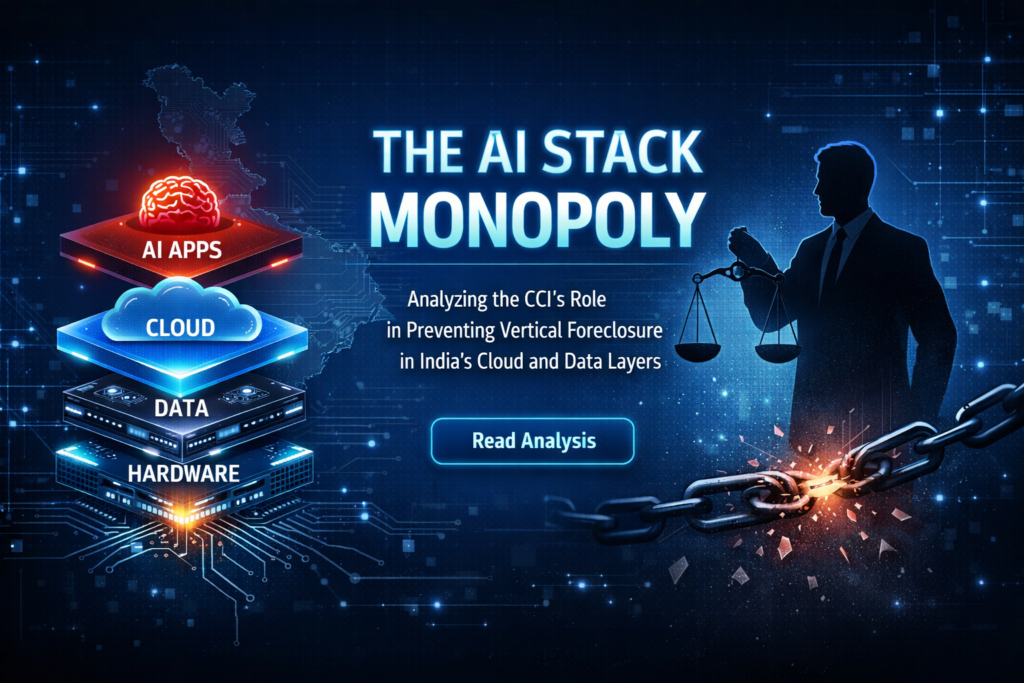
In the rapidly evolving landscape of the digital economy, the “AI Stack” has emerged as the definitive architecture of modern innovation. This stack comprises a hierarchy of interdependent layers: the foundational hardware (compute/GPUs), cloud infrastructure, large language models (LLMs), and downstream vertical applications. As a handful of global technology titans vertically integrate across these layers, the risk of vertical foreclosure—where a dominant upstream enterprise restricts or eliminates a competitor’s access to essential inputs—has become a paramount antitrust concern.
The Mechanics of Data-Driven Foreclosure
In the AI-driven economy, vertical foreclosure often manifests as “data-driven foreclosure.” Dominant platforms frequently hoard massive “data lakes” generated from user interactions and transactions. By denying rivals access to these equivalent informational inputs, these incumbents create unbridgeable competitive gaps, effectively “moating” their position against potential disruptors. This control over the data layer ensures that the most powerful AI models remain concentrated within a few proprietary ecosystems.
The Regulatory Shift in India
The Competition Commission of India (CCI) is increasingly tasked with navigating these complex digital monopolies. Recognizing that traditional antitrust frameworks—often focused on static price effects—are ill-suited for the dynamic AI sector, the CCI is transitioning toward nuanced, technology-specific interventions.
This involves a shift from ex-post enforcement (addressing harm after it occurs) to a more proactive stance. By scrutinizing how compute power is allocated and how data is shared, the CCI aims to prevent the AI stack from becoming a series of closed “walled gardens.” For legal practitioners and policymakers, understanding this anatomy is crucial for ensuring that the future of Indian AI remains competitive, transparent, and open to innovation.
STATUTORY FRAMEWORK
The Competition Act, 2002, serves as the primary legislative bulwark against the concentration of power within the AI stack. By applying its provisions to the unique layers of digital infrastructure, the Competition Commission of India (CCI) ensures that the “gatekeepers” of compute and data do not stifle the next wave of innovation.
Abuse of Dominant Position (Section 4)
The core of India’s antitrust intervention lies in Section 4, which prohibits the abuse of a dominant position. In the context of the AI stack, three specific sub-sections are critical:
- Section 4(2)(a): Prohibits the imposition of unfair or discriminatory conditions or prices. This is particularly relevant when cloud providers charge prohibitive “egress fees” to customers trying to move their data to a competing AI model provider.
- Section 4(2)(c): Targets practices resulting in the “denial of market access.” The CCI has frequently invoked this in digital platform cases to prevent incumbents from locking out competitors through technical or contractual barriers.
- Section 4(2)(e): This is perhaps the most “foundationally relevant” provision for AI. it prohibits leveraging dominance in one market (e.g., cloud infrastructure) to protect or enter another market (e.g., downstream AI applications). If a provider uses its 80% share in cloud services to force its proprietary LLM on users, it risks a Section 4(2)(e) violation.
Vertical Restraints (Section 3(4))
Vertical agreements—such as exclusive supply, exclusive distribution, and tie-in arrangements—are governed by Section 3(4). Unlike horizontal cartels, these are assessed under a “Rule of Reason” framework. The CCI evaluates these against the factors in Section 19(3), determining if the agreement creates insurmountable barriers to entry or drives existing competitors out of the market. In the AI sector, a “tie-in” might occur if a hardware manufacturer mandates that its GPUs only be used with its proprietary software stack.
Locus Standi: Empowering the Ecosystem
A critical procedural advantage in India is the broad Locus Standi for filing complaints. The Supreme Court has clarified that “any person” may provide information to the CCI under Section 19(1)(a). They do not need to be a direct victim of the practice. This allows startups, researchers, and whistleblowers to challenge monopolistic practices in the AI and cloud sectors without having to prove individual personal injury, fostering a more vigilant and competitive digital environment.
JURISPRUDENTIAL EVOLUTION
From Traditional Markets to Digital Ecosystems To understand how the CCI will treat AI stack monopolies, legal professionals must analyze the shift from traditional effects-based analysis to aggressive digital market enforcement.
The Effects-Based Analysis in Traditional Markets
In the landmark Schott Glass judgment, the Supreme Court mandated that abuse under Section 4 requires proof of actual or likely anti-competitive effects, not mere dominance.
Rebate schemes, long-term agreements, and vertical integration are not per se abusive if they possess objective commercial justifications and do not result in total market foreclosure.
Digital Platform Foreclosure -The Google and Apple Investigations
Google Android and Play Store: The CCI fined Google ₹1,337 crore for tying its Play Store with Google services, holding it abusive under Section 4(2)(d) and citing foreclosure via mandatory pre-installation LL. Furthermore, Google’s mandate of the Google Play Billing System (GPBS) and discriminatory UPI integration (favoring Google Pay) were investigated as a denial of market access to payment aggregators under Section 4(2)(c) and leveraging under Section 4(2)(e).
Apple iOS App Store: The CCI delineated “app stores on iOS platform” as a distinct relevant market, rejecting Apple’s defense of having a low smartphone market share due to the strict lock-in effect of the iOS ecosystem ET Indiatimes. Apple’s mandatory 30% In-App Purchase (IAP) commission and anti-steering rules are being scrutinized for imposing unfair conditions and foreclosing downstream payment rivals ET Indiatimes.
Data-Driven Foreclosure
In the WhatsApp/Meta (2024) case, the CCI imposed a ₹213 crore penalty for data-sharing policies that foreclosed advertising rivals by leveraging user data moats LL. This recognized that exclusive control over data acts as a barrier to entry, a concept directly applicable to LLM training data in the AI stack.
In MakeMyTrip/OYO, platform parity clauses that restricted hotels from offering lower prices offline were treated as vertical foreclosure under Section 4(2)(c), demonstrating the CCI’s willingness to penalize multi-sided platforms that leverage upstream suppliers to foreclose downstream rivals Amsshardul,
VERTICAL FORECLOSURE IN THE AI COMPUTE AND CLOUD DATA LAYERS
Applying India’s existing statutory framework and digital jurisprudence to the AI stack reveals a sophisticated landscape of antitrust risks. As AI becomes the “general purpose technology” of the 21st century, the Competition Commission of India (CCI) is increasingly focused on how control over specific layers of the stack can be used to stifle innovation.
- Input Foreclosure in the Compute Layer
The foundational hardware—specifically high-end GPUs—serves as the “oil” of the AI economy. Currently, a handful of dominant cloud providers control the vast majority of this specialized compute capacity. From a legal standpoint, if an infrastructure provider restricts or degrades access to this capacity to favor its own proprietary models, it directly triggers Section 4(2)(c) of the Competition Act, 2002, which prohibits the denial of market access.
Furthermore, using dominance in the “Cloud/Compute” market to gain an unfair advantage in the “AI Model” market constitutes leveraging under Section 4(2)(e). This structural dependency creates a bottleneck where the gatekeepers of hardware can effectively determine which downstream AI applications succeed.
- The Essential Facilities Doctrine
While the Essential Facilities Doctrine (EFD) is not explicitly codified in Indian statutes, the CCI has consistently applied analogous principles in high-tech cases. For a component of the AI stack to be deemed an “essential facility,” it must be:
- Necessary for competitors to function in a downstream market.
- Uneconomical or impossible to replicate by competitors.
- Refused without an objective technical or commercial justification.
In the context of foundational LLMs or massive GPU clusters, the inability of a startup to build its own infrastructure may lead the CCI to treat these upstream assets as essential facilities, thereby mandating FRAND (Fair, Reasonable, and Non-Discriminatory) access for third-party developers.
- Data Hoarding and Algorithmic Self-Preferencing
The integration of AI into broader digital ecosystems allows platforms to engage in data-driven foreclosure. By hoarding vast “data lakes” of user transactions and interactions, dominant firms deny rivals the informational inputs necessary to train competitive models. This challenges traditional market definitions under Section 2(r), as the “relevant market” shifts from a finished product to the informational inputs themselves.
Furthermore, algorithmic self-preferencing—where a platform’s interface or search engine inherently prioritizes its own AI services over third-party plugins—represents a subtle but powerful form of vertical foreclosure. By controlling the discovery layer, these platforms can effectively “hide” competitors, regardless of the quality of their AI.
THE EX-ANTE REGULATORY SHIFT: DRAFT DIGITAL COMPETITION BILL, 2024
Recognizing the limitations of ex-post enforcement under the Competition Act, India has proposed the Draft Digital Competition Bill (DCB), 2024. This framework represents a paradigm shift for AI and cloud monopolies
Systemically Significant Digital Enterprises (SSDEs)
The Draft DCB empowers the CCI to designate SSDEs based on quantitative thresholds (e.g., global turnover exceeding INR 4,000 crore or Indian turnover above INR 1,500 crore) and qualitative criteria (network effects, data concentration) Tandfonline Prsindia.
The Bill targets nine Core Digital Services (CDS), including online search engines, cloud services, and online intermediation, which directly encompass the AI stack Promarket Tcclr
Gatekeeper Obligations and AI Implications
Ban on Self-Preferencing: SSDEs cannot promote their own goods or services over competitors. For AI, this means cloud providers cannot bias their AI recommendation engines or infrastructure allocation to favor their in-house foundational models Nliu Carnegieendowme.
Data Misuse Prohibitions: SSDEs are banned from using non-public business user data for competitive advantage Nliu Tandfonline. This directly impacts the ability of cloud providers to use client data to train their proprietary generative AI models.
Tying and Bundling: The Bill prohibits bundling CDS with non-CDS without consent, threatening the common industry practice of tying cloud infrastructure discounts to the use of proprietary AI APIs Nliu.
Critiques and Challenges
Unlike the EU Digital Markets Act (DMA), the Draft DCB lacks a robust rebuttal mechanism for SSDE designation, raising due process concerns under Articles 14 and 19(1)(g) of the Constitution Promarket Hnluccls. Startups and legal bodies fear this could stifle innovation within India’s AI Mission 2047 by over-regulating emerging foundational models Cbltrgnul
STRATEGIC RECOMMENDATIONS FOR LEGAL PROFESSIONALS
For legal professionals advising technology companies, cloud providers, and AI startups, the evolving landscape requires proactive compliance strategies
Documenting Objective Justifications
Given the Supreme Court’s effects-based approach in Schott Glass Conventuslaw Ksandk, dominant tech firms must meticulously document technical and commercial justifications for any vertical restraints, API access limits, or differentiated pricing in their cloud and AI services. Efficiency gains and consumer benefits must be quantifiable.
Data Ring-Fencing
To mitigate risks under Section 4 of the Competition Act and the upcoming DCB, cloud providers must implement strict internal data ring-fencing. Ensure that non-public business data generated by downstream competitors using the cloud infrastructure is not utilized to train the provider’s competing AI models Nliu Tandfonline.
Preparing for SSDE Self-Assessment
Tech enterprises must conduct internal audits against the Draft DCB’s quantitative and qualitative thresholds Promarket Prsindia. If an entity qualifies as an SSDE, it must prepare for mandatory data portability and interoperability requirements, ensuring their AI APIs and cloud environments can integrate effectively with rival services Nliu.
Structuring Vertical Agreements
When drafting cloud service agreements or LLM licensing contracts, avoid strict exclusivity clauses or platform parity mandates. As seen in the MakeMyTrip/OYO and Amazon/Flipkart investigations, such clauses are highly susceptible to CCI scrutiny under Section 3(4) and Section 4.
CONCLUSION
The intersection of Artificial Intelligence (AI), cloud computing, and antitrust law represents the most complex regulatory frontier in India’s legal history. As AI becomes integrated into every facet of the digital economy, the Competition Commission of India (CCI) has signaled a zero-tolerance policy toward vertical foreclosure within the “AI Stack.” Recent enforcement actions, including the landmark penalties against Google for its Android and Play Store policies and the ongoing probes into Apple’s ecosystem, demonstrate the CCI’s commitment to dismantling “walled gardens” that stifle innovation.
We are witnessing a fundamental transition in Indian jurisprudence. For decades, the Competition Act, 2002, operated on an ex-post basis, requiring the regulator to prove an “Appreciable Adverse Effect on Competition” (AAEC) after the harm occurred. However, the unique “speed-to-scale” nature of AI means that by the time an investigation concludes, a competitor may already be driven out of the market.
To counter this, the Draft Digital Competition Bill, 2024, introduces ex-ante obligations. This framework does not wait for an abuse of dominance to happen; instead, it imposes proactive duties on Systemically Significant Digital Enterprises (SSDEs). These entities—the gatekeepers of compute and data—must now ensure:
- Interoperability: Allowing third-party AI models to run seamlessly on their cloud infrastructure.
- Non-Discrimination: Treating third-party developers with the same priority as their in-house applications.
- Data Portability: Enabling users to move their massive datasets without facing prohibitive technical or financial barriers.
For legal practitioners and AI startups, the message is clear: the era of “growth at any cost” through data hoarding or platform locking is ending. Survival in India’s digital economy—guided by the ambitious IndiaAI Mission 2047—will require business models that are inherently transparent and open. Companies must pivot toward compliance-by-design, ensuring that their algorithms and cloud-sharing agreements are robust enough to withstand the scrutiny of a regulator that is no longer just watching from the sidelines, but actively shaping the playing field.
REFERNCES
[1] The Competition Act, 2002 — 295d2068… https://app.nyayassist.ai/library/results/act/eb1a5159-6a10-448b-83cd-62
[2] Competition commission of india vs Bharti airtel limited and others — sults/judgement/2018INSC1154 https://app.nyayassist.ai/library/re
[3] Competition commission of india vs Co-ordination committee of artists and technicians of w.b. film and television and ors. — https://app.nyayassist.ai/library/results/judgement/2017INSC211
[4] Samir agrawal vs Competition commission of india & ors. — gement/2020INSC700
[5] dig.watch — https://app.nyayassist.ai/library/results/jud https://dig.watch/updates/indias-eu-inspired-antitrust-law-raises-concerns-among…
[6] forum.nls.ac.in —
[7] livelaw.in — https://forum.nls.ac.in/ijlt-blog-post/regulating-algorithms-and-market-power-th… https://www.livelaw.in/articles/indian-competition-law-limits-525299 https://www.taxmann.com/post/blog/abuse-of-dominance-u-s-4-of-the-competition-a
[8] taxmann.com — c…
[9] cci.gov.in — https://www.cci.gov.in/images/antitrustorder/en/order1666696935.pdf
[10] jmsr-online.com — https://jmsr-online.com/article/data-monopolies-and-antitrust-examining-big-tech…
[11] competitionlawyer.in — nalysi…
[12] conventuslaw.com — https://www.competitionlawyer.in/supreme-court-mandates-an-effects-based-a https://conventuslaw.com/report/competition-law-targets-abuse-of-dominance-n ot-i…
[13] ksandk.com — https://ksandk.com/competition/sc-mandates-effects-based-test-for-market-dominan…
[14] techcrunch.com — https://techcrunch.com/2024/03/15/india-orders-antitrust-probe-into-google-app-s…
[15] economictimes.com — e-p… https://economictimes.com/tech/technology/cci-confirms-apples-anti-competitiv
[16] timesofindia.indiatimes.com — e-against…
[17] amsshardul.com — https://timesofindia.indiatimes.com/technology/tech-news/cci-set-to-rul https://www.amsshardul.com/insight/vertical-agreements-in-indian-competition-la w…
[18] tandfonline.com —
[19] prsindia.org —
[20] promarket.org — p…
[21] tcclr.com —
[22] crclp.nliu.ac.in — https://www.tandfonline.com/doi/full/10.1080/24730580.2025.2506958 https://prsindia.org/files/parliamentry-announcement/2024-04-15/CDCL-Report-2024… https://www.promarket.org/2024/05/29/assessing-indias-ex-ante-framework-for-com https://www.tcclr.com/post/revolutionizing-digital-competition-unpacking-the-202… https://crclp.nliu.ac.in/assessing-obligations-under-the-digital-competition-bil…
[23] carnegieendowment.org — ompetitiv…
[24] hnluccls.in — https://carnegieendowment.org/research/2025/08/assessing-the-nine-antic https://hnluccls.in/2025/12/16/contesting-the-big-tech-tag-indias-digital-compet…
[25] cbltrgnul.in — https://www.cbltrgnul.in/post/ex-ante-excesses-unpacking-the-pitfalls-of-india-s…
[26] vintagelegalvl.com — c… https://www.vintagelegalvl.com/post/vertical-agreements-and-sonline-sales-restr