This article has been written by Niranjana Singhal & Nishu Priya, Law undergraduate students at SRM University, Sonipat.
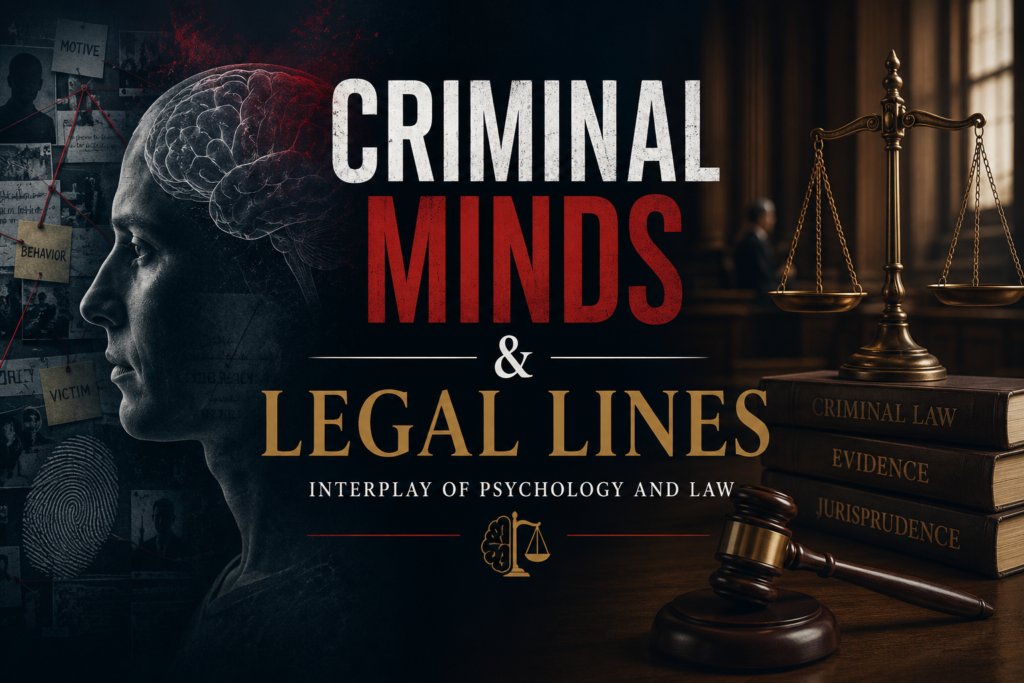
Psychology has been defined as the science that studies mental processes, experiences and behaviors in various contexts, subjective in nature. It employs methods from biological and social sciences to gather data systematically and analyze and organise it as knowledge. Key components of the study of Psychology include: Mental processes which are activities of the mind and brain related to cognition such as thinking, remembering and problem solving; Experiences, which are subjective feelings and awareness influenced by internal and external conditions and behaviors which are responses or reactions that can be observed or internal such as laughing or thinking. Psychology has an ever-increasing role in shaping our legal outcomes.
Law is a structured set of rules and principles that govern the conduct of individuals, organizations and governments that serves to maintain, resolve disputes, protect liberties and promote social justice.
In recent times, there has been a growing recognition of the relevance and importance of incorporating psychological principles and research into the legal system. This recognition stems from the realization that human behavior and mental processes play a significant role in understanding crime, assessing witness credibility, determining culpability, and shaping legal policies like The M’Naghten Rule (Insanity Defense): legal standard for insanity is rooted in the psychology of cognitive impairment. It requires proving the accused was suffering from a “defect of reason” caused by a “disease of mind,” meaning they did not know the nature of their act or that it was wrong, Juvenile Justice Reforms (Solitary Confinement): Based on psychological research demonstrating that adolescent brains are still developing and that isolation causes severe mental harm, many jurisdictions have implemented policies restricting or banning solitary confinement for juveniles and Eyewitness Identification Reforms: Due to research showing the fallibility of memory and the high rate of false convictions based on misidentification, many police departments have adopted protocols like double-blind lineups and standardized instructions to witnesses to prevent influencing their memory.
Evolution of Psychology’s influence on Law
To fully comprehend the complexities of today’s legal landscape, it is crucial to explore the historical context of how psychology’s influence on the legal system has evolved over time.
Dating back to the late 19th century, psychology began to emerge as a distinct field of study, focusing on understanding human behavior and the workings of the mind. During this period, legal systems predominantly relied on traditional legal principles.
In the 20th century, pioneering psychologists like Hugo Munsterberg and William Marston began advocating for the application of psychological principles in legal settings. Munsterberg, often regarded as the father of forensic psychology, emphasized the importance of utilizing psychological expertise to enhance the accuracy of witness testimony and to assess the mental state of defendants. As years passed, psychology’s influence on the legal system continued to grow. The field expanded to encompass areas such as criminal profiling, jury selection, eyewitness identification, and the assessment of mental competency in court proceedings. This integration of psychology into the legal framework reflected a recognition that human behavior and mental processes play a crucial role in determining guilt, innocence, and overall justice. The complexities of today’s legal landscape requires a deep understanding of human behavior, motivation and decision making process .From jury selectiono sentencing someone to prison, psychology is playing and evidence-based approaches. However, as psychology continued to evolve and gain recognition as a scientific discipline, its relevance to the legal field became increasingly apparent.
In recent years, the impact of psychology on the legal system has become even more pronounced. With advancements in neurology and technology, forensic psychology has gained new tools and methods for evaluating the reliability of evidence and understanding the complexities of human cognition and memory. Moreover, psychological research has shed light on the factors that influence decision-making, bias, and the potential for wrongful convictions.
Importance of Psychology in Law
Now that we understand exactly how psychology evolved in close relation to law ,let’s dive into why is it essential in the legal field.
- Psychology can help the present decision makers in making decisions by providing more accurate images and pictures of human perceptions and preferences.
- It helps to check the veracity of witnesses, as eyewitnesses are often known to be influenced by or afraid of the accused.
- It can also help in reducing false confessions by adopting peace models such as those that are highly used by the U.K. police.
- Psychological studies include the examination of different areas which have legal and social significance.
- It is based on the empirical and psychological research of legal institutions as well as law and focuses on legal psychology rather than clinically oriented forensic psychology.
- Pronouncing judgements considering the psychological aspects of the accused’s mind ensures justice in its real meaning.
There are branches of Psychology which influence law and justice: legal psychology and forensic psychology, which together form psychology and law.
Legal Psychology
Legal psychology deals with cognitive and social principles and their usage in the legal system. It is based on empirical and psychological research of law along with legal institutions. It is different from forensic psychology which is based on the clinical orientation on experimentation. The relevance of legal psychology can be seen in legal proceedings in different manners:
- Academics and research– Legal psychologists basically conduct empirical research on new legal topics, which are yet to be popularized. They also work as mentors and guide the upcoming legal representatives.
- Advisory role– Many a time it is seen that legal psychologists plays an advisory role in court systems. They advise the judges and legal decision makers on some psychological issues pertaining to the concerned case.
- Trial consulting– Sometimes, legal psychologists also work for trial consulting. In some cases, a psychologist who works as an academician is called up as a trial consultant when their expertise is helpful in any particular case. Trial consultants play different roles such as picking up the jurors, performing mock trials, etc.
- Policy making and legislative guidance– A legal psychologist’s work is based on empirical research and many a time there is a need to establish some policies based on empirical research. Hence, in those times of crises they help the state and national lawmakers.
- Amicus briefs– Amicus briefs primarily means to provide opinions with a scientific backup and statistics. But the assistance which a legal professional provides in the form of amicus briefs is questionable.
- Expert witnesses– Legal psychologists are well trained to handle legal issues even though they have no formal training. They are helpful in testifying the witnesses. They also test the memory of eye witnesses whereas the forensic psychologist particularly testifies the competency of the defendant.
Forensic Psychology
Forensic psychology means applying psychology in understanding crimes and other legal concerns. American psychologists have defined forensic psychology as the application of clinical specialties in the legal arena. The ones who are experts in forensic law help with legal proceedings in different manners:
- Assessment of mental condition– Forensic psychology helps in analyzing the mental condition with regards to the insanity plea, which is a tactic adapted by people to avoid death sentence and imprisonment. Hence, forensic psychology helps in determining whether a person is really suffering from any mental disorder or not.
- Prediction of violence and risk management– Forensic psychology also helps in determining whether a person has violent tendencies or not; this indicates the harm that can be inflicted by such person either upon himself or on others. This method is mainly applied when an accused is imprisoned or is set free.
- Assessment of Child Custody in Divorce– Determining the custody of a child after a divorce is the most crucial question and also a difficult decision to make as the child’s future is at stake. So the forensic psychologists analyze the couple and after evaluating the situation, they recommend to the judge or jury as to whom the custody of the child should be given.
- Competency to stand trial– Since the trial process is too long and tiring, it cannot be handled by mentally or physically ill people. Hence, forensic psychology helps in determining who can endure the trial and who should be immediately sent for psychiatric treatment.
Distinguishing between Legal and Forensic Psychology
The core difference between legal and forensic psychology is that legal psychology is the study of the thought processes and behaviors of jurors, the court system, legal processes, etc., while forensic psychology mostly focuses on criminal cases (i.e. suspects, defendants, and convicted criminal/felons), and the psychological issues involved in them.
For instance, a forensic psychologist helps determine whether a defendant was sane when he or she committed a crime. A forensic psychologist also helps the judge and jurors determine if the suspect/criminal is more likely to commit the crime again in the future.
In many cases, a forensic psychologist will help determine if a felon will be released from jail or prison, or if probation or parole will be denied. Forensic psychologists typically work directly with suspects and defendants/criminals in the penal system.
The main functions of a forensic psychologist are: evaluating clients (i.e. criminals, felons, and defendants) to determine if they are legally sane or criminally insane, and predicting the risk level for repeating the same or similar crimes. Most forensic psychologists are asked to provide mental stability evaluations, testimonies, and assessments during trials.
Legal psychologists typically work with lawyers and police officers. They also conduct research studies to show patterns within the legal process and court system. This psychologist examines legal, court, and jury patterns, in an effort to improve the system – they are not concerned with criminals/defendants, per se.
The main functions of legal psychologists are to examine how jurors are chosen, ho juries make decisions, and the credibility of eyewitness testimonies. These psychologists also interview potential jurors to get a better understanding of their mental states, and thought processes.
These mental health professionals typically work at courthouses, law offices, police precincts, private practices, and colleges/universities. Legal psychologists tend to find eyewitness testimonies unreliable and invalid. They also tend to believe that preferences and biases (i.e. personalities of the jurors, knowledge of legal terminologies, and the introduction of evidence) significantly influence jury decisions and outcomes.
Legal psychologists hold a doctorate in legal psychology, forensic psychology, or a related field. It is important to note that a psychologist must have a doctorate and licenses/certifications, before providing services to clients.
With a doctorate in legal psychology, an individual can work as a police psychologist, legal research psychologist, or correctional psychologist. On the other hand, an individual may work as a legal psychology assistant or legal technician, if he or she has a bachelor’s or master’s degree in legal psychology, forensic psychology, or a related field.
After an undergraduate degree, future forensic psychologists need to obtain a Doctor of Philosophy (PhD) degree. Individual graduate schools set their own requirements for admission, but a “B” average in undergraduate work is usually the minimal undergraduate achievement acceptable for entrance.
A forensic psychologist must also hold a doctorate in forensic psychology, legal psychology, or a related field. In addition, he or she must have the appropriate licenses and certifications, before providing services to clients. A bachelor’s or master’s degree in forensic psychology may allow an individual to seek employment as a forensic psychology assistant (working under a forensic psychologist).
The connection between mental health and criminal behavior is a topic of great significance in today’s legal landscape. Understanding the complexities of assessing competency and insanity is crucial for legal professionals, psychologists, and the general public alike.
When it comes to criminal cases, determining an individual’s mental state at the time of the offense is a critical aspect of the legal process. The assessment of competency to stand trial involves evaluating whether a defendant has the mental capacity to understand the charges against them and assist in their own defense. This evaluation takes into account factors such as the individual’s intellectual functioning, comprehension of legal proceedings, and ability to communicate with their attorney.
On the other hand, the defense of insanity is a complex and highly debated concept that relies heavily on psychological expertise. Insanity refers to a mental state in which an individual is deemed not responsible for their actions due to a severe impairment or disorder. The evaluation of insanity involves assessing the defendant’s mental state at the time of the crime, determining if they could distinguish right from wrong, and establishing if their mental condition influenced their behavior.
Conclusion
In conclusion, the intersection of psychology and law in the realm of mental health and criminal behavior is a multifaceted and intricate field. It demands a comprehensive understanding of psychological principles, legal standards, and ethical considerations. By exploring the complexities of assessing competency and insanity, we can better comprehend the challenges faced by legal professionals and mental health experts in today’s legal landscape.
Law is derived from various sources like customs, precedents and practices. The essence of this fact lies in the fact that law keeps the sociodynamic and biological conditions of the people it governs and serve and Psychological state of an individual plays a major role in their conduct and to ensure the process fair trials and implementation of justice, it’s important that the relationship between Psychology and Law be implemented.