This article has been written by Kilimi Praneeth Reddy a law student pursuing the B.A. LL.B. (Hons.) program at Dr. Ram Manohar Lohiya National Law University (RMLNLU), Lucknow.

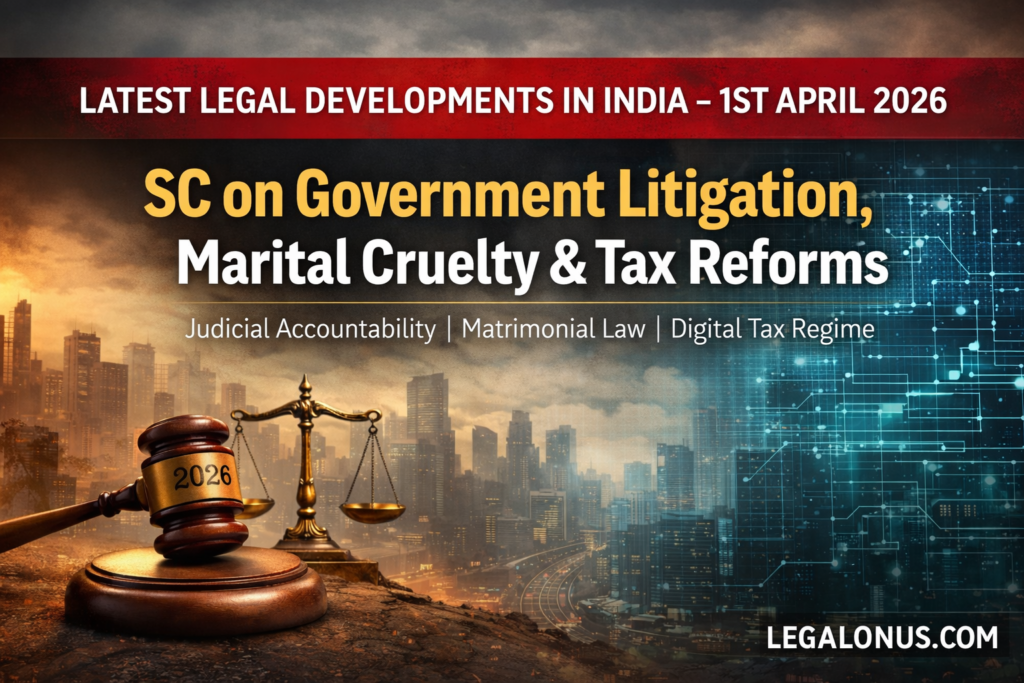
The present set of judicial and policy developments reflects a nuanced evolution in Indian law, where courts and regulatory authorities are increasingly prioritising substantive justice, administrative fairness, and constitutional values over rigid formalism. The Madras High Court’s ruling that routine marital disagreements do not constitute cruelty reinforces the need to distinguish between ordinary matrimonial discord and legally cognizable cruelty, thereby preserving the sanctity of marriage. Simultaneously, the Supreme Court’s strong censure of the Union Government for unnecessary litigation highlights concerns regarding judicial pendency and the State’s obligation to act as a responsible litigant, grounded in principles of proportionality and efficiency.
Further, the clarification issued by the Central Board of Direct Taxes regarding condonation of delay in filing Form 10A underscores the importance of procedural flexibility and taxpayer relief, ensuring that genuine claims are not defeated by technical delays. In the realm of tax administration, the launch of PRARAMBH 2026 and the revamped Income Tax portal signifies a shift towards digital governance, simplification, and voluntary compliance, reflecting modern administrative reforms. Lastly, the Supreme Court’s intervention in cases of racial discrimination emphasises the urgent need for time-bound trials and institutional sensitivity, linking procedural efficiency with the protection of fundamental rights. Collectively, these developments demonstrate a broader jurisprudential trend where law seeks to balance individual rights, institutional accountability, and governance efficiency, ensuring that justice remains not only lawful but also fair, accessible, and responsive to contemporary societal challenges.
Keywords: Marital Cruelty , Matrimonial Law , Restitution of Conjugal Rights , Sanctity of Marriage , Judicial Restraint in Divorce , Government Litigation Policy, Judicial Pendency, Proportionality Doctrine , Responsible Litigant Principle , Special Leave Petition (SLP) , CBDT Circular 01/2026, Form 10A Registration, Section 12A Income Tax Act, Condonation of DelayRoutine Marital Bickering Not Cruelty: Madras High Court Upholds Sanctity of Marriage
Introduction
In a significant ruling on matrimonial law, the Madras High Court has held that routine disagreements and bickering between spouses do not amount to “cruelty” warranting dissolution of marriage. Emphasising the importance of patience, adjustment, and mutual understanding, the Court refused to grant divorce, reinforcing that matrimonial relationships cannot be dissolved on trivial or ordinary conflicts.
Factual Background
The case arose from an appeal filed by the husband challenging the order of the Family Court, which had:
- Dismissed the divorce petition filed on the ground of cruelty
- Allowed the wife’s petition for restitution of conjugal rights
The husband alleged that:
- The wife disrespected him and his parents
- She left the matrimonial home and stayed with her parents
- She did not allow him to meet their child after birth The wife, on the other hand, contended that:
- She was subjected to neglect and emotional distress
- The husband failed to visit her during childbirth
- She was compelled to leave the matrimonial home
- She expressed willingness to resume cohabitation
Core Legal Issue
Whether ordinary marital disputes and initial disagreements between spouses constitute “cruelty” under matrimonial law sufficient to grant divorce?Judicial Reasoning
The Division Bench comprising Justice Anand Venkatesh and Justice P. Dhanabal upheld the findings of the Family Court.
Key Judicial Observation
“The bickering that takes place between a husband and wife… is a common phenomenon… If the same is projected as cruelty, most marriages will have to be dissolved.”
The Court emphasised that:
- Minor disagreements are natural incidents of married life
- •Marriage is a long-term relationship requiring patience and adjustment
- Not every conflict amounts to legal cruelty
Concept of Cruelty in Matrimonial Law
- The Court clarified that:
- Cruelty must be grave and substantial, not trivial
- It must be:
° Physical or mental
° Of such nature that cohabitation becomes. impossible In the present case:
- The couple had lived together only briefly
- Disputes arose at an early stage and were not resolved
- No evidence of serious cruelty was established
Procedural Observation
The Court also noted a procedural irregularity:
- The husband filed a single appeal against both:
° Dismissal of divorce petition
° Grant of restitution of conjugal rights The Court clarified that:
- Separate appeals should have been filed for distinct reliefs However, the Court confined its analysis to the divorce
- Final Decision The High Court:
- Dismissed the appeal filed by the husband
- Upheld the Family Court’s decision
- Held that no case of cruelty was made out
- Found no reason to interfere with the lower court’s findings
Legal Significance
This judgment is important because it:
- Prevents misuse of “cruelty” as a ground for divorce
- Reinforces the idea that marriage requires tolerance and adjustment
- Distinguishes between ordinary marital discord and legal cruelty
- Promotes preservation of marriage unless serious grounds exist
Conceptual Understanding
Cruelty vs Normal Marital Disputes- Normal Disputes: Arguments, misunderstandings, temporary separation
- Cruelty: Persistent, grave conduct causing mental or physical suffering The Court reaffirmed that:
Not every disagreement is equal to Cruelty
Conclusion
The Madras High Court’s ruling serves as a reminder that marriage is a social institution built on mutual patience, tolerance, and adjustment, and cannot be dissolved for ordinary disagreements. By refusing to equate routine marital conflicts with cruelty, the Court has preserved the integrity of matrimonial law and prevented its trivialisation. Ultimately, the judgment reinforces a key legal principle:
Matrimonial law protects marriages from breakdown due to trivial confficts, reserving divorce for cases of genuine and substantial cruelty.
Government as Biggest Litigant: Supreme Court Imposes Costs on Union for Unnecessary Appeal
Introduction
In a significant observation on judicial efficiency and State litigation policy, the Supreme Court of India criticised the Union Government for unnecessarily pursuing litigation, thereby contributing to mounting judicial pendency. The Court imposed costs while dismissing a Special Leave Petition (SLP), emphasising that the government must act as a responsible litigant and avoid mechanically challenging well-reasoned judicial orders.
Factual Background
The case arose from disciplinary proceedings against a CISF constable who was dismissed from service on allegations of:
- Unauthorised absence for 11 days
- Alleged misconduct relating to a family matter involving another constable’s daughter The Punjab and Haryana High Court:
- Set aside the dismissal order
- Directed reinstatement with continuity of service
- Granted 25% back wages
Aggrieved, the Union of India approached the Supreme Court challenging the High Court’s decision.
Core Legal Issue
Whether the Union Government was justified in challenging the High Court’s decision, particularly when the punishment was found to be disproportionate and relief had already been granted?
Judicial Reasoning
The Bench comprising Justice BV Nagarathna and Justice Ujjal Bhuyan strongly disapproved the Union’s approach.
Key Judicial Observation
“We fail to understand why the Union of India… have approached this Court… We dismiss this SLP with cost of ₹25,000.”The Court held that:
- The punishment of dismissal for 11 days’ absence was disproportionate
- The High Court had already granted appropriate relief
- There was no compelling reason to invoke the Supreme Court’s jurisdiction
Government as the Largest Litigant
The Court made a broader institutional observation:
“Pendency, pendency; who is the biggest litigant?”
It highlighted that:
- The Union Government is the largest contributor to judicial pendency
- Frivolous or unnecessary appeals burden the justice delivery system
- Government litigation must be guided by legal prudence, not routine practice
- Principle of Proportionality
The Court implicitly applied the doctrine of proportionality, noting that:
- Minor misconduct (11-day absence) does not justify extreme punishment like dismissal
- Disciplinary action must be commensurate with the gravity of misconduct
- Need for Responsible Litigation Policy The Court emphasised that:
- Law officers should exercise independent legal judgment
- Appeals should not be filed merely as a matter of routine
- Government must avoid becoming a “compulsive litigant”
Judicial Suggestion:
If the High Court grants justified relief, the State should accept the decision instead of appealing
- Final Decision The Supreme Court:
- Dismissed the SLP filed by the Union of India
- Imposed costs of ₹25,000
- Refused to interfere with:
° Reinstatement of the constable
° Grant of 25% back wages
Legal Significance
This judgment is significant because it:
- Reinforces the principle of proportionality in disciplinary actions
- Criticises unnecessary government litigation
- Promotes efficient judicial administration
- Encourages adoption of a responsible litigation policy
- Addresses the issue of judicial backlog and pendency
Conceptual Understanding
Key Doctrines Involved- Proportionality: Punishment must match the misconduct
- Judicial Discipline: Higher courts should not be approached without strong grounds
- Responsible Governance: State must act as a fair litigant, not an adversarial one
Conclusion
The Supreme Court’s ruling serves as a strong reminder that the government must act not merely as a litigant, but as a model litigant committed to justice and efficiency. By imposing costs and criticising unnecessary appeals, the Court has underscored the need to reduce avoidable litigation and focus judicial resources on genuine disputes. Ultimately, the judgment establishes a crucial principle:
State power must be exercised with responsibility, and litigation should be pursued only where it serves justice not merely as a routine administrative exercise.
CBDT Clarifies Power to Condon Delay in Filing Form 10A: Jurisdictional Commissioner Competent Authority
Introduction
In a significant clarification aimed at ensuring procedural fairness and reducing hardship for taxpayers, the Central Board of Direct Taxes has issued Circular No. 01/2026 clarifying that the power to condone delay in filing Form 10A lies with the jurisdictional Principal Commissioner or Commissioner of Income-tax. This clarification resolves ambiguity regarding the competent authority and reinforces the principle of substantive justice over procedural technicalities under the Income Tax Act, 1961.
Factual Background
Under the Income Tax Act, trusts and charitable institutions seeking tax exemption under Sections 11 and 12 must:
- Apply for registration under Section 12A
- File such application in Form 10A within the prescribed time However, delays in filing Form 10A led to uncertainty regarding:
- Whether such delay could be condoned
- Which authority had the power to condone such delay
The confusion arose particularly because Form 10A is processed centrally by the CPC
(Bengaluru), raising questions about whether the CPC or jurisdictional authorities would exercise condonation powers.
Statutory Framework
- Section 12A – Registration Requirement
- Mandatory for claiming exemption under Sections 11 C 12
- Requires timely filing of Form 10A
Allows condonation of delay if:
- There is reasonable cause
- Authority is satisfied with the explanation
Core Legal Issue
Which authority is competent to condone delay in filing Form 10A for registration of trusts under the Income Tax Act?CBDT Clarification
The CBDT clarified that:
“The jurisdictional Principal Commissioner of Income-tax or Commissioner of Income-tax shall have powers to condone delay in filing Form No. 10A…”
Thus:
- Power lies with the jurisdictional tax authorities
- Not with the Central Processing Centre (CPC)
Legal Basis of the Clarification
- The Circular has been issued under:
- Section 11G(2)(b) of the Income Tax Act, 1G61
This provision empowers CBDT to:
- Issue directions for the proper administration of the Act
- Grant relief to mitigate genuine hardship to taxpayers
- Scope and Applicability: The clarification applies to:
- All cases where Form 10A is filed beyond the prescribed time
- Pending condonation applications
- Future applications filed after the date of the Circular
It ensures uniform application of the law across jurisdictions.
- Legal Significance
This clarification is important because it:
- Removes ambiguity regarding competent authority
- Facilitates timely relief for charitable institutions
- Promotes substantive justice over procedural delay
- Strengthens administrative clarity in tax law
- Supports ease of compliance for non-profit organisations
-
Conceptual Understanding
Condonation of Delay
- A legal mechanism to excuse delay Requires:
- Reasonable cause
- Satisfaction of competent authority Administrative Principle
Law should not defeat legitimate claims due to procedural lapses
Conclusion
The CBDT’s clarification marks an important step towards ensuring clarity, consistency, and fairness in tax administration. By vesting condonation powers with jurisdictional authorities, the framework becomes more accessible and responsive to genuine taxpayer difficulties. It reinforces the principle that procedural requirements must serve justice, not obstruct it. Ultimately, the development reflects a broader legal principle:
Tax administration must balance strict compliance with fairness, ensuring that genuine claims are not defeated by technical delays.
PRARAMBH 2026 and Income Tax Website 2.0: Government’s Push Towards Simplified and Digital Tax Regime
Introduction
In a major step towards modernising India’s tax administration, Union Finance Minister Nirmala Sitharaman launched the nationwide awareness campaign PRARAMBH 2026 and unveiled the revamped Income Tax Website 2.0. These initiatives are aimed at facilitating a smooth transition to the forthcoming Income Tax Act, 2025, which is set to come into force from April 1, 2026. The move reflects a broader governmental objective of promoting simplification, digitalisation, and taxpayer-friendly compliance mechanisms.
Background
The Government has introduced a new Income Tax framework to:
- Replace and simplify the existing tax structure
- Reduce complexity in provisions
- Enhance clarity and accessibility for taxpayers
To ensure effective implementation, the government has launched a structured outreach programme to educate stakeholders and minimise transition-related challenges.
- PRARAMBH 2026: Awareness Campaign PRARAMBH 2026 is a nationwide initiative designed to:
- Educate taxpayers about the new tax law
- Promote voluntary compliance
- Reduce confusion during transition
Key Components
- Multi-platform outreach: Social media, digital campaigns, advertisements
- Educational material: Simplified guides, compliance manuals
- Stakeholder engagement: Interaction with professionals, industries
- Multilingual access: Regional language dissemination for inclusivity
Income Tax Website
The revamped e-filing portal introduces:
- Improved user interface and navigation
- Faster and more efficient service delivery
- Simplified filing procedures
- Integration of digital tools for enhanced compliance
Additionally, the CBDT introduced an AI-enabled chatbot “Kar Saathi” to assist taxpayers with queries related to:
- New provisions
- Filing requirements
- Legal and procedural clarifications
- Objectives of the Reform The initiatives aim to:
- Ensure ease of compliance
- Enhance transparency in tax administration
- Reduce litigation arising from ambiguity
- Strengthen trust between taxpayers and the State
- Promote a technology-driven governance model
Legal and Administrative Significance
1. Legal Significance- Represents a major reform in direct tax law framework
- Moves towards simplified legislative drafting
- Facilitates better interpretation and compliance
- Ensures smooth implementation of new law
- Reduces compliance burden
- Enhances efficiency in tax administration
- Encourages voluntary tax compliance
- Improves revenue collection
- Strengthens the formal economy
Critical Analysis
While the initiative is progressive, certain challenges remain:
- Effectiveness depends on last-mile awareness
- Rural and small taxpayers may face digital accessibility issues
- Continuous support and training will be essential
However, early awareness efforts can significantly reduce:
- Non-compliance
- Litigation
- Transitional confusion
- Broader Implications
The initiative reflects a shift towards:
- Digital governance and AI integration
- Citizen-centric service delivery
- Preventive approach rather than punitive enforcement
It marks a transition from complex taxation to simplified and participatory compliance systems.
Conclusion
The launch of PRARAMBH 2026 and the new Income Tax portal represents a forward- looking reform aimed at making taxation simpler, transparent, and accessible. By combining legislative reform with awareness and digital infrastructure, the government seeks to ensure not just implementation, but effective understanding and acceptance of the new tax regime. Ultimately, the initiative reinforces a key governance principle:
A successful tax system is not only built on law, but on clarity, accessibility, and informed compliance by taxpayers.
Racial Discrimination and Judicial Response: Supreme Court Calls for Expeditious Trials in Sensitive Cases
Introduction
In a significant intervention addressing issues of racial discrimination and delays in criminal justice, the Supreme Court of India has emphasised the need for expeditious trials in sensitive cases involving racial and regional discrimination, particularly against individuals from Northeastern States. The Court, while dealing with a Public Interest Litigation, highlighted that justice in such cases must not be delayed, as prolonged trials undermine both fairness and effectiveness of legal remedies.
Factual Background
The matter arose from a PIL filed by Advocate Modoyia Kayina, highlighting: Increasing instances of racial discrimination against Northeastern citizens Use of racial slurs, social exclusion, and physical violence Delays in trials despite completion of investigation and filing of chargesheets The petition also referred to the tragic case of Nido Tania (2014), whose death led to the constitution of the Bezbaruah Committee, which documented systemic discrimination but saw limited institutional follow-up.
Core Issue
Whether there is a need for time-bound and expeditious trial mechanisms in cases involving racial discrimination and identity-based violence?
Observations of the Supreme Court
A Bench comprising Surya Kant, Joymalya Bagchi, and Vipul Pancholi observed that:
- Such cases require “out-of-turn adjudication”
- Delays defeat justice, especially when victims relocate or discontinue proceedings
- Sensitive cases demand priority treatment within the judicial system
Key Judicial Direction
The Court requested the Chief Justice of the Delhi High Court to:
- Consider the issue administratively
- Frame a holistic policy framework
- Ensure time-bound disposal of such cases
Legal Reasoning
The Court refrained from adjudicating the merits but emphasised:
- Judicial delay in sensitive cases affects access to justice
- Victims, particularly students and migrants, often withdraw due to prolonged proceedings
- The system must ensure effective and meaningful justice, not merely procedural compliance
Constitutional and Legal Significance
1. Protection of Fundamental Rights- Article 14 – Equality before law
- Article 15 – Protection against discrimination
- Article 21 – Right to life and dignity
The judgment reinforces that procedural delays can indirectly violate fundamental rights.
2. Access to Justice- Timely adjudication is part of fair trial rights
- Delayed trials weaken deterrence and accountability
- Recognises the role of High Courts in policy-making on administrative side
- Encourages institutional reform rather than case-specific relief
- Broader Context
- Continued reports of discrimination against Northeastern communities
- Lack of effective implementation of Bezbaruah Committee recommendations
- Need for systemic reforms in handling identity-based crimes
- Critical Analysis
- Focus on systemic reform rather than isolated adjudication
- Recognition of ground realities faced by victims
- Strengthening of time-bound justice principle
- Absence of binding guidelines
- Reliance on administrative action may delay implementation
- Need for statutory or procedural codification
Conclusion
The Supreme Court’s intervention marks an important step towards recognising that justice delayed in sensitive cases is justice denied in substance. By urging institutional reform and prioritised adjudication, the Court has highlighted the necessity of aligning procedural efficiency with constitutional values of equality and dignity. Ultimately, the ruling reinforces a crucial principle:
In cases involving identity, dignity, and discrimination, the justice system must respond not only lawfully but swiftly and sensitively.
CONCLUSION
These contemporary legal developments collectively underscore a transformative approach in Indian jurisprudence, where the focus is shifting towards context-sensitive adjudication, administrative accountability, and rights-oriented governance. By distinguishing trivial marital disputes from genuine cruelty, discouraging unnecessary State litigation, enabling procedural relief in taxation, promoting digital compliance mechanisms, and addressing delays in sensitive criminal trials, the judiciary and policymakers are reinforcing the core values of fairness, efficiency, and constitutional morality. At the same time, these developments highlight the growing need to ensure that legal processes are not merely formalistic but effective in delivering real justice, particularly in areas involving personal dignity, economic rights, and social discrimination. The emphasis on responsible governance, timely adjudication, and accessible systems reflects a deeper commitment to strengthening the rule of law in a rapidly evolving society. Ultimately, these decisions reaffirm a foundational legal principle:
Justice must be practical, humane, and timely ensuring that law serves society not just in theory, but in lived reality.